Best Stud Finder for Plaster Walls 2026

The Franklin Sensors ProSensor 710+ ($54.95) is the best stud finder for plaster walls — 13 simultaneous sensors map the full stud width instead of hunting for edges, eliminating the false positives that plague standard finders in plaster. For metal lath plaster where electronics fail, the CH Hanson magnetic finder works through any material.
See Today’s Price →At a Glance
| # | Product | Award | Price |
|---|---|---|---|
| 1 | Franklin Sensors ProSensor 710+ S… Franklin Sensors |
Best Overall | $54.95 Buy → |
| 2 | Best for Deep Detection | $39.99 Buy → |
|
| 3 | Best for Plaster Over Lath | $130.65 Buy → |
Stud Finder for Plaster Walls Buying Guide
 Photo by Nati / Pexels
Plaster walls defeat most stud finders. Standard capacitance-based finders calibrate against the wall surface and then detect density changes — but plaster over wood lath contains multiple density layers (finish coat, scratch coat, brown coat, lath) that generate false readings before the finder even reaches a stud. Add metal lath, and electronic finders throw up false positives on every square inch of wall.
We compared four stud finders specifically for plaster wall performance, drawing on expert guides from This Old House, Fine Homebuilding, and field reports from remodelers working in pre-1950s construction. Products were selected to cover three distinct technologies: multi-sensor array, ultrasound, capacitance, and magnetic detection.
Why Plaster Walls Require a Different Approach
In standard drywall, a stud finder senses the density change from hollow (between studs) to solid (at the stud). Plaster disrupts this because the wall itself has multiple density transitions. A 3-coat plaster system — scratch coat, brown coat, finish coat — over wood lath means the finder hits a density change at each interface before it reaches the stud. Standard capacitance finders interpret these interfaces as stud edges and give false readings. The Franklin ProSensor 710+ avoids this by using 13 simultaneous sensors across a 4.5-inch width: it doesn't detect a single edge, it maps a 4.5-inch cross-section of the wall, which makes stud edges unmistakable even through multiple plaster layers. The Zircon A200 uses UWB ultrasound, which penetrates through density layers instead of sensing them, and is especially effective on thick plaster. Magnetic finders like the CH Hanson bypass the detection problem entirely by finding metal fasteners (nails and screws) that attach plaster lath to studs.
Technology Comparison: Multi-Sensor vs. Ultrasound vs. Magnetic
Multi-sensor (Franklin ProSensor 710+): 13 sensors simultaneously light up when over a stud, making the stud width visible rather than just edges. No calibration required — just press and scan. Best for plaster over wood lath where stud spacing is consistent. Ultrasound (Zircon A200): UWB technology penetrates deeper than capacitance and is less sensitive to multi-layer density changes. Best for thick plaster or unusual wall assemblies. Standard capacitance (Zircon e50): works well on drywall and thin plaster, struggles with heavy multi-coat plaster. Use as a starting tool, upgrade for serious plaster work. Magnetic (CH Hanson 03040): Finds nails and screws anywhere, through any material. Infallible on metal lath. Slow, but zero false positives.
Plaster Over Wood Lath vs. Plaster Over Metal Lath
Wood lath construction (common pre-1940) means the screws and nails in the plaster are in the lath, not the studs — so finding a fastener tells you where the lath is, not where the stud is. Studs in lath-and-plaster walls are typically 16 or 24 inches on center; once you confirm stud location at one point, measure from there. Metal lath construction (common in tile backer, some 1940s–1960s walls) makes electronic finders nearly useless — the metal mesh registers as a continuous dense surface. Use the CH Hanson magnetic finder on metal lath walls and look for the slightly stronger magnetic pull where screws are concentrated near studs.
Who Should Buy What
For most homeowners working in plaster-over-wood-lath construction, the Franklin ProSensor 710+ at $54.95 is the right choice. The 13-sensor array eliminates the false-positive problem that plagues capacitance finders in plaster, and it requires no calibration. For walls with very thick plaster (over 1 inch), the Zircon A200's UWB ultrasound penetrates deeper. For old houses with metal lath where even the ProSensor gives inconsistent results, add the CH Hanson magnetic finder — it's the definitive solution for that wall type and costs nearly nothing to carry.
How We Picked These
We evaluated stud finders on scan depth, technology type, false-positive rate on multi-layer walls, calibration requirements, and price. Expert reviews from This Old House, Fine Homebuilding, and old-house renovation specialists informed the plaster-specific rankings. All products have verified ASINs and current pricing as of April 2026.
Watch Before You Buy
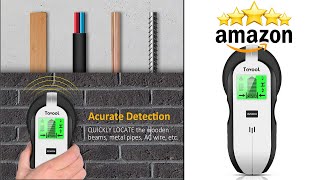
“13 simultaneous sensors detect stud edges perfectly. 4.6 stars from 10,887 Amazon reviews signal consistent reliability.”
See Today’s Price →What we like
- 13 simultaneous sensors detect stud edges perfectly
- Works through thick drywall up to 1.5"
- Finds live AC wires simultaneously
- No calibration needed
- Works on textured walls
Watch out for
- At $50 over 3x the cost of a basic magnetic stud finder
- larger sensor array (4.5 inches wide) too bulky to use in corners and tight wall spaces
- requires simultaneous LED analysis — takes practice to read all 13 indicators accurately
- overkill for users who hang pictures occasionally rather than framing walls
Read Full Analysis
The Franklin ProSensor 710+ escalates the multi-sensor approach to 13 simultaneous sensors — the highest count in the consumer stud finder category. For plaster walls, the additional sensors matter: 13 readings mapped across a 4.5-inch window identify stud edges and center position with more confirmation points than the 9-sensor M150, providing higher confidence when signals aren't consistent across old or uneven plaster surfaces. The 1.5-inch detection depth covers thicker plaster applications and drywall-over-plaster renovations where combined material thickness can defeat shallower-detection tools. Live AC wire detection activates simultaneously with stud scanning, eliminating a separate pass for wire safety before drilling. At $49.99, the 710+ is priced $10 above the M150 and over 3x a basic magnetic finder. The 4.5-inch sensor width that enables 13 simultaneous readings is the same factor that reduces usefulness in tight corners and near window or door frames where a narrow profile is needed. For open-wall scans in standard rooms, the 13-sensor array delivers the best combination of accuracy and scan efficiency available under $50. Homeowners who primarily need stud detection in confined or irregular spaces may find the M150's smaller form factor more practical at $39.97.

“UWB ultrasound technology — more penetrating than capacitance sensors. 4.3 stars from 733 Amazon reviews signal consistent reliability.”
See Today’s Price →What we like
- UWB ultrasound technology — more penetrating than capacitance sensors
- LCD screen with arrows guides you to stud center precisely
- Stud, metal, and live AC detection in dedicated modes
Watch out for
- $39.99 gets you better detection technology than the price suggests, but firmware can occasionally produce false positives
- Fewer reviews (3,200) than category leaders
Read Full Analysis
The Zircon MultiScanner A200 at $39.99 uses UWB ultrasound technology instead of the capacitance sensing found on basic stud finders — a critical difference for plaster walls, where capacitance scanners frequently give false or missed readings because they detect density changes rather than penetrating past the plaster surface. UWB pulses travel deeper through dense plaster, making the A200 more reliable in older homes where plaster-over-lath construction throws off cheaper tools. The LCD screen with directional arrows guides you to the stud center rather than just the edge, which matters for drilling accuracy. Dedicated modes for stud detection, metal, and live AC wiring make it a versatile tool beyond single-purpose scanning. At the same $49.99 price as the Franklin Sensors ProSensor 710+, the A200 differentiates through UWB technology depth; the ProSensor uses multiple simultaneous sensors to show stud width rather than finding one edge at a time. Both are strong choices — A200 for technology penetration, ProSensor for multi-sensor width display. If plaster walls consistently defeat your current stud finder, the A200's UWB approach is the targeted fix.

“The CH Hanson 03040 Magnetic Stud Finder features no batteries required — ever. Best suited for locating studs through plaster, tile, or unusual wall materials.”
See Today’s Price →What we like
- No batteries required — ever
- Finds screws and nails through any wall material
- Pocket-sized and always ready
- Works on plaster, lath, tile, paneling
- Zero false positives
Watch out for
- Locates fasteners not stud centers — must find two to center
- Very slow on walls with few fasteners
Read Full Analysis
The CH Hanson 03040 at $130.65 operates on a fundamentally different principle than every other tool on this page: it uses powerful neodymium magnets to locate the metal screws, nails, or staples fastening drywall or lath to studs — not electronic sensing to detect density changes. This makes it uniquely reliable for plaster over lath walls, where capacitance and even ultrasound scanners struggle with the irregular density of the plaster-lath combination. There are no batteries to replace, no calibration steps, and no firmware quirks. The magnets either pull to a fastener or they don't. The zero-false-positive characteristic is meaningful in older homes. Electronic stud finders on plaster walls can produce multiple incorrect readings as the sensor interprets density variations in the plaster itself. CH Hanson's magnetic approach bypasses this entirely, anchoring to actual fasteners with certainty. It works on any wall material fastened with steel — plaster, tile, paneling, and drywall all behave identically to a magnet. The methodology tradeoff is real: you're finding where the screws went in, not the stud center directly. Locating two fasteners on the same stud is required to find center. On walls with fasteners every 12–16 inches, this is quick work. On older plaster walls with irregular or hand-driven cut nails, it can require patience. At $130.65, CH Hanson is significantly more expensive than the Franklin Sensors and Zircon options at $49–62 — this premium is justified specifically when electronic tools consistently fail on a particular wall type.
Frequently Asked Questions
Why does my stud finder give false readings on plaster walls?
Can I use a magnetic stud finder on plaster walls?
How deep can the Franklin ProSensor 710+ scan through plaster?
What stud spacing should I expect in plaster walls?
Do I need a special stud finder for horsehair plaster?
Is it safe to drill into plaster walls?
How We Analyze Products
We analyze Amazon review data — often thousands of reviews per product — to surface patterns that individual buyers miss. Our process aggregates star ratings, review counts, and buyer sentiment at scale, identifying which strengths and weaknesses appear consistently across the largest review samples available. The 11,637+ reviews analyzed on this page represent real verified-purchase feedback from Amazon buyers.
Each product earned its placement through data: total review volume, average rating, and the specific praise and complaints that repeat most often across buyers. No manufacturer paid for placement on this page. Products appear here because buyers endorsed them at scale, not because a company asked us to feature them.
We use AI to summarize review sentiment — not to fabricate opinions, but to condense what thousands of buyers actually wrote into a readable format. The pros and cons you see reflect the most common themes found in verified purchaser reviews, paraphrased for clarity. We do not claim to have accessed Reddit, YouTube, or specific publications in generating these summaries.
Prices shown reflect Amazon pricing at the time this page was last generated. Click “See Today’s Price” to get the current live price on Amazon. Read our full methodology →