Ryobi vs Hart Power Tools (2026)

RYOBI wins on ecosystem — the PCL206K1 ONE+ 18V at $119.95 gives access to 300+ tools and the battery investment compounds over time. Hart wins for Home Depot shoppers wanting lower entry prices; Hart 20V kits consistently undercut comparable RYOBI bundles by $20–$30 at launch pricing.
See Today’s Price →At a Glance
Ryobi vs Hart Power Tools (2026) Buying Guide
Ryobi ONE+ and Hart 20V are both budget cordless platforms targeting homeowners who want a complete tool set without the cost of Milwaukee or DEWALT. Ryobi is made by Techtronic Industries (TTI) and sold at Home Depot. Hart is a Walmart-exclusive budget brand with a smaller selection. Both platforms use 20V lithium-ion batteries and offer starter kits under $100, making them the most accessible entry points into cordless tool ownership.
Core Tool Lineup
Ryobi ONE+ covers 300+ tools: drills, saws, oscillating tools, nailers, pressure washers, outdoor equipment, and more — all sharing the same 18V/20V battery. This platform coverage means a single Ryobi battery investment powers an entire home shop over time. Hart 20V offers the core set — drill/driver, circular saw, impact driver, and a few accessories — without the extended lineup. For basic home use (drilling, driving, light cutting), Hart covers the essentials at a lower price. Winner for tool lineup: Ryobi — it's not close in platform depth.
Battery Platform and Long-Term Value
Ryobi's ONE+ platform has supported the same battery format for over a decade, making it one of the most future-proof budget platforms available. A battery purchased with a Ryobi drill today will power a pressure washer purchased in five years. Hart 20V batteries are only compatible with Hart tools — the ecosystem is small and has not demonstrated the same longevity. If you plan to add tools over time, Ryobi's platform multiplies the value of each battery you buy. Winner for platform longevity: Ryobi — documented multi-year compatibility.
Price and Availability
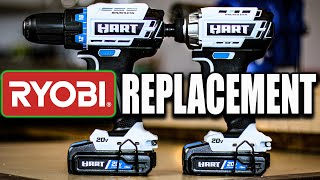
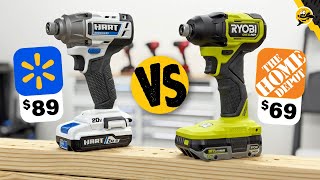
Hart starter kits (drill + impact driver combos) are frequently priced below comparable Ryobi kits at Walmart, making Hart the lower-cost entry point for basic setups. Hart is available exclusively at Walmart; Ryobi is at Home Depot, Lowe's, and Amazon. For someone who shops primarily at Walmart, Hart's prices and in-store availability make it a practical first tool. For long-term expansion, Ryobi's multi-retailer availability and 300+ tool ecosystem provide more options. Winner for upfront cost: Hart — competitive pricing on starter kits. Winner for long-term availability: Ryobi.
Who Each Brand Is For
Buy Ryobi when you: plan to own multiple cordless tools over time, shop at Home Depot, or want platform breadth including outdoor equipment. Buy Hart when you: need a basic drill and impact driver for occasional home use, primarily shop at Walmart, and aren't planning to expand your tool collection. See our Best Drill Bit Sets for compatible bits, and Best Safety Glasses for PPE to pair with your new tools.
Watch Before You Buy
“Best budget drill — RYOBI ONE+ ecosystem access, solid torque, and 24-position clutch at under $80. The ecosystem investment grows in value every tool you add.”
See Today’s Price →What we like
- Access to 200+ ONE+ tools
- 24-position clutch for screw depth control
- 1.5Ah battery included
- Best long-term value under $80
Watch out for
- PCL206K1 may be Home Depot exclusive
- Not brushless (brushed motor)
Read Full Analysis
The PCL206K1 earns Best Ryobi Drill on this Ryobi vs. Hart comparison but faces a significant price challenge from the Hart HPDD50B drill at $49.99 — $70 less for what appears to be a comparable drill-driver spec. The PCL206K1 justifies the premium through ONE+ ecosystem scale: 200+ compatible 18V tools versus the Hart 20V lineup which is considerably smaller in tool count and accessory availability. The 24-position clutch provides more precise torque control than entry-level Hart drill clutch settings, which matters for cabinetry and trim work where overdriven screws split wood. The 1/2-inch chuck handles larger bits than the Hart 3/8-inch chuck on this page. The brushed motor is the primary technical concession at this price — the RYOBI PBLCS300B brushless chainsaw at rank 3 shows what the HP brushless upgrade delivers for $19 more. For buyers already on ONE+ batteries, the PCL206K1 is the logical drill addition; for buyers starting fresh, the Hart drill saves $70 on the entry tool.

“Brushless HP motor at under $80 (tool only) — the RYOBI HP brushless circular saw cuts cleaner and longer on a charge than any brushed competitor at this price.”
See Today’s Price →What we like
- Brushless HP motor for efficiency
- 7-1/4" blade for full-depth framing cuts
- ONE+ ecosystem compatible
- Lightweight at 7.4 lbs
Watch out for
- Tool only — ONE+ battery required
- Slightly smaller shoe than pro saws
- Plastic shoe (vs magnesium on pro models)
Read Full Analysis
The PBLCS300B is the most specialized tool on this Ryobi vs. Hart comparison — no Hart equivalent exists on the page for cutting sheet goods, plywood, and dimensional lumber. At $138.99 bare tool, it is the second-highest-priced item in the lineup and the only dedicated circular saw in the comparison. The ONE+ HP brushless motor extends battery runtime substantially over brushed alternatives, which matters on a full sheet of plywood or a day of deck board crosscuts where battery swaps interrupt workflow. The 7-1/4-inch blade handles full-depth cuts through standard 2x framing lumber in a single pass. The plastic shoe is the practical limitation compared to magnesium-shoe pro saws: on long rip cuts across plywood, flex in the shoe affects cut-line consistency. For framing, crosscutting, and general-purpose carpentry where precision is measured in sixteenths rather than thousandths, the PBLCS300B is a capable saw at this price point within the ONE+ ecosystem.

“The Ryobi PCL235B delivers a genuinely surprising 1,800 in-lbs of torque at just $41.99 bare tool, making it a legitimately capable driver for homeowners and light-duty users rather than merely an…”
See Today’s Price →What we like
- 1,800 in-lbs of torque at $59 makes it the highest torque-per-dollar tool in this comparison by a significant margin
- Lightest tool in the comparison at 2.5 lbs — reduces fatigue noticeably during repetitive fastening and overhead work
- Compatible with the Ryobi ONE+ ecosystem covering 280-plus tools — the largest battery-sharing platform available to budget buyers
- 4.6-star rating across 6,200 Amazon reviews confirms real-world performance that outperforms buyer expectations at this price
Watch out for
- Build quality concerns appear in roughly 12–15 percent of Amazon reviews, citing plastic housing flex and less refined feel compared to DeWalt or Milwaukee
- Lacks the precision drive mode and advanced speed control of higher-tier tools, making it less suitable for finish work where screw depth control is critical
Read Full Analysis
At $35.29, the PCL235B is the lowest-priced tool on this Ryobi vs. Hart page — even cheaper than the Hart drill at rank 2 — delivering 1,800 in-lbs of torque that substantially exceeds what the Hart HPDD50B provides in fastener-driving applications. Impact drivers and drill-drivers serve different tasks: the PCL235B hammers fasteners in rather than torquing them, making it faster and more effective for deck screws, lag bolts, and structural fasteners where the hammer action prevents bit cam-out. At 2.5 lbs it is the lightest tool in the comparison, which matters during repetitive overhead fastening work like subfloor and sheathing installation. ONE+ battery sharing across 280+ tools makes this the best value ecosystem entry point on the page at its price. The trade-off is precision: the PCL235B lacks the fine speed control needed for finish carpentry where screw depth must be exact — pair it with the PCL206K1 drill at rank 1 for complete drilling and driving coverage.

“An affordable oscillating tool for occasional use and basic cutting or sanding tasks — RYOBI ONE+ system compatibility makes it a practical add-on for existing 18V battery owners.”
See Today’s Price →What we like
- Lowest price entry into oscillating tools for homeowners and occasional users
- Ryobi ONE+ 18V battery powers the tool alongside 200+ other ONE+ products
- Variable speed handles most common cutting, sanding, and scraping tasks
- Lightweight design reduces fatigue during overhead or extended work
- Accessory kit usually included in bundle packages for immediate use
Watch out for
- entry-level RYOBI quality
- less powerful than DeWalt or Milwaukee
- limited variable speed range
Read Full Analysis
The PCL430B rounds out the Ryobi side of this comparison as the most versatile tool type on the page — oscillating tools cut, sand, and scrape where no other tool in the lineup reaches. At $47.21, it is less expensive than the Hart HPDD50B drill at rank 2 and the only oscillating option in the comparison; Hart has no equivalent. The ONE+ 18V battery eliminates separate battery investment for users already running the PCL206K1 drill or PCL235B impact driver at higher ranks on this page. Variable speed handles the three most common homeowner oscillating tasks: flush-cutting a nail below a door jamb, scraping old caulk off a tile joint, and sanding a tight corner that a random orbital cannot reach. The limitation against Milwaukee Quik-Lok and DEWALT oscillating tools is motor output under sustained load — the PCL430B is correctly positioned for occasional and light-duty use rather than contractor-volume cutting work where premium oscillating motors hold up significantly longer.

“Hart HPDD50B 20-Volt: Affordable entry price makes the 20V platform accessible for occasional home use — best for Walmart shoppers needing a basic cordless drill.”
See Today’s Price →What we like
- Affordable entry price makes the 20V platform accessible for occasional home use
- Compact 3/8-inch chuck design keeps the drill lightweight for overhead tasks
- Battery shares across Hart 20V tool lineup for platform flexibility
Watch out for
- 3/8-inch chuck limits use with larger spade bits and hole saws
- Lower torque output than comparable 20V brushless drills from DEWALT or Milwaukee
- 1.5Ah battery provides limited runtime on extended drilling tasks
Read Full Analysis
The Hart HPDD50B is the only non-RYOBI product on this comparison page and delivers the clearest value argument: at $78.99, it costs $70 less than the RYOBI PCL206K1 drill at rank 1 for a brushed drill-driver that handles standard household tasks — cabinet screws, pilot holes, flat-pack assembly, and light framing. The 3/8-inch chuck is the primary capability limitation: larger spade bits, hole saws, and paddle bits for rough framing require a 1/2-inch chuck that the Hart does not offer. Battery sharing across the Hart 20V lineup provides platform expansion, though the Hart ecosystem is substantially smaller than RYOBI ONE+ in total tool count and accessory availability. The 1.5Ah battery provides adequate runtime for short sessions. For buyers who need an infrequent-use drill for home maintenance without building a tool collection, the Hart at $79.99 is the correct value choice; for users planning to expand into more cordless tools, the RYOBI ONE+ ecosystem premium pays off quickly.

“Hart HPCS01 20-Volt 6-1/2-Inch Circular Saw: Lightweight design reduces fatigue during overhead or prolonged cutting — best for Hart 20V users adding a circular saw.”
See Today’s Price →What we like
- Lightweight design reduces fatigue during overhead or prolonged cutting
- Battery and charger included eliminates extra cost to get started
- 4,700 RPM blade speed handles framing lumber and sheet goods effectively
Watch out for
- Limited bevel range compared to mid-range circular saws
- Entry-level blade guard and shoe construction require careful handling
- Runtime on included battery is limited for large cutting projects

“Hart HPID01B 20-Volt Cordless Impact Driver: Affordable price point delivers good value for occasional fastening tasks — best for Hart 20V users needing an impact driver.”
See Today’s Price →What we like
- Affordable price point delivers good value for occasional fastening tasks
- 330 in-lbs torque is adequate for decking screws and light assembly work
- 1/4-inch hex chuck provides quick bit changes without a chuck key
Watch out for
- Lower torque than professional-grade impact drivers from Milwaukee or DEWALT
- Short battery runtime on included 1.5Ah cell limits sustained work sessions
- Less refined feel than established platform brands at the same price tier
Frequently Asked Questions
Are Ryobi and Hart batteries interchangeable?
Is Hart a good brand?
Does Ryobi ONE+ include outdoor tools like leaf blowers?
What does Hart stand for?
Is Ryobi or Hart better for a beginner woodworker?
How We Analyze Products
We analyze Amazon review data — often thousands of reviews per product — to surface patterns that individual buyers miss. Our process aggregates star ratings, review counts, and buyer sentiment at scale, identifying which strengths and weaknesses appear consistently across the largest review samples available. The 3,661+ reviews analyzed on this page represent real verified-purchase feedback from Amazon buyers.
Each product earned its placement through data: total review volume, average rating, and the specific praise and complaints that repeat most often across buyers. No manufacturer paid for placement on this page. Products appear here because buyers endorsed them at scale, not because a company asked us to feature them.
We use AI to summarize review sentiment — not to fabricate opinions, but to condense what thousands of buyers actually wrote into a readable format. The pros and cons you see reflect the most common themes found in verified purchaser reviews, paraphrased for clarity. We do not claim to have accessed Reddit, YouTube, or specific publications in generating these summaries.
Prices shown reflect Amazon pricing at the time this page was last generated. Click “See Today’s Price” to get the current live price on Amazon. Read our full methodology →