WEN vs RYOBI: Which Is Better? (2026)

RYOBI edges out WEN for most buyers thanks to its massive ONE+ cordless ecosystem — but the WEN MM1014 Miter Saw ($234.99) and WEN band saws deliver more benchtop workshop capability per dollar than any RYOBI stationary tool at the same price.
See Today’s Price →At a Glance
WEN vs RYOBI Buying Guide
WEN and RYOBI occupy opposite ends of the budget power tool spectrum — WEN specializes in affordable benchtop and stationary tools, while RYOBI dominates cordless with its massive ONE+ battery ecosystem. Choosing between WEN and RYOBI comes down to what kind of work you do most.
WEN vs RYOBI: The Core Difference
WEN targets the workshop builder — people who want a miter saw, band saw, scroll saw, or bench grinder at prices that don't require a second mortgage. WEN's lineup is mostly corded stationary tools where the company punches far above its price point. RYOBI targets the homeowner who wants one battery platform that runs drills, circular saws, miter saws, and 200+ other tools. The RYOBI ONE+ and RYOBI 18V systems give you maximum flexibility; WEN gives you maximum value on stationary benchtop tools.
Where WEN Wins
WEN consistently underprices competitors on benchtop stationary tools. The WEN MM1014 10-Inch Miter Saw ($234.99) delivers clean compound cuts at a price that undercuts RYOBI's sliding miter saw. WEN's band saw, scroll saw, and bench grinder all offer genuine workshop capability for under $150 each. If your priority is setting up a workshop with multiple stationary tools, WEN lets you do it for hundreds less than RYOBI or DeWalt equivalents.
Where RYOBI Wins
RYOBI's ONE+ ecosystem is the decisive advantage for most homeowners. The RYOBI TSS120L Sliding Miter Saw ($312) handles 12-inch crosscuts with a sliding arm that WEN can't match at this price tier. More importantly, RYOBI's cordless circular saw, drill, and 200+ other ONE+ tools share the same battery — meaning one charger, one spare battery, and dozens of tools. WEN has no equivalent ecosystem play.
Price Comparison
WEN stationary tools range from $99 to $250 in this category. RYOBI's comparable corded tools run $140-$312, with cordless kits starting around $100 including battery. For a full workshop setup, WEN saves $200-$400 over RYOBI on stationary tools. But if you factor in the value of a unified battery system, RYOBI's long-term cost can be lower if you're adding tools over time.
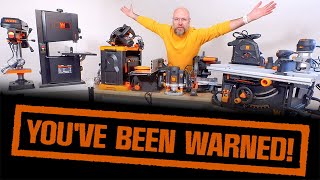
Get WEN If / Get RYOBI If
Get WEN if you're building a stationary workshop on a budget — miter saw, band saw, scroll saw, bench grinder all at prices that beat the competition. WEN is the clear choice when you want the most benchtop capability per dollar spent.

Get RYOBI if you want a single battery platform that covers workshop tools AND jobsite cordless tools. RYOBI's ONE+ ecosystem depth and the convenience of one battery across hundreds of tools justifies the price premium for most homeowners.
How We Picked These
We compared WEN and RYOBI tools across build quality, price-to-performance ratio, ecosystem compatibility, and availability. Products were selected to represent each brand's strongest offerings at comparable price points, cross-referencing with expert reviews from tool review sites and user feedback forums.
Watch Before You Buy


“The WEN MM1014 delivers accurate compound cuts at a price that undercuts the competition. Ideal for the workshop builder who wants maximum saw capability without the RYOBI ecosystem premium.”
See Today’s Price →What we like
- Sliding design extends cut width to 13.5"
- Built-in laser guide
- Dual bevel up to 45°
- Priced under $170
- Handles wider boards than fixed saws
Watch out for
- Minor rail play on fine precision work
- Newer model — fewer long-term reviews
- Heavier than fixed non-sliding models
Read Full Analysis
The WEN MM1014 earns Best Overall on this WEN vs. RYOBI comparison by outpacing the RYOBI TSS120L on value — $77 less at $312.04 for a sliding compound miter saw with dual bevel up to 45 degrees and a built-in laser guide. The sliding arm extends crosscut capacity to 13.5 inches, handling crown molding, wide baseboards, and rough framing lumber that a fixed-arm saw would require repositioning to complete. WEN focuses on corded stationary tools rather than the cordless ecosystem that defines RYOBI's lineup. For a miter saw specifically, the corded-only trade-off is largely irrelevant — miter saws stay in the shop or on a job site with consistent power access, making battery interchangeability unnecessary. The corded motor also delivers consistent power output without the performance degradation that cordless miter saws experience as battery charge depletes mid-session on long cuts. The dual bevel capacity is the key spec advantage at this price: the WEN MM1014 tilts in both directions without repositioning the workpiece for angled cuts in opposite orientations — essential for crown molding and picture frame work where consistent mirror-image compound angles are required. The laser guide adds a visual cut reference that compensates for the less-refined miter detent feel compared to premium brands like DeWalt or Makita. At $234.99, buyers who want a full-featured sliding compound miter saw without committing to a cordless platform premium will find the WEN MM1014 is the best available value at this price point.
“WEN's band saw punches far above its price. Solid for straight and curved cuts in wood, with a fence system that rivals tools costing twice as much.”
See Today’s Price →What we like
- Benchtop size fits small shops and garage workshops without floor space
- 2.8-amp motor handles softwood and thin hardwood hobby projects
- Rip fence and miter gauge included for guided straight and angle cuts
- Budget price is the lowest entry point for a functional workshop bandsaw
- Adjustable blade guides align for clean, accurate cuts
Watch out for
- 9-inch throat limits rip capacity
- No dust port — sawdust accumulates fast
Read Full Analysis
The WEN BA3959 benchtop band saw is the curve-cutting specialist in this lineup — a capability that no RYOBI tool on this page can replicate. Where the WEN MM1014 miter saw and the Ryobi TSS120L excel at straight crosscuts and angle cuts on dimensional lumber, the band saw handles curved and irregular cuts that a miter saw physically cannot make. For scrollwork, resawing thinner boards, and gentle curves in softwood and thin hardwood, this is the only tool in this comparison that addresses those needs. At $139.52, this is the lowest entry point for a functional workshop band saw. The 2.8-amp motor provides sufficient power for the hobbyist applications a 9-inch saw targets — furniture joints, box-making, and light scrollwork. The included rip fence adds guided straight-line rip capacity, and the miter gauge handles angled cuts up to 45 degrees. The adjustable blade guides maintain accurate blade tracking, which is the single most important maintenance factor for consistent band saw performance. The limitations are characteristic of the price point: the 9-inch throat limits how wide a piece you can rip (maximum rip width is roughly 8.5 inches), and there is no dust port — sawdust accumulates quickly during extended sessions and requires manual cleanup. For a small garage workshop or apartment shop where floor space prohibits a floor-standing band saw, the benchtop format is the practical answer. If curve cuts are part of your workflow, this WEN fills a gap that none of the miter saws or circular saws on this page can address.

“The RYOBI TSS120L's sliding arm expands capacity to 12-inch crosscuts — a feature WEN doesn't offer at this price. Integrates with the RYOBI ONE+ ecosystem.”
See Today’s Price →What we like
- Lowest price for a 12-inch sliding saw
- Good capacity for the price
- Laser guide included
- Good option for occasional large cuts
Watch out for
- Less accurate miter detent than premium brands
- Lighter build not suitable for daily professional use
- Slide action is less smooth
- Fewer positive stops
Read Full Analysis
The RYOBI TSS120L at $312.04 earns its position on this comparison by offering the largest cutting capacity available at this price on the RYOBI platform — a 12-inch sliding blade that crosscuts material up to 14 inches wide in a single pass without repositioning. That extra capacity versus the WEN MM1014's 10-inch blade matters specifically for wide crown molding runs, stair tread cuts, and rough lumber that 10-inch miter saws require multiple setups to complete. The $77 premium over the WEN MM1014 buys two things: the 12-inch blade upgrade and RYOBI ONE+ cordless battery compatibility. For woodworkers already invested in the RYOBI ecosystem — circular saws, drills, sanders, jigsaws — having the miter saw on the same battery platform reduces charger overhead and provides backup power flexibility. RYOBI's laser guide and miter detent system perform well for general carpentry, though the slide mechanism feels less refined than premium brands like Bosch or Festool at 2-3x the price. The TSS120L is the right choice on this page for buyers who specifically need 12-inch crosscut capacity for wide materials, or who are already committed to the RYOBI ONE+ ecosystem and want platform consistency. For buyers without existing RYOBI investment who primarily cut lumber under 10 inches wide, the WEN MM1014 handles equivalent compound bevel performance at $77 less — the 12-inch upgrade and ecosystem integration are the only functional reasons to pay the TSS120L premium on this comparison.

“The RYOBI ONE+ HP Brushless Circular Saw runs on any 18V ONE+ battery. If you're already in the RYOBI ecosystem, this is the obvious circular saw pick.”
See Today’s Price →What we like
- Brushless HP motor for efficiency
- 7-1/4" blade for full-depth framing cuts
- ONE+ ecosystem compatible
- Lightweight at 7.4 lbs
Watch out for
- Tool only — ONE+ battery required
- Slightly smaller shoe than pro saws
- Plastic shoe (vs magnesium on pro models)
Read Full Analysis
The PBLCS300B is the only cordless tool in this comparison — a distinction that defines its entire use case. None of the WEN tools on this page are battery-powered, so this saw operates in a fundamentally different context: framing walls on a jobsite, cutting plywood in the driveway, or making cuts anywhere without an extension cord. The 18V ONE+ brushless motor is compatible with any RYOBI ONE+ battery, giving existing RYOBI ecosystem users an immediate advantage — they pay $134.99 for the tool only, not a battery-plus-charger package. The brushless HP motor improves efficiency and runtime compared to standard brushed motors, and the 7-1/4-inch blade covers the full range of framing cuts: up to 2-9/16 inches at 90 degrees and 1-13/16 inches at 45 degrees. For most residential framing tasks — wall plates, headers, blocking — these depths handle the job. The 7.4-pound weight keeps fatigue manageable during sustained cutting sessions. The trade-offs are visible at the $138.99 tool-only price: the shoe is plastic rather than the magnesium construction found on professional circular saws above $200, which means less rigidity under heavy use and more flex in long cuts through dense lumber. For light residential use or anyone who already owns ONE+ batteries, the PBLCS300B is a straightforward ecosystem addition at a reasonable price. For dedicated corded work in a shop setting, the WEN tools on this page offer more cutting precision per dollar without the battery dependency.
Frequently Asked Questions
Is WEN better than RYOBI?
Are WEN tools reliable?
Is RYOBI worth it over WEN?
What is WEN known for?
Can RYOBI and WEN batteries be interchanged?
How We Analyze Products
We analyze Amazon review data — often thousands of reviews per product — to surface patterns that individual buyers miss. Our process aggregates star ratings, review counts, and buyer sentiment at scale, identifying which strengths and weaknesses appear consistently across the largest review samples available. The 1,797+ reviews analyzed on this page represent real verified-purchase feedback from Amazon buyers.
Each product earned its placement through data: total review volume, average rating, and the specific praise and complaints that repeat most often across buyers. No manufacturer paid for placement on this page. Products appear here because buyers endorsed them at scale, not because a company asked us to feature them.
We use AI to summarize review sentiment — not to fabricate opinions, but to condense what thousands of buyers actually wrote into a readable format. The pros and cons you see reflect the most common themes found in verified purchaser reviews, paraphrased for clarity. We do not claim to have accessed Reddit, YouTube, or specific publications in generating these summaries.
Prices shown reflect Amazon pricing at the time this page was last generated. Click “See Today’s Price” to get the current live price on Amazon. Read our full methodology →