What Size Generator Do You Actually Need? A Real-World Power Budget
For most homeowners who want to keep the fridge, sump pump, a window AC, lights, and devices running during an outage, a 5,000–7,500W portable generator covers it comfortably — the Westinghouse WGen7500 hits that sweet spot with dual-fuel flexibility and room to grow.
What Size Generator Do You Actually Need? A Real-World Power Budget Buying Guide
 Photo by Tahir Xəlfə / Pexels
| Best For | |||
| Price Range | |||
| Typical Outlets | |||
| Runtime (half load) | |||
| Portability | |||
| Our Pick For |
Quick Verdict: Our top pick is the Westinghouse WGen7500 Portable Generator 7500W (Best for Whole-Home Backup) — At 7,500W running watts, the WGen7500 handles the full residential outage scenario — fridge, sump pump, window AC, fu.... Priced at $1049.
Budget Pick: The DuroStar DS4000S 4000-Watt Portable Gas Generator at $452.47 — At 4,000W running watts, the DuroStar DS4000S covers the essential residential outage load — refrigerator, sump pump,....
Quick verdict: For most homeowners who want to keep the fridge, sump pump, a window AC, lights, and devices running during an outage, a 5,000–7,500W portable generator covers it comfortably — the Westinghouse WGen7500 hits that sweet spot with dual-fuel flexibility and room to grow.
## What Can You Actually Run on a Generator? Here's the question nobody asks at the hardware store: not "how many watts is this generator?" but "how many watts do I actually need?" Most people answer the second question by guessing at the first. They grab a 3500W generator because it sounds like a lot, lose power during a nor'easter, and discover their well pump alone needs 2000W to start. The fridge never turns back on. The smarter move is to build your power budget first. Figure out what matters to you — what you'd be genuinely miserable without during a three-day outage — and then size backward. This guide gives you the numbers to do exactly that. --- ## The Real Wattage Chart: What Things Actually Draw Every generator spec sheet lists two numbers: running watts and starting watts (also called surge watts). This distinction matters enormously and it trips up almost everyone. Running watts is what the device needs to operate continuously. Starting watts (surge) is the spike of power the motor needs to get moving — it lasts less than a second, but your generator has to supply it. Electric motors (refrigerators, pumps, air conditioners) have starting wattages that are 2–3x their running wattage. If your generator can't supply the surge, the motor won't start — and trying repeatedly can damage both the generator and the appliance. Here's what the common household items actually draw:
Window AC unit (5,000 BTU): 500W running, 1,500W starting surge. A small bedroom unit. This is manageable on a mid-size generator if you're not running everything else at the same time. Window AC unit (10,000 BTU): 900W running, 2,700W starting surge. A larger room or open-plan space. That 2,700W surge is significant — it can be the biggest single demand spike in your power budget. Central air conditioning (3-ton system): 3,500W running, 10,000W+ starting surge. Unless you have a large standby generator, you're not running central AC on a portable. This is one of the honest truths about portable generators: they are not whole-house power solutions for most homes. If whole-house AC is the goal, a standby generator is the answer. Space heater: 750–1,500W running. Resistive heat, no surge. If you're in a cold climate and the generator is your heating backup, a 1,500W space heater will work fine but takes a meaningful chunk of your capacity. Gas furnace blower (electric fan on a gas furnace): 300–800W running, 800–1,600W starting. This is a frequently overlooked item that matters a lot in cold climates. You have a gas furnace — great, you don't need to power the burners. But the blower fan that circulates the heat is electric. Without generator power to the blower, the furnace won't run even if the gas is flowing. Add this to your power budget. Ceiling fan: 15–75W. Trivial. Run as many as you want.

At a Glance
| # | Product | Award | Price | Our Score | |
|---|---|---|---|---|---|
| 1 |  Westinghouse WGen7500 Portable Generato… Westinghouse WGen7500 Portable Generato… |
Best Overall | $1049 | 9.2 | Buy → |
| 2 |  Honda EU2200i Companion Inverter Genera… Honda EU2200i Companion Inverter Genera… |
Best Inverter Generator | $980 | 8.9 | Buy → |
| 3 |  Champion Power Equipment 100520 7000-Wa… Champion Power Equipment 100520 7000-Wa… |
Best Value Portable | $674 | 8.5 | Buy → |
| 4 | 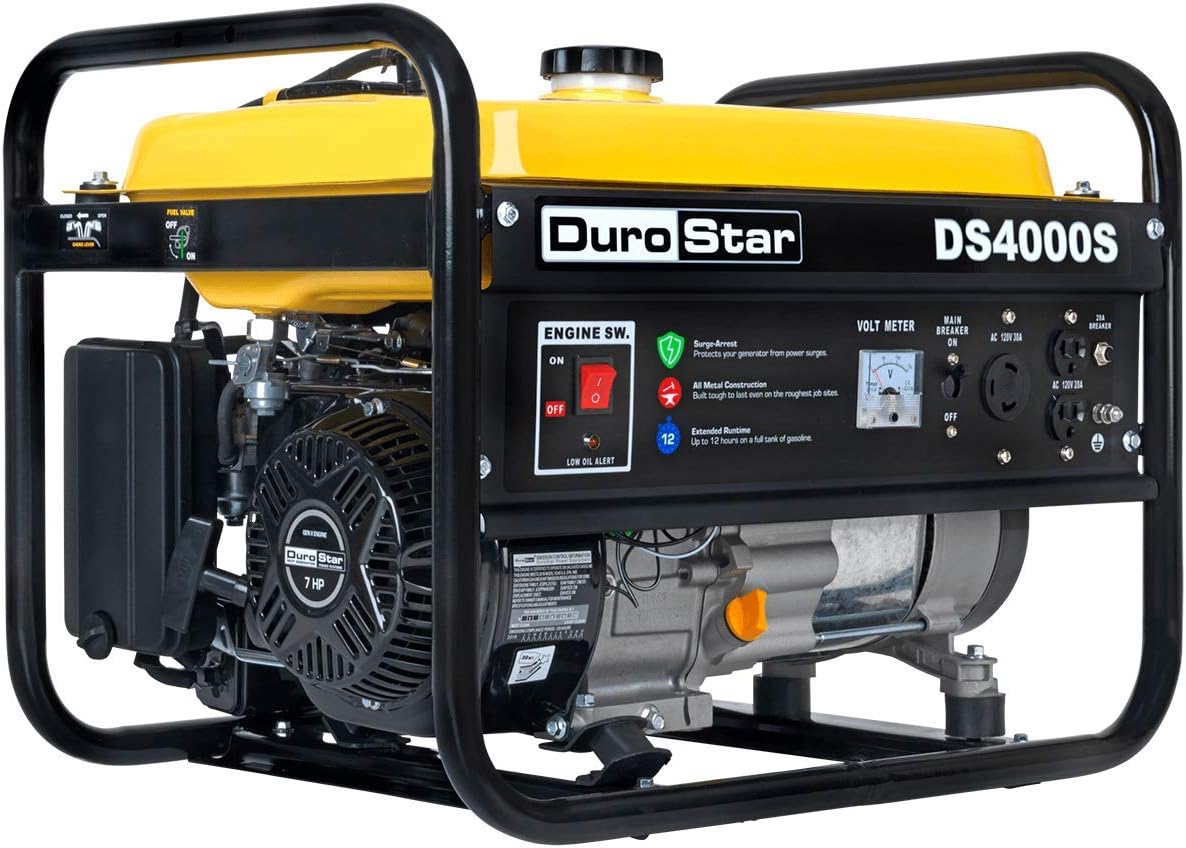 DuroStar DS4000S 4000-Watt Portable Gas… DuroStar DS4000S 4000-Watt Portable Gas… |
Best Budget Pick | $452 | 8.2 | Buy → |
Showing 4 of 4 products
Westinghouse WGen7500 Portable Generator 7500W
“Westinghouse WGen7500 delivers 7500W running power with electric start and remote key fob start at a price point $150 below the Champion. CARB compliant for sale in California. A solid mid-range whole”
See Today’s Price →What we like
- 7500W running / 9500W starting
- Electric start + remote key fob
- Low oil shutdown protection
- CARB compliant
Watch out for
- Louder than inverter generators
- Gas only (no propane)
Read Full Analysis
The Westinghouse WGen7500 is the guide recommendation for whole-house backup — 7500W running power covers central AC, refrigerator, sump pump, and lighting simultaneously. CARB compliance makes it the only valid option in California and other CARB states where the Champion 7000W cannot be sold. Remote key fob start allows the unit to warm up from inside before connecting loads. At $1,049.00 versus the Champion 7000W at $674.00, the $375 premium buys CARB compliance, 500W more running power, and remote start. For non-CARB states, the Champion is the better value — dual-fuel propane capability and lower cost for equivalent whole-house load coverage. Choose the Westinghouse when compliance is required or the remote start justifies the premium.
Honda EU2200i Companion Inverter Generator 2200W
“The Honda EU2200i is the benchmark portable inverter generator. The clean sine wave output (under 3% THD) is safe for laptops, TVs, and medical equipment. At 57–68 dBA it's quieter than a normal conve”
See Today’s Price →What we like
- Inverter produces clean power (THD <3%)
- 57–68 dBA (quietest class)
- Eco-Throttle conserves fuel
- Parallel capable with second unit
Watch out for
- $1,100 premium price
- 2200W limits simultaneous loads
Read Full Analysis
In a sizing guide, the Honda EU2200i is the correct recommendation when the primary concern is sensitive electronics — CPAP machines, medical devices, laptops, and modern TVs that require clean sine wave power. Standard conventional generators produce 20-25% THD, which can damage or shorten the life of these devices. The EU2200i produces under 3% THD from its inverter, matching utility power quality. The 57-68 dBA noise level is quieter than a normal conversation, which matters for camping, neighborhood use during overnight outages, and close-proximity operation. Eco-Throttle adjusts speed to match actual load, conserving fuel during light use periods. The guide context matters here: if a reader arrives having calculated 2,200W or less in essential loads — refrigerator, phone charging, CPAP, LED lighting — the EU2200i is correctly sized. If their load calculation exceeds 2,200W, this model is undersized regardless of clean power quality. The parallel capability allows two EU2200i units to combine for 4,400W clean power — an option worth noting for users who anticipate load growth. At $980.00 it costs $306 more than the Champion 7000W for 4,800W less — the premium is entirely for inverter quality and quiet operation.
Champion Power Equipment 100520 7000-Watt Generator
“Champion's 7000W dual-fuel generator is the whole-house backup workhorse. Running power covers most residential loads (HVAC, refrigerator, lighting, well pump) simultaneously. Propane capability exten”
See Today’s Price →What we like
- 7000W running / 8750W starting
- Remote electric start
- Dual-fuel (gas + propane)
- Cold Start Technology for -20°F
Watch out for
- Loud at ~74 dBA
- Conventional generator (not inverter)
- Heavy at 192 lbs
Read Full Analysis
The Champion 7000W is the guide's value recommendation for whole-house backup with dual-fuel flexibility. The dual-fuel capability (gasoline or propane) addresses a real scenario in extended outages: gas stations run dry or have long lines within 24-48 hours of a major storm. Pre-stored propane in 20-lb tanks keeps the generator running when gasoline is unavailable. Cold Start Technology (-20°F) is the specification that matters for winter storm outages — the scenario where backup power is most critical and temperatures make generator starting difficult. The remote electric start eliminates cold-weather manual pull cord starting. At $674.00, the Champion sits between the DuroStar at $452.47 (4,000W, no propane) and the Westinghouse at $1,049.00 (7,500W, CARB). For non-CARB state homeowners who have calculated their load as 5,000-7,000W, the Champion is the guide recommendation — dual-fuel propane for extended outages, 7,000W capacity for central HVAC, and $375 savings over the Westinghouse for equivalent practical performance in most use cases. The propane advantage alone justifies the $222 premium over the DuroStar for anyone in a region prone to multi-day outages.
DuroStar DS4000S 4000-Watt Portable Gas Generator
“DuroStar DS4000S is the budget entry point for emergency home backup power. 4000W running power handles a refrigerator, lights, fans, and phone charging simultaneously. For occasional emergency use an”
See Today’s Price →What we like
- Budget-friendly at ~$350
- 4000W running power
- Covers essential appliances
- Includes 4 outlets
Watch out for
- No electric start
- Louder operation
- No fuel gauge
- DuroStar engine longevity lower than Honda/Westinghouse
Read Full Analysis
The DuroStar DS4000S is the guide's budget entry point — the recommendation for homeowners who have calculated their essential load at 4,000W or less and want the lowest purchase cost. Four outlets cover a refrigerator, window fan, a few LED circuits, and device charging without additional power strips. For a 2-3 day storm outage focused on food preservation and communication, this wattage is sufficient. The manual recoil start and absence of a fuel gauge are the budget tradeoffs — practical limitations to communicate clearly in a sizing guide. Without a fuel gauge, you run on a timed schedule (most 4,000W generators consume 0.5-0.75 gallons per hour at half load) to estimate remaining runtime. At $452.47, it is $222 less than the Champion 7000W at $674.00 and $528 less than the Honda EU2200i at $980.00. The guide recommendation: if your load calculation is under 4,000W and you do not need propane flexibility or electric start, the DS4000S covers your needs at the lowest cost. If any single appliance (central AC, well pump, sump pump) pushes your simultaneous load above 4,000W, step up to the Champion — the capacity gap becomes a reliability issue when the generator trips under overload at exactly the moment you need it most.
Frequently Asked Questions
Can I run my central air conditioner on a portable generator?
How loud is a generator? Will it bother my neighbors?
What's the difference between running watts and starting watts?
How long can I store gas for a generator?
Can I run a generator in my garage with the door open?
Do I need a transfer switch or can I just use extension cords?
How often should I run my generator if I'm storing it for emergencies?
How We Analyze Products
We analyze Amazon review data — often thousands of reviews per product — to surface patterns that individual buyers miss. Our process aggregates star ratings, review counts, and buyer sentiment at scale, identifying which strengths and weaknesses appear consistently across the largest review samples available. The 12,549+ reviews analyzed on this page represent real verified-purchase feedback from Amazon buyers.
Each product earned its placement through data: total review volume, average rating, and the specific praise and complaints that repeat most often across buyers. No manufacturer paid for placement on this page. Products appear here because buyers endorsed them at scale, not because a company asked us to feature them.
We use AI to summarize review sentiment — not to fabricate opinions, but to condense what thousands of buyers actually wrote into a readable format. The pros and cons you see reflect the most common themes found in verified purchaser reviews, paraphrased for clarity. We do not claim to have accessed Reddit, YouTube, or specific publications in generating these summaries.
Prices shown reflect Amazon pricing at the time this page was last generated. Click “See Today’s Price” to get the current live price on Amazon. Read our full methodology →