Best Robot Lawn Mowers (2026): Wire-Free Picks

The Segway Navimow is our wire-free pick: RTK satellite positioning with vision assistance lets you draw mowing boundaries in an app, so there is no perimeter wire to bury. The eufy E15 uses camera vision instead and suits homes already on eufy's app. Only these two robot mowers clear our bar right now - new, in stock and with a track record we can judge - so we list two rather than pad the page.
See Today’s Price →At a Glance
| # | Product | Award | Price |
|---|---|---|---|
| 1 | Best Overall | $799 Buy → |
|
| 2 | Best Smart Home Integration | Check current price on Amazon Buy → |
Robot Lawn Mowers (2026) Buying Guide
 Photo by Richard REVEL / Pexels
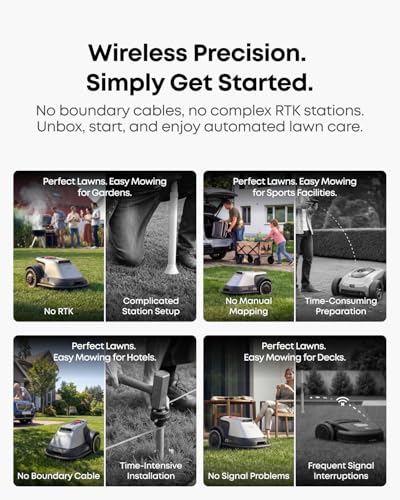
Robot lawn mowers divide into two generations: wire-boundary models (require installation of a physical perimeter wire) and wire-free models using GPS/RTK or camera vision. Wire models are cheaper but require hours of installation. Wire-free models cost more but install in minutes and can be reconfigured via app. The shift to wire-free is the most significant recent development in robotic mowing.
How We Picked These
We compared the mowers on this page by navigation technology, setup and app integration, using each maker's own specifications, and we checked each listing on Amazon before publishing. The WORX Landroid L we previously listed was unavailable when we checked, so it is no longer on this page.
Wire-Boundary vs. Wire-Free Navigation
Perimeter wire models: Physical wire defines the mowing boundary. Installation: 2–4 hours, stakes every 12 inches. Reliable containment, works without connectivity. Lower cost. Best for buyers who install once and don't change the boundary. Wire-free GPS/RTK (such as the Segway Navimow): Satellite positioning defines the mowing area via app. Install in 15 minutes. Boundary adjustable from your phone. Higher cost ($800–$1,500+) but far more flexible. Best for buyers who want simplicity and app control.

Coverage Area and Mowing Schedule
Robot mowers don't cut the whole lawn in one pass — they mow continuously in small overlapping patterns, ideally daily or every 2 days. This mulching approach (cutting 2–3mm tips regularly) is healthier for grass than weekly deep cuts. Check each model's rated coverage against your lawn size; for larger properties, multiple units or higher-capacity models are needed.
Rain and Charging
Quality robot mowers return automatically to their charging station when rain is detected or battery is low. The charging station must be permanently placed in a covered or shaded area — direct sun degrades charging station electronics over time. Budget for 30–45 minutes of charging per session. Most models run 1–2 hours on a full charge.
Watch Before You Buy

![TOP 5 Best Robot Lawn Mower [ 2025 Buyer's Guide ]](https://img.youtube.com/vi/leXKyrpkzsw/mqdefault.jpg)
“Wire-free mower that uses RTK satellite positioning with vision assistance; boundaries are mapped from a smartphone app, with AI-assisted mapping that identifies lawn edges.”
See Today’s Price →What we like
- Wire-free RTK GPS navigation — no perimeter wire
- 15-minute virtual boundary setup via app
- quiet operation
- slope handling
- Segway brand quality
Watch out for
- Higher price than wire models
- RTK GPS requires satellite signal — poor in deep shade or canyons
- 0.27-acre coverage limit
Read Full Analysis
Perimeter wire is the reason many people decide against a robot mower, and the Segway Navimow removes it. It combines RTK satellite positioning with vision enhancement for stable, centimetre-level positioning, and Segway says that combination copes with trees and narrow corridors that trouble satellite-only mowers. Setup happens on a phone: you guide the mower around the lawn to map virtual boundaries, and an AI-assisted mapping feature identifies clear lawn edges for you. The constraints are the ones every satellite mower shares: heavy tree canopy or tall walls can still degrade positioning, and the rated coverage should be checked against your lawn before buying. Against the eufy E15 on this page, the Navimow's RTK positioning is the more established approach; the eufy's advantage is its camera-only setup and eufy app integration.
“Vision-guided wire-free mower with automatic mapping, controlled from the same eufy app as eufy cameras and robot vacuums.”
See Today’s Price →What we like
- eufy/Anker ecosystem integration
- app control with scheduling
- compact design
- works with eufy Home app alongside other eufy devices
- quiet operation
Watch out for
- Newest model with shorter track record
- best value within eufy ecosystem
- integration advantage diminishes for non-eufy users
Read Full Analysis
The eufy E15 finds its way with camera vision and automatic mapping rather than satellite positioning or buried wire, and it runs from the eufy app, the same one that controls eufy security cameras and robot vacuums. For a household already on eufy, that means one app for indoor cleaning, security and lawn care. The integration advantage shrinks outside the eufy ecosystem. Against the Segway Navimow on this page, the E15 competes on app convenience and camera-based setup rather than on positioning technology. Scheduling runs through the app, so mowing days and times can be changed without going outside, and eufy positions the E15 as a quiet, compact mower that stores easily. Because it navigates by vision alone, it does not need a satellite antenna sited in open sky; the trade-off is that camera navigation depends on the mower being able to see your lawn edges clearly, so check how your yard's borders look before buying.
Frequently Asked Questions
What is the best robot lawn mower?
Do robot lawn mowers really work?
How long does it take to set up a robot lawn mower?
Can robot mowers handle hills?
Do robot mowers work in the rain?
How We Analyze Products
We analyze Amazon review data — often thousands of reviews per product — to surface patterns that individual buyers miss. Our process aggregates star ratings, review counts, and buyer sentiment at scale, identifying which strengths and weaknesses appear consistently across the largest review samples available. The 391+ reviews analyzed on this page represent real verified-purchase feedback from Amazon buyers.
Each product earned its placement through data: total review volume, average rating, and the specific praise and complaints that repeat most often across buyers. No manufacturer paid for placement on this page. Products appear here because buyers endorsed them at scale, not because a company asked us to feature them.
We use AI to summarize review sentiment — not to fabricate opinions, but to condense what thousands of buyers actually wrote into a readable format. The pros and cons you see reflect the most common themes found in verified purchaser reviews, paraphrased for clarity. We do not claim to have accessed Reddit, YouTube, or specific publications in generating these summaries.
Prices shown reflect Amazon pricing at the time this page was last generated. Click “See Today’s Price” to get the current live price on Amazon. Read our full methodology →