How to Choose a Pool Cleaner in 2026: Buyer's Guide
For most above-ground and smaller in-ground pools, a robotic pool cleaner in the $200 to $500 range provides the best cleaning performance with lowest ongoing cost. Suction-side cleaners are the most affordable entry point. Pressure-side cleaners are best for pools with heavy debris from trees. Robotic cleaners work independently of the pool pump.
How to Choose a Pool Cleaner Buying Guide
 Photo by Matheus Bertelli / Pexels
The most important distinction between pool cleaner types is their relationship to the pool pump and filtration system. Suction-side cleaners connect to the skimmer or a dedicated suction port and use pool pump suction to move and collect debris — this means they run the pump more, increasing energy costs and pump wear. Pressure-side cleaners connect to a return jet and use water pressure to propel and collect debris into a separate bag — some require a booster pump. Robotic cleaners are fully self-contained with their own motor, filtration, and navigation, and plug into a standard electrical outlet independently of the pool system. Understanding this distinction helps predict ongoing costs, maintenance, and performance.
Robotic Pool Cleaners: Performance and Independence
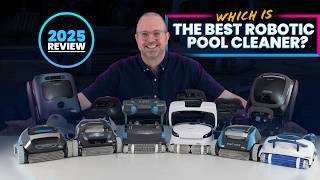
Robotic cleaners are the premium option and for most pool owners represent the best long-term investment. They clean more thoroughly than suction or pressure alternatives, operate independently without increasing pump runtime, filter down to 2 microns (finer than most pool filter systems), and have dropped in price significantly since 2020. Entry-level robotics from Dolphin and Wybot now start around $200 for above-ground pools. Premium models for large in-ground pools with programmable schedules and app control run $600 to $1,500. The primary disadvantage is upfront cost and the need for a power outlet within reach of the pool. Robotic cleaners require periodic filter cleaning but no ongoing chemical or pump costs. Our best pool cleaners for above-ground pools rates robotic models specifically for above-ground use. For in-ground pools, see best pool vacuums.
Suction-Side Cleaners: Affordable Entry Point
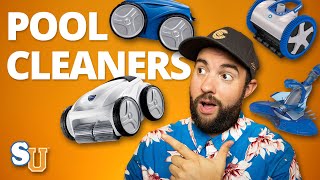
Suction-side cleaners connect to the pool skimmer or a dedicated suction port and are propelled and driven by pool pump suction. They are the most affordable option (typically $100 to $300) and effective for pools with fine debris like sand and small leaves. The key limitation is that they run through the pump filtration system, which increases pump runtime, energy consumption, and filter load. Fine debris captured by the cleaner goes into the pool filter, which means more frequent filter cleaning and backwashing. For pools with heavy organic debris (large leaves, acorns), suction cleaners can clog and require frequent checking. They work best for pools with light debris loads and as a complement to routine manual vacuuming rather than a full replacement. Compatibility depends on your skimmer or dedicated suction port configuration.
Pressure-Side Cleaners: Best for Heavy Debris
Pressure-side cleaners connect to a return jet or dedicated pressure port and use water pressure for propulsion and debris collection into an onboard bag. Because debris collects in the cleaner bag rather than the pool filter, they do not increase filter load. This is their primary advantage for pools with heavy tree debris. Many pressure-side cleaners require a separate booster pump (adding $200 to $500 installation cost and ongoing electricity expense) though some work on existing pump pressure. They cover pool surfaces effectively including walls and the waterline. The onboard debris bag requires emptying and cleaning, and the bag is the most common maintenance point. For pools with significant leaves, pine needles, or larger debris, pressure-side cleaners are more appropriate than suction-side alternatives. See our above-ground pool cleaner guide for pressure-compatible models.
Above-Ground vs. In-Ground Pool Compatibility
Above-ground pools have different surface profiles (typically a flat bottom with a liner) and connection points than in-ground pools. Most robotic cleaners specify above-ground or in-ground compatibility — verify this before purchasing. Suction-side cleaners work on both if the skimmer configuration matches. Pressure-side cleaners designed for in-ground pools may not be compatible with above-ground pool return jets. For above-ground pools, the Dolphin E10 and Wybot Osprey are purpose-designed entry-level robotics. For in-ground pools up to 50 feet, the Dolphin Nautilus and Polaris models are the most popular. Always check pool dimensions against the cleaner cable length — most cleaners come with 40 to 60 feet of cable, which may be insufficient for very large pools.
Total Cost of Ownership

Upfront price is only part of the cost comparison. Robotic cleaners have higher upfront cost but the lowest ongoing cost: electricity for running the unit (typically 100 to 200 watts) and periodic filter cleaning at no consumable cost. Suction-side cleaners have the lowest upfront cost but increase pump electricity consumption and filter cleaning frequency. Pressure-side cleaners that require a booster pump add installation cost, electricity, and pump maintenance. Calculate 3-year total cost including electricity and any consumables before comparing price tags. For most pool owners running a cleaner 3 to 5 times per week during swim season, a quality robotic unit pays for itself in reduced pump runtime within 2 to 3 seasons compared to suction-side operation. Our cordless pool cleaner guide covers battery-powered options for the simplest setup.
At a Glance
| # | Product | Award | Price |
|---|
How We Analyze Products
We analyze Amazon review data — often thousands of reviews per product — to surface patterns that individual buyers miss. Our process aggregates star ratings, review counts, and buyer sentiment at scale, identifying which strengths and weaknesses appear consistently across the largest review samples available.
Each product earned its placement through data: total review volume, average rating, and the specific praise and complaints that repeat most often across buyers. No manufacturer paid for placement on this page. Products appear here because buyers endorsed them at scale, not because a company asked us to feature them.
We use AI to summarize review sentiment — not to fabricate opinions, but to condense what thousands of buyers actually wrote into a readable format. The pros and cons you see reflect the most common themes found in verified purchaser reviews, paraphrased for clarity. We do not claim to have accessed Reddit, YouTube, or specific publications in generating these summaries.
Prices shown reflect Amazon pricing at the time this page was last generated. Click “See Today’s Price” to get the current live price on Amazon. Read our full methodology →