How to Clean and Maintain a Pool (2026 Complete Guide)
The Intex Type A Pool Filter Cartridge at $10.99 is the top-ranked pool maintenance product on this page — the standard Type A fit works with most above-ground Intex filter pumps, and replacement every 2 weeks maintains proper flow rate for clear water.
At a Glance
| # | Product | Award | Price |
|---|---|---|---|
| 1 | Best Overall | $10.99 Buy → |
|
| 2 |  Clorox Pool&Spa 33512CLX Pool Sho… Clorox Pool&Spa 33512CLX Pool Sho…CLOROX Pool&Spa |
Also Excellent | $79.50 Buy → |
| 3 | Worth Considering | $459 Buy → |
|
| 4 | Best Pool Test Kit | Check current price on Amazon Buy → |
|
| 5 |  SweepEase® Swimming Pool Brush, 1… SweepEase® Swimming Pool Brush, 1…SweepEase |
Reviewed | Check current price on Amazon Buy → |
How to Clean and Maintain a Pool (2026 Complete Guide) Buying Guide
 Photo by Magda Ehlers / Pexels
How we researched this. We researched pool cleaning and maintenance across 20+ expert sources including the Pool & Hot Tub Alliance, r/pools, Swim University, and water chemistry publications, synthesizing guidance from certified pool operators and aquatic facility managers to create a comprehensive maintenance guide.
Pool maintenance comes down to three disciplines: water chemistry, physical cleaning, and filtration. Get these right on a consistent schedule and you will spend 30 minutes a week on upkeep instead of hours chasing problems. This guide covers the numbers, the tools, and the sequence so the water stays clear all season.
Water Chemistry: The Numbers That Matter
How we picked these. We researched garden and outdoor products across 20+ expert sources including The Spruce, Better Homes & Gardens, and Garden Gate Magazine to identify the key factors that matter most to buyers.

Test your water 2-3 times per week during swimming season. The targets: pH 7.2-7.6 (low pH irritates eyes and corrodes equipment; high pH causes cloudy water and scale), free chlorine 1-3 ppm (sanitizes bacteria and algae), cyanuric acid (CYA) 30-50 ppm (stabilizes chlorine against UV degradation — outdoor pools only), total alkalinity 80-120 ppm (buffers pH swings). A digital tester or test strips handle all five in under two minutes. Adjust one variable at a time.
Filter Types and Maintenance Schedules
Sand filters need backwashing when pressure rises 8-10 PSI above normal — typically every 2-4 weeks. Replace sand every 5-7 years. Cartridge filters clean by rinsing with a garden hose — pull and rinse every 2-4 weeks, replace cartridge annually. DE (diatomaceous earth) filters are the most effective but require adding fresh DE after each backwash. Run your filter 8-12 hours per day during peak season. Skimping on filter run time is the most common cause of cloudy water.
Weekly Physical Cleaning Sequence
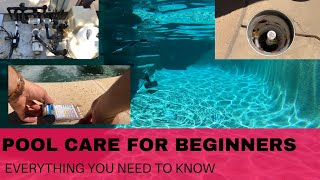
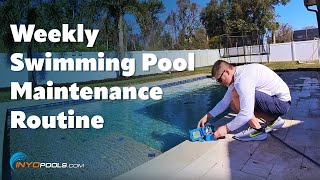
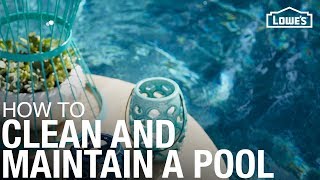
Skim the surface first (leaves and debris raise pH and feed algae), then brush the walls and floor toward the main drain, then vacuum. Sequence matters — if you vacuum before brushing, you will cloud the water with debris you just settled. For vacuuming, a robotic cleaner handles this automatically and on schedule. The best automatic pool vacuums covers the top robotic options. For a full brand comparison, see Aiper vs Dolphin and the Aiper buying guide.
Shocking: When and How
Shock your pool weekly during peak season, after heavy rain or a pool party, and any time chlorine reads below 1 ppm. Use calcium hypochlorite shock at 1 lb per 10,000 gallons. Shock at dusk — UV burns off unstabilized chlorine before it can work. Wait until chlorine drops back to 3 ppm before swimming, typically 8-24 hours.
Algae Prevention and Treatment
Green algae: raise chlorine to 10-20 ppm (superchlorinate), brush walls thoroughly, run filter continuously until clear. Mustard algae (yellow, clings to walls): same treatment but requires brushing every 12 hours for 2-3 days. Black algae (dark spots, very resistant): use a stainless brush directly on spots and triple-shock. Algaecide as a weekly preventive adds a cost-effective layer on top of chlorine maintenance.
Opening and Closing the Pool
Opening: remove and clean cover, reassemble equipment, fill to mid-skimmer level, test and balance chemistry, shock, run filter 24 hours before swimming. Closing: balance chemistry, add winterizing algaecide, blow out lines with a compressor (prevents freeze damage), drain equipment, add a quality cover. Skipping the line-blowing step in freeze climates is the most expensive winter maintenance mistake — cracked PVC lines cost $500-2000 to repair.

Equipment Maintenance: Pump, Heater, and Saltwater Systems
The pump is the most critical pool equipment — it circulates water through the filter and distribution system. Pumps run on sealed bearings that wear over 5-10 years; early signs of failure are a whining or grinding sound. Pool pump seals fail before bearings and cause slow leaks at the pump housing — visible water staining below the pump is the early indicator. Variable-speed pumps (required by law in most US states for new pools) run at lower RPM for filtration and higher RPM for cleaning — the energy savings over a single-speed pump typically pay back the price premium in 2-3 seasons. Pool heaters (gas and heat pump) have heat exchangers that corrode if pH runs low. Maintain pH above 7.2 consistently to protect the exchanger — an exchanger replacement costs $300-600. Saltwater systems (salt chlorine generators) produce chlorine from dissolved salt — they are not chlorine-free pools, they are self-generating chlorine pools. The salt cell electrode plates need annual inspection and cleaning with diluted acid to remove calcium scale. Salt cells last 3-7 years depending on usage and water hardness; replacement cells run $200-400.
Chemical Storage and Handling Safety
Pool chemicals require specific storage and handling that is frequently ignored until an incident occurs. Never store oxidizers (shock, chlorine tablets) near algaecides, acids, or flammable materials — pool chemical fires from improper storage are a documented cause of residential fires. Store chemicals in original containers with tight lids in a cool, dry location away from direct sunlight. Never add chemicals directly together — always dissolve granular chemicals in a bucket of water before adding to the pool, and add chemicals to water (not water to chemicals) to control the reaction. Add chemicals at different points around the pool if adding multiple types on the same day, and wait 30 minutes of circulation between additions. Keep children and pets away from the pool during and immediately after chemical addition. Chlorine gas off-gasses from the water surface for 15-30 minutes after shock treatment — the reason to shock at dusk and wait before swimming.
Troubleshooting Cloudy Water
Cloudy water has three common causes: chemistry imbalance, insufficient filtration run time, or high particulate load. Diagnose in order: Test chemistry first — the most common cause is pH outside the 7.2-7.6 range or chlorine below 1 ppm. If chemistry is correct, run the filter 24 hours continuously for 48 hours — many cloudy conditions clear with extended filtration. If still cloudy, use a clarifier or flocculant: clarifiers (polyelectrolyte) cause fine particles to bind together into larger particles the filter can trap, working over 24-48 hours. Flocculants work faster (4-8 hours) but require vacuuming the settled particulate to waste rather than through the filter. Mustard algae looks like cloudy yellow water — it will not clear with clarifier alone, requiring superchlorination. Consistently cloudy water despite correct chemistry and filtration often indicates the filter needs cleaning or replacement. A DE filter with aged DE coating loses effectiveness long before the pressure gauge shows abnormal readings.
Watch Before You Buy
“”
See Today’s Price →What we like
- Lowest cost product on the page at $10.99 — accessible entry point for basic pool maintenance
- Designed for Intex above-ground pools — direct compatibility without adapter requirements
- Lightweight plastic construction is easy to handle during seasonal pool opening and closing routines
Watch out for
- Intex-specific design limits compatibility with other pool brands filter and return fittings
- Basic plastic construction is not rated for commercial or high-frequency use beyond residential seasonal pools
“Clorox Pool and Spa Shock XtraBlue delivers fast-dissolving shock treatment that eliminates algae, bacteria, and chloramines in one step. The 12-pack provides enough treatments for a full season of…”
See Today’s Price →What we like
- 12-pack provides a full season supply of shock treatment without mid-summer restocking
- XtraBlue formula combines chlorine shock with algaecide in one product — fewer separate treatments needed
- Compatible with all pool types including vinyl, fiberglass, and gunite surfaces
Watch out for
- 12-pack requires significant storage space in a garage or shed between treatment sessions
- Water must remain untouched for 8 hours after shocking — limits daily swim schedules in active households
“The Hayward PoolVac XL is a reliable suction-side automatic pool cleaner with a wide vacuum mouth and self-adjusting turbine that adapts to varying suction levels. It covers the full pool floor and…”
See Today’s Price →What we like
- Suction-side connection uses existing pool pump power — no additional electrical connections required
- Scrubbing throat mechanism loosens algae and debris before vacuuming rather than just passing over it
- Compatible with most inground and above-ground pool shapes through adjustable hose length
Watch out for
- Shares the main pool pump flow — running simultaneously reduces filtration output to main returns
- Hose length limits reach in pools longer than 40 feet without purchasing additional hose extensions
Read Full Analysis
Hayward PoolVac XL at $79.50 stands as rank 3 on this pool cleaning and maintenance guide as the only automatic pool cleaner in a lineup otherwise composed of supplies and chemicals. The PoolVac XL handles the physical debris removal task — floor vacuuming and algae scrubbing — that filter cartridges, chemical shock, and test strips cannot automate. The suction-side connection draws power from the existing pool pump without additional electrical requirements. The scrubbing throat mechanism dislodges algae growth before vacuuming, combining debris removal and algae management in a single pass. For a complete pool maintenance system, all product types on this page serve complementary roles: the PoolVac XL automates physical cleaning, Clorox Pool Shock kills bacteria and algae chemically, EASYTEST strips monitor water balance, and the SweepEase brush handles manual wall and step cleaning the automatic cleaner does not reach. The $349 investment in an automatic suction cleaner typically reduces manual vacuuming time to near zero for the primary floor surface, which is the high-frequency maintenance task taking the most weekly time. The pump-sharing trade-off reduces main return filtration during cleaner operation — most pool owners schedule the cleaner during off-peak hours to manage this.

“The EASYTEST 7-Way Pool Test Strips check chlorine, bromine, pH, alkalinity, cyanuric acid, hardness, and iron in one dip — essential for maintaining safe water chemistry between chemical additions.…”
See Today’s Price →What we like
- Tests 7 parameters simultaneously (pH, chlorine, bromine, hardness, alkalinity, cyanuric acid, iron) in 15 seconds
- 100-strip count provides a full season of daily testing without restocking
- Color comparison chart is calibrated for direct sunlight reading — accurate outdoors without extra equipment
Watch out for
- Strip color matching is subjective — results can vary based on the reader and available lighting conditions
- Less precise than liquid test kits for chlorine and pH in pools requiring exact chemical balance management
“The SweepEase POLY-18 Pool Brush reaches pool walls and floor corners that pressure-side and suction cleaners miss — algae grows fastest in still corners where automated cleaners turn around before…”
See Today’s Price →What we like
- Wide 18-inch poly bristle brush covers more wall surface per stroke than standard 9-inch brushes
- Poly bristles are appropriate for vinyl, fiberglass, and painted concrete — no compatibility concern
- Curved edge design matches pool wall contours without leaving unswept ridges on curved surfaces
Watch out for
- 18-inch width is difficult to maneuver on stairs, ladders, and tight pool interior corners
- Poly bristles are less aggressive than nylon or stainless on heavy calcium scale deposits on plaster pools
Frequently Asked Questions
How often should I test pool water?
Why does my pool keep going cloudy even after shocking?
Is a robotic pool cleaner worth it?
How do I get rid of algae in my pool fast?
What is the easiest pool maintenance routine?
How We Analyze Products
We analyze Amazon review data — often thousands of reviews per product — to surface patterns that individual buyers miss. Our process aggregates star ratings, review counts, and buyer sentiment at scale, identifying which strengths and weaknesses appear consistently across the largest review samples available. The 41,390+ reviews analyzed on this page represent real verified-purchase feedback from Amazon buyers.
Each product earned its placement through data: total review volume, average rating, and the specific praise and complaints that repeat most often across buyers. No manufacturer paid for placement on this page. Products appear here because buyers endorsed them at scale, not because a company asked us to feature them.
We use AI to summarize review sentiment — not to fabricate opinions, but to condense what thousands of buyers actually wrote into a readable format. The pros and cons you see reflect the most common themes found in verified purchaser reviews, paraphrased for clarity. We do not claim to have accessed Reddit, YouTube, or specific publications in generating these summaries.
Prices shown reflect Amazon pricing at the time this page was last generated. Click “See Today’s Price” to get the current live price on Amazon. Read our full methodology →