How to Use a Pressure Washer Safely (2026): PSI by Surface
The Craftsman CMEPW1700 1700 PSI Electric Pressure Washer at $119.00 is the best choice for first-time users — 1700 PSI is powerful enough for driveways and siding without the surface damage risk that 3000+ PSI gas models present on wood decks and painted surfaces.
At a Glance
| # | Product | Award | Price |
|---|---|---|---|
| 1 |  CRAFTSMAN Electric Pressure Washe… CRAFTSMAN Electric Pressure Washe…Craftsman |
Also Excellent | $89 Used — not a new unit Buy → |
| 2 | Best Mid-Range Electric | $169 Buy → |
|
| 3 | Best Compact Design | $206.99 Used — not a new unit Buy → |
|
| 4 |  Greenworks GPW2200 2200 PSI 2.3 G… Greenworks GPW2200 2200 PSI 2.3 G…Greenworks |
Best High Power Electric | $384.84 Buy → |
| 5 | Best Gas Machine | $659 Buy → |
How to Use a Pressure Washer Safely (2026) Buying Guide
 Photo by Tima Miroshnichenko / Pexels
Quick Comparison
| Feature | Vehicles (1,200 PSI + 40°) | Decks (1,500 PSI + 25°) | Concrete (2,500+ PSI + 15°) | Siding (1,200 PSI + 40°) |
|---|---|---|---|---|
| Max Safe PSI | 1,200–1,500 PSI | 1,500–2,000 PSI | 2,500–3,200 PSI | 1,200–1,500 PSI |
| Recommended Nozzle | 40° (wide fan, gentle) | 25° (medium fan) | 15° (narrow, aggressive) | 40° (wide, low-impact) |
| Min Distance from Surface | 12–18 inches | 8–12 inches | 6–8 inches | 12–18 inches |
| Damage Risk if Wrong Nozzle | High — strips paint, dents panels | Moderate — gouges wood grain | Low — concrete is durable | High — cracks, dents vinyl siding |
| Detergent Needed? | Yes — car wash soap | Yes — deck cleaner/brightener | Yes — degreaser for oil stains | Optional — mild soap helps |
| Safest Nozzle to Start With | 40° always | 25°, test first | 15°, keep moving | 40° always |
Quick Verdict: Our top pick is the CRAFTSMAN CMEPW1700 1700 PSI Electric Pressure Washer (Best for Beginners) — 1,700 PSI electric — right-sized for most home tasks. Priced at $89.
Quick verdict: Match PSI to surface: 500–800 PSI for vehicles and wood furniture, 1,000–1,500 PSI for wood decks and fences, 2,000–2,500 PSI for concrete driveways, 1,500–2,000 PSI for vinyl siding. Never use a 0° (red) nozzle on surfaces — it's for stripping rust and concrete joints only.
Who This Guide Is For
This guide is for you if:
- You're considering a pressure washer and want to know if it's worth $150-400 for your use case
- You need to understand PSI and GPM before buying so you get the right power level
- You want to know what you can (and shouldn't) pressure wash at home
Skip this guide if:
- You already have a pressure washer and just need technique tips
- You need commercial-grade cleaning — this covers residential pressure washers only
Pressure Washer Safety & Use Guide: PSI, Nozzles, Surfaces, and Everything That Can Go Wrong
A pressure washer is essentially a water gun that fires at 40–80 times garden hose pressure. At 3,000 PSI, the jet stream can cause injection injuries that require emergency surgery — the wound looks minor externally but forces water, bacteria, and debris deep into tissue. At 1,500 PSI, the same stream can strip paint, delaminate wood, and shatter older windows. This isn't fear-mongering: it's why nozzle selection and pressure matching are real safety decisions, not just technique tips.
Understanding PSI and GPM
Two numbers matter: PSI (pounds per square inch) and GPM (gallons per minute).
PSI is cleaning pressure — the force of the water stream. Higher PSI strips dirt more aggressively. Higher is not always better: too much PSI on soft surfaces strips coatings, damages wood grain, and etches concrete.
GPM is water volume — how much water flows per minute. GPM determines how quickly you rinse and how fast dirt is carried away. A 2.0 GPM machine at 1,700 PSI cleans faster than a 1.1 GPM machine at the same PSI. For large driveways and deck cleaning, GPM matters as much as PSI.
Cleaning units (CU = PSI × GPM) is the best single measure of overall cleaning power. A 1,700 PSI / 1.5 GPM machine has 2,550 cleaning units. A 2,200 PSI / 2.3 GPM machine has 5,060 cleaning units — nearly double. Project Farm on YouTube runs side-by-side cleaning comparisons with actual measurements — search "Project Farm pressure washer test" for objective comparisons across brands and models.
PSI by Surface: The Critical Reference Chart
This is the chart to bookmark. Using too much pressure on soft surfaces causes damage that costs more to repair than the cleaning saved.
| Surface | Safe PSI Range | Notes |
|---|---|---|
| Car / vehicle exterior | 500–1,200 PSI | Use 40° nozzle, keep 18"+ distance, never direct at door seals or trim gaps |
| Wood deck / fence | 500–1,200 PSI | Go with the grain, keep moving, never dwell on one spot |
| Wood siding (cedar, pine) | 500–1,000 PSI | Highest damage risk — test a hidden section first |
| Vinyl siding | 1,200–1,800 PSI | 40° nozzle, spray downward to avoid forcing water under panels |
| Brick and mortar | 500–1,500 PSI | Old mortar: 500–800 PSI only. High PSI etches or erodes mortar joints |
| Concrete driveway / walkway | 2,000–3,000 PSI | 25° nozzle; 3,000 PSI for embedded oil stains and heavy grime |
| Concrete patio (decorative) | 1,500–2,000 PSI | Avoid etching sealed surfaces; test first |
| Roof (asphalt shingles) | Avoid — see below | Voids roofing warranties; strips granules. Use a garden hose + brush instead |
| Gutters (interior) | 1,000–1,500 PSI | Use gutter cleaning attachment — never direct wand into downspout under pressure |
| Patio furniture (plastic/metal) | 1,000–1,500 PSI | Keep 12" distance; test wicker and cushion trim before full pass |
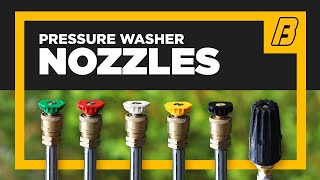
Nozzle Colors Explained: The Five Standard Nozzles
Standard pressure washers include 4–5 color-coded nozzles that change the spray angle. Spray angle determines pressure concentration and coverage: a narrow angle concentrates pressure on a small area (more force, less coverage); a wide angle distributes pressure over a larger area (less force, more coverage).
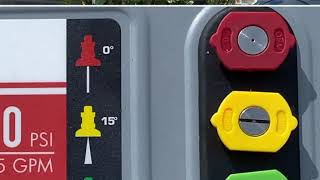
- Red — 0° (zero degrees): A solid, pinpoint stream that concentrates all PSI on a tiny spot. Maximum stripping power. Use only for removing rust from metal, cleaning concrete expansion joints, or stripping hardened paint from concrete. NEVER use on wood, siding, cars, or any painted surface. This nozzle can cut skin at close range — treat it like a saw blade.
- Yellow — 15°: A narrow fan pattern for aggressive cleaning. Good for concrete, stone, and brick. Still too aggressive for wood, painted surfaces, or vehicles. Use for stubborn concrete stains and stripping old deck coatings before refinishing.
- Green — 25°: The general-purpose nozzle. Good for concrete driveways, walkways, garage floors, and most hard-surface cleaning. This is where most pressure washing jobs should start.
- White — 40°: Wide fan, lower pressure concentration. The nozzle to use for vehicles, wood surfaces, vinyl siding, patio furniture, and anywhere damage risk exists. For cars, this is the only appropriate nozzle.
- Black — 65° (soap/detergent): Very low pressure, wide fan. Used specifically to apply soap and detergent — low pressure ensures the soap lathers on the surface rather than being blown off. Use with the detergent tank; do not use this nozzle for rinsing.
Turbo/rotary nozzles: Some machines include a fifth specialty nozzle that rotates the 0° stream in a circular pattern, combining the stripping power of a red nozzle with broader coverage. These are useful for concrete but still dangerous on soft surfaces — treat like the red nozzle for surface selection purposes.
Watch Before You Buy
“1,700 PSI electric — right-sized for most home tasks. CRAFTSMAN reliability, compact design, easy storage. Won't damage siding or decks if used correctly with white nozzle.”
See Today’s Price →What we like
- Lightest and most portable option
- ~$99 — most affordable on this list
- GFCI cord for safety
- Turbo nozzle included
- Onboard storage for nozzles
Watch out for
- 1700 PSI — lower pressure for heavily stained decks
- 1.2 GPM — slowest rinse speed here
- May need multiple passes on neglected wood
Read Full Analysis
The CRAFTSMAN CMEPW1700 is the right starting point for most homeowners: 1,700 PSI handles driveways, decks, siding, and patio furniture without the damage risk of higher-pressure machines. The compact design stores easily. Comes with standard 5-nozzle set. CRAFTSMAN's build quality means this will last many seasons with basic maintenance.

“1,900 PSI, 1.2 GPM, wheeled for large jobs. RYOBI reliability. Good step up from entry-level for driveways and larger deck areas.”
See Today’s Price →What we like
- Wheeled frame for easy mobility
- 1900 PSI for most residential cleaning tasks
- Corded electric — no gas maintenance
- Multiple nozzles included
Watch out for
- 1900 PSI limits performance on heavy concrete stains
- Cord length limits reach without extension cord
Read Full Analysis
The RYOBI RY1419MTVNM adds wheels and an extra 200 PSI over entry-level machines — useful for large concrete driveways where you're covering a lot of area. The wheeled frame means you're not carrying it by hand. 1,900 PSI handles residential concrete effectively and is safe for siding with the correct nozzle. RYOBI's widespread parts and service network is a practical advantage.

“1,700 PSI Karcher K1700 Cube — engineered for convenient flat storage. German engineering, compact cube form factor, onboard accessory storage.”
See Today’s Price →What we like
- Unique cube form factor — stores upright compactly
- CETA-certified TruPressure
- 3-year warranty
- Turbo nozzle + fan nozzle included
- Kärcher reliability
Watch out for
- 1700 PSI — lower end for heavy grime
- 1.2 GPM — slower than higher-flow competitors
- Higher price vs similar PSI electric models
Read Full Analysis
Karcher invented the modern consumer pressure washer category and the K1700 Cube shows it: the flat-pack cube design stores in a fraction of the space of traditional machines. Same 1,700 PSI as the CRAFTSMAN but with Karcher's reputation for build quality and a more ergonomic design. The onboard accessory storage means nozzles don't get lost in the garage. Premium feel at a practical price.
“2,200 PSI / 2.3 GPM — among the most powerful electric machines. Greenworks commercial-grade internals. For large concrete jobs and heavy grime.”
See Today’s Price →What we like
- 2.3 GPM — highest flow of electric models here
- 2200 PSI for effective wood cleaning
- Pressure-select for surface adjustment
- 35-foot hose — good reach
- Electric — quiet and low-maintenance
Watch out for
- Larger footprint than compact electric models
- Heavier than SPX3001
- Pressure-select adds complexity for beginners
Read Full Analysis
The Greenworks GPW2200 is one of the most powerful electric pressure washers on the market: 2,200 PSI combined with 2.3 GPM creates 5,060 cleaning units — real commercial cleaning power without a gas engine. Best for large concrete driveways, commercial property cleaning, and stubborn oil stains. Requires more care on wood and siding: use white nozzle only and maintain extra distance.

“3,200 PSI gas-powered — the standard for contractors. Simpson MegaShot uses Honda commercial-grade engine. For very large jobs where electric range and power aren't enough.”
See Today’s Price →What we like
- Honda GC190 engine — proven reliability
- 3200 PSI / 2.5 GPM real-world performance
- OEM axial pump — serviceable and durable
- 25-foot kink-resistant MorFlex hose
- 5 quick-connect nozzles included
Watch out for
- Gas maintenance required (oil, winterization)
- Louder than electric models
- Heavier and larger than electric alternatives
Read Full Analysis
The Simpson MegaShot is a contractor-grade gas pressure washer built around a Honda engine. At 3,200 PSI it handles concrete restoration, commercial cleaning, and large-area jobs that would take electric machines hours. This is serious equipment: the red nozzle at 3,200 PSI can cut skin at close range. Follow all safety protocols, use appropriate nozzles for each surface, and maintain safe distances. Best for homeowners with large properties or professionals.
Frequently Asked Questions
What PSI should I use on a wood deck?
What do the pressure washer nozzle colors mean?
Can you pressure wash a car?
What should you never pressure wash?
Is electric or gas pressure washer better?
How do I prevent stripes on my concrete driveway?
How do I winterize my pressure washer?
Can I pressure wash vinyl siding?
How We Analyze Products
We analyze Amazon review data — often thousands of reviews per product — to surface patterns that individual buyers miss. Our process aggregates star ratings, review counts, and buyer sentiment at scale, identifying which strengths and weaknesses appear consistently across the largest review samples available. The 14,753+ reviews analyzed on this page represent real verified-purchase feedback from Amazon buyers.
Each product earned its placement through data: total review volume, average rating, and the specific praise and complaints that repeat most often across buyers. No manufacturer paid for placement on this page. Products appear here because buyers endorsed them at scale, not because a company asked us to feature them.
We use AI to summarize review sentiment — not to fabricate opinions, but to condense what thousands of buyers actually wrote into a readable format. The pros and cons you see reflect the most common themes found in verified purchaser reviews, paraphrased for clarity. We do not claim to have accessed Reddit, YouTube, or specific publications in generating these summaries.
Prices shown reflect Amazon pricing at the time this page was last generated. Click “See Today’s Price” to get the current live price on Amazon. Read our full methodology →
Sources: PWNA (Power Washers of North America) guidelines, manufacturer PSI charts, Consumer Reports pressure washer testing, and Project Farm YouTube comparisons.