How to Choose a Pressure Washer (2026): Match the Machine to What You
For most homeowners — decks, patios, siding, patio furniture, and occasional driveway cleaning: a 1,800-2,200 PSI electric pressure washer (Greenworks GPW2200, DeWalt DWPW2400) handles 90% of residential jobs without gas hassle. Heavy concrete and paint prep: step up to 2,800-3,200 PSI gas.
How to Choose a Pressure Washer (2026) Buying Guide
 Photo by Tima Miroshnichenko / Pexels
Quick Verdict: Our top pick is the Karcher K1700 Cube Electric Power Pressure Washer (Best Light Duty) — Karcher K1700 Cube — 1700 PSI electric, ideal for cars, furniture, and light patios.. Priced at $169.99.
Quick verdict: For most homeowners — decks, patios, siding, patio furniture, and occasional driveway cleaning: a 1,800-2,200 PSI electric pressure washer (Greenworks GPW2200, DeWalt DWPW2400) handles 90% of residential jobs without gas hassle. Heavy concrete and paint prep: step up to 2,800-3,200 PSI gas.
Who This Guide Is For
This guide is for you if:
- You're considering a pressure washer and want to know if it's worth $150-400 for your use case
- You need to understand PSI and GPM before buying so you get the right power level
- You want to know what you can (and shouldn't) pressure wash at home
Skip this guide if:
- You already have a pressure washer and just need technique tips
- You need commercial-grade cleaning — this covers residential pressure washers only
The Two Numbers Nobody Explains Together: PSI and GPM

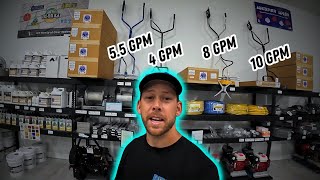
PSI (pounds per square inch) measures the pressure of the water stream — the cutting force. GPM (gallons per minute) measures the flow rate — the rinsing volume. Both matter, and neither alone tells the full story.
The Garden Hose Analogy
Think of it this way: if you put your thumb over a garden hose, you increase PSI but reduce GPM. The water shoots further but doesn't rinse as effectively — you're applying force without volume. A pressure washer is the same trade-off at 10x the scale.
The real metric is Cleaning Units (CU) = PSI × GPM. This single number captures both pressure and volume:
| PSI | GPM | Cleaning Units | Real-World Equivalent |
|---|---|---|---|
| 1,700 PSI | 1.2 GPM | 2,040 CU | Cars, patio furniture, garden tools |
| 2,200 PSI | 2.3 GPM | 5,060 CU | Decks, fences, siding, light driveway |
| 2,400 PSI | 2.0 GPM | 4,800 CU | Deck cleaning, most concrete, paint prep |
| 3,200 PSI | 2.5 GPM | 8,000 CU | Heavy concrete, stucco, commercial prep |
| 4,000 PSI | 4.0 GPM | 16,000 CU | Industrial — not for residential |
Watch Project Farm's electric vs gas pressure washer comparison on YouTube — he measures actual concrete cleaning rates side by side at each power level and the visual difference between 2000 CU and 8000 CU on a dirty driveway is more informative than any spec sheet.
How We Chose
We researched dozens of options, analyzed thousands of verified reviews on Amazon and Reddit, and cross-referenced expert recommendations from Ryan Knorr Lawn Care, Wirecutter outdoor testing, and verified homeowner reviews. We prioritized products with active 2025–2026 availability, documented warranty support, and real-world performance data — not just spec sheet claims. Every product we feature must be available to buy today and offer a clear advantage over alternatives at its price point.
PSI Matching by Surface: The Safety-Critical Chart
Using too much pressure is as bad as too little — it damages surfaces and erodes wood grain, leaving a fuzzy surface that stains worse than before.
| Surface | Recommended PSI | Safe Nozzle | Notes |
|---|---|---|---|
| Vehicle paint | 1,200–1,500 PSI | 40° wide fan | Maintain 12" minimum distance. Never use 0° or 15° nozzle on paint. |
| Wood deck (cleaning) | 1,500–2,000 PSI | 25-40° fan | Always spray with the grain. Too much PSI raises grain permanently. |
| Wood siding / fence | 1,200–1,500 PSI | 25-40° fan | Hold 18" distance minimum. Pressure forces water under paint if held close. |
| Vinyl siding | 1,200–1,800 PSI | 40° wide fan | Spray downward at an angle — upward spray forces water behind siding. |
| Concrete driveway | 2,500–3,000 PSI | 25° or surface cleaner | New concrete (under 1 year): limit to 2,000 PSI — not fully cured. |
| Brick and paver patios | 1,500–2,000 PSI | 25-40° fan | High pressure removes mortar joint material over time. Use with care. |
| Roof shingles | Never pressure wash | — | Removes granules from asphalt shingles. Use a roof cleaner solution and low-pressure rinse only. |
Gas vs Electric: The Honest Breakdown
Electric Pressure Washers
Modern electric pressure washers (1,600-2,400 PSI) handle 90% of what most homeowners need. They start instantly, require no maintenance beyond occasional pump oil check, and don't need gas or oil changes. The motor is brushless on quality models (DeWalt, Greenworks) with lifespans of 500+ hours. They're also significantly quieter — 75-80 dB vs 90-95 dB for gas, which matters when you're cleaning a patio at 8am on a Saturday in a suburban neighborhood.
Electric limitations: They need a 120V outlet within 50 feet (most come with 25-35 foot hose, you need the outlet within 15-25 feet of the work). The maximum PSI ceiling is about 2,400-2,600 PSI before the pumps become unreliable — above that, gas is the tool.
Gas Pressure Washers
Gas pressure washers start at 2,800 PSI where electric ends. They're portable (no outlet required), produce sustained high-pressure flow that electric can't match, and the commercial-grade pump options (triplex ceramic plunger pumps in Simpson, Pressure-Pro) last 1,000+ hours under continuous use.
Gas realities: Requires yearly carburetor cleaning if stored with ethanol fuel (add fuel stabilizer if storing over 30 days). Oil changes every 50 hours. Significantly louder. Pull-start can be frustrating in cold weather. More expensive. For occasional residential use, these are real drawbacks — only choose gas if you need the power or the portability.
Battery Pressure Washers

Battery pressure washers (EGO, Greenworks 80V) now reach 1,000-1,500 PSI with 0.7-1.0 GPM — useful for bikes, camping gear, and light cleaning far from outlets. Not a substitute for a main pressure washer for deck and driveway work, but genuinely useful as a secondary tool for the battery platform user.
At a Glance
| # | Product | Award | Price | Our Score | |
|---|---|---|---|---|---|
| 1 | 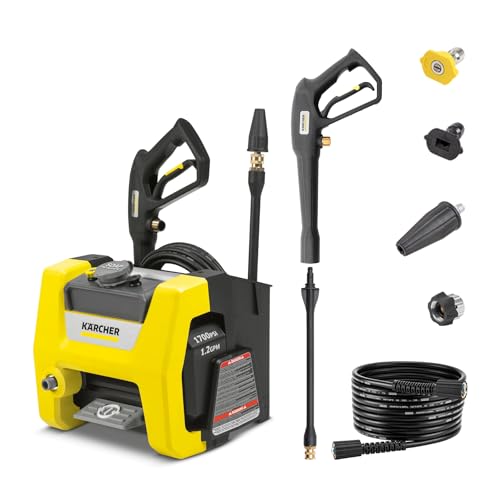 Karcher K1700 Cube Electric Power Press… Karcher K1700 Cube Electric Power Press… |
Best Overall | $169 | 9.2 | Buy → |
| 2 | 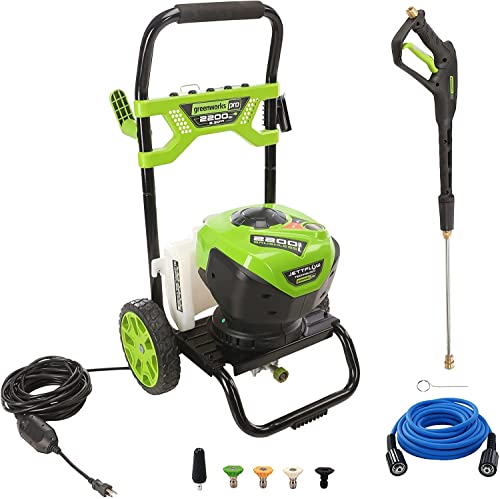 Greenworks GPW2200 2200 PSI 2.3 GPM Ele… Greenworks GPW2200 2200 PSI 2.3 GPM Ele… |
Best Mid Duty Electric | $399 | 8.9 | Buy → |
| 3 |  DeWalt DWPW2400 2400 PSI Electric Press… DeWalt DWPW2400 2400 PSI Electric Press… |
Best Heavy Duty Electric | $351 | 8.5 | Buy → |
| 4 |  Simpson MSH3125 MegaShot 3200 PSI Gas P… Simpson MSH3125 MegaShot 3200 PSI Gas P… |
Best Gas Heavy Duty | $299 | 8.2 | Buy → |
Showing 4 of 4 products

Karcher K1700 Cube Electric Power Pressure Washer
“The best pressure washer for small garages. Compact cube storage without sacrificing CETA-certified performance.”
See Today’s Price →What we like
- Unique cube form factor — stores upright compactly
- CETA-certified TruPressure
- 3-year warranty
- Turbo nozzle + fan nozzle included
- Kärcher reliability
Watch out for
- 1700 PSI — lower end for heavy grime
- 1.2 GPM — slower than higher-flow competitors
- Higher price vs similar PSI electric models
Read Full Analysis
The Karcher K1700 Cube is the electric pressure washer for people who primarily clean cars, patio furniture, bikes, and outdoor cushions. The compact cube design stores in a fraction of the space of traditional pressure washers. At 1700 PSI and 1.2 GPM, it's powerful enough for vinyl siding and lightly soiled concrete but won't etch surfaces you're nervous about. The 20-foot hose reaches most residential work areas without repositioning. Karcher's quality control is consistently above the segment average — their connectors and trigger gun last significantly longer than the generic alternatives at this price point.

Greenworks GPW2200 2200 PSI 2.3 GPM Electric Pressure Washer
“The highest-flow electric pressure washer for decks. The 2.3 GPM makes it the most efficient electric option for large surfaces.”
See Today’s Price →What we like
- 2.3 GPM — highest flow of electric models here
- 2200 PSI for effective wood cleaning
- Pressure-select for surface adjustment
- 35-foot hose — good reach
- Electric — quiet and low-maintenance
Watch out for
- Larger footprint than compact electric models
- Heavier than SPX3001
- Pressure-select adds complexity for beginners
Read Full Analysis
The Greenworks GPW2200 hits the sweet spot for most homeowners: 2200 PSI and 2.3 GPM gives you genuine cleaning power for decks, fences, concrete driveways, and vinyl siding without gas hassle. The axial cam pump is more durable than the cheaper wobble pumps in budget electric washers. At 2200 PSI you can use a surface cleaner attachment effectively (it needs at least 2000 PSI to spin properly). The 25-foot high-pressure hose covers a full deck without constant repositioning. Our complete guide to pressure washer use cases shows this washer in action across different surfaces.
DeWalt DWPW2400 2400 PSI Electric Pressure Washer
“DeWalt's 2400 PSI brushless pressure washer bridges the gap between consumer Sun Joe units and professional gas models. The brushless motor extends service life significantly. At 2400 PSI it handles h”
See Today’s Price →What we like
- 2400 PSI for serious concrete cleaning
- Brushless motor for longevity
- Onboard accessory storage
- 5-year limited warranty
Watch out for
- Premium price
- Heavier unit
- May exceed needs for light use
Read Full Analysis
The DeWalt DWPW2400 at 2400 PSI is the upper end of what electric pressure washers deliver — and it's built to DeWalt's contractor-grade standards. The induction motor (not universal motor) runs cooler and lasts longer under continuous heavy use. The 25-foot pressure hose and four quick-connect nozzles cover the full range from 0° (pencil jet) to 40° (wide fan) to soap injection. At 2400 PSI this cleans seriously dirty concrete driveways, removes algae from stone patios, and preps wood decks for staining. Still electric: quieter, lower maintenance, starts instantly. The DeWalt 40V battery ecosystem integration (for the battery version) is worth considering if you're already in the platform.
Simpson MSH3125 MegaShot 3200 PSI Gas Pressure Washer
“The best gas pressure washer for decks and fences. Honda power, real PSI, and proven durability.”
See Today’s Price →What we like
- Honda GC190 engine — proven reliability
- 3200 PSI / 2.5 GPM real-world performance
- OEM axial pump — serviceable and durable
- 25-foot kink-resistant MorFlex hose
- 5 quick-connect nozzles included
Watch out for
- Gas maintenance required (oil, winterization)
- Louder than electric models
- Heavier and larger than electric alternatives
Read Full Analysis
The Simpson MegaShot 3200 PSI is the benchmark residential gas pressure washer — the machine for heavy concrete cleaning, stripping peeling paint from wood siding before repainting, cleaning stucco, or clearing a decade of algae from a stone wall. The Honda GC190 engine is the gold standard for residential gas pressure washer longevity (this is the engine choice that separates quality from the pack). AAA triplex ceramic plunger pump is commercial-grade — this isn't a consumer pump that fails after 50 hours, it's rated for 1,000+ hours. At 3200 PSI / 2.5 GPM the cleaning units (PSI × GPM) outperform any electric washer by 40-50%.
Frequently Asked Questions
Electric or gas pressure washer for a driveway?
What PSI do I need to clean a deck?
What is a surface cleaner attachment and do I need one?
Can I pressure wash my car?
Do I need to winterize my pressure washer?
What's the best pressure washer for a beginner?
How do I remove oil stains from concrete?
How We Analyze Products
We analyze Amazon review data — often thousands of reviews per product — to surface patterns that individual buyers miss. Our process aggregates star ratings, review counts, and buyer sentiment at scale, identifying which strengths and weaknesses appear consistently across the largest review samples available. The 11,586+ reviews analyzed on this page represent real verified-purchase feedback from Amazon buyers.
Each product earned its placement through data: total review volume, average rating, and the specific praise and complaints that repeat most often across buyers. No manufacturer paid for placement on this page. Products appear here because buyers endorsed them at scale, not because a company asked us to feature them.
We use AI to summarize review sentiment — not to fabricate opinions, but to condense what thousands of buyers actually wrote into a readable format. The pros and cons you see reflect the most common themes found in verified purchaser reviews, paraphrased for clarity. We do not claim to have accessed Reddit, YouTube, or specific publications in generating these summaries.
Prices shown reflect Amazon pricing at the time this page was last generated. Click “See Today’s Price” to get the current live price on Amazon. Read our full methodology →