How to Use a Pressure Washer on Everything Around Your Home (2026)
For most homeowners, a 2000–2400 PSI electric pressure washer handles 90% of jobs — driveways, siding, decks, cars, and furniture — without the maintenance hassle of gas. Step up to a 3000+ PSI gas unit if you have large concrete surfaces, a long driveway, or commercial-grade grime to deal with.
How to Use a Pressure Washer on Everything Around Your Home (2026) Buying Guide
 Photo by Tima Miroshnichenko / Pexels
Quick Verdict: Our top pick is the Simpson MSH3125 MegaShot 3200 PSI Gas Pressure Washer (Best Gas Pick) — The Simpson MSH3125 MegaShot is powered by a Honda GC190 engine — one of the most reliable small engines in the indus.... Priced at $299.
Budget Pick: The Sun Joe SPX3001 2030 PSI Electric Pressure Washer with Hose Reel at $143.65 — The Sun Joe SPX3001 earns its place as the entry point with a genuinely useful differentiator: a built-in hose reel t....
This guide is for you if:
-
You're considering a pressure washer and want to know if it's worth $150-400 for your use case
-
You need to understand PSI and GPM before buying so you get the right power level
-
You want to know what you can (and shouldn't) pressure wash at home
Skip this guide if:
-
You already have a pressure washer and just need technique tips
-
You need commercial-grade cleaning — this covers residential pressure washers only
| Car/Boat Washing | ||||
| Deck/Patio Cleaning | ||||
| Concrete Driveway | ||||
| Siding (vinyl/wood) | ||||
| Fence Staining Prep | ||||
| Roof Cleaning | ||||
| Grease on Concrete | ||||
| Nozzle Key |
Red=0° (most powerful/dangerous). Yellow=15°. Green=25°. White=40°. Black=soap/low pressure. When in doubt, use 40° and test on hidden spot first. |
Quick verdict: For most homeowners, a 2000–2400 PSI electric pressure washer handles 90% of jobs — driveways, siding, decks, cars, and furniture — without the maintenance hassle of gas. Step up to a 3000+ PSI gas unit if you have large concrete surfaces, a long driveway, or commercial-grade grime to deal with.
## You've Been Cleaning Things Wrong Here's a Saturday afternoon scenario: you're on your hands and knees scrubbing a section of driveway with a stiff brush and a bucket of soapy water. An hour in, you've covered maybe four square feet. The oil stain is lighter, not gone. Your back hurts. Now here's the same job with a [pressure washer](/yard/best-pressure-washer-under-200-2026/): you hook up the machine, swap on a surface cleaner attachment, and walk at a normal pace. Fifteen minutes later, the entire driveway looks like it was just poured. The oil stain is gone. That's the thing about pressure washers — they don't just clean faster. They reach a level of clean that scrubbing literally cannot achieve. The concentrated force of water gets into the pores of concrete, blasts out the oxidized grime from wood grain, and strips mildew from vinyl siding without a single drop of harsh chemical. But here is where most people go wrong: they buy a machine, point it at things, and either under-clean (wrong nozzle, too much distance) or damage surfaces (too much pressure, wrong technique). This guide fixes that. Every surface. Every use case. Exact technique for each. --- ## The Complete Use Case List This is the section that usually makes people realize they've been under-using their pressure washer — or that they need one.This is the pressure washer's home turf. Concrete is porous and tough, which means it needs both high pressure and the right technique to get fully clean.
Recommended PSI: 2800–3200 PSI for residential driveways. Older or softer concrete can crack at extreme pressure, so stay under 3500.
Best technique: Skip the standard lance for large flat areas. A surface cleaner attachment — a rotating bar with two nozzles inside a plastic housing — eliminates the striping pattern you get from a single spray wand. Move it like a lawnmower in overlapping passes. For oil stains, pre-treat with a concrete degreaser, let it dwell for five minutes, then hit it with the surface cleaner.
What to expect: Fresh oil stains come out almost completely. Years-old stains lighten significantly. Mildew, moss, and dirt: gone.

Wood is where pressure washers earn their reputation for damage — and where technique matters most.
Recommended PSI: 1500–2000 PSI maximum. At 2500 PSI with a narrow nozzle, you'll see visible gouging in softwood like cedar or pine within seconds.
Best technique: Always go with the wood grain, never across it. Use a 25-degree (green) nozzle at 12–18 inches from the surface. Before you start, test one inconspicuous board — a joist edge or a corner board that isn't visible — and look for any fuzzing of the wood fibers. If you see fuzzing, back off the pressure or increase your distance.
For best results, use the soap nozzle to apply a dedicated deck cleaner first. Let it sit for five to ten minutes, then rinse with the 25-degree nozzle. The chemical does the deep work; the water knocks it out.
Follow up the next day with a deck brightener (neutralizes any remaining cleaner residue) and finish with a penetrating sealant. A well-cleaned and sealed deck lasts years longer.
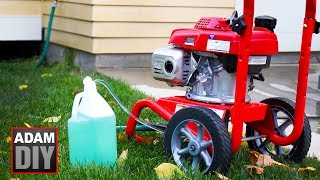
Yes, you can wash your car with a pressure washer. No, you should not grab the same nozzle you used on the driveway.
Recommended PSI: 1200–1900 PSI. Modern car paint is actually quite robust, but the combination of high pressure and a narrow nozzle at close range can chip or peel clear coat, especially on older vehicles or areas with existing paint damage.
Best technique: Start with the black (soap) nozzle to apply car wash soap. Let it dwell on the surface for 60–90 seconds. Then switch to the white (40-degree) nozzle to rinse, maintaining at least 12 inches of distance from the paint at all times. Work panel by panel, top to bottom — roof, hood, trunk, then doors and lower panels.
Pay special attention to wheel wells and door sills — these collect road salt and brake dust that a regular hose rinse misses. The 25-degree nozzle works well in wheel wells since paint is not a concern there.
Never aim directly into door seams, window seals, convertible tops, or exhaust tips. Never use the 0-degree or 15-degree nozzle anywhere on the exterior. ChrisFix has a great step-by-step car wash technique video if you want to see the exact motions — it covers everything from soap dwell time to the rinse sequence.
At a Glance
| # | Product | Award | Price | Our Score | |
|---|---|---|---|---|---|
| 1 |  Simpson MSH3125 MegaShot 3200 PSI Gas P… Simpson MSH3125 MegaShot 3200 PSI Gas P… |
Best Overall | $299 | 9.2 | Buy → |
| 2 |  DeWalt DWPW2400 2400 PSI Electric Press… DeWalt DWPW2400 2400 PSI Electric Press… |
Best Electric Heavy-Duty | $351 | 8.9 | Buy → |
| 3 | 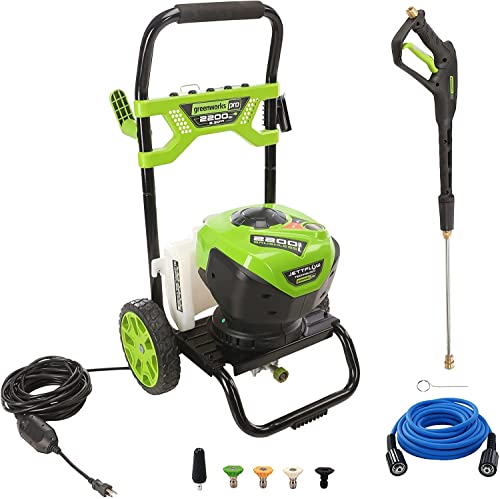 Greenworks GPW2200 2200 PSI 2.3 GPM Ele… Greenworks GPW2200 2200 PSI 2.3 GPM Ele… |
Best for Decks & Cars | $399 | 8.5 | Buy → |
| 4 | 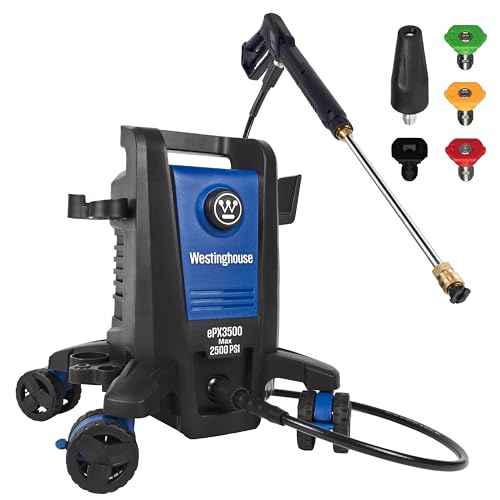 Westinghouse ePX3500 Electric Pressure … Westinghouse ePX3500 Electric Pressure … |
Best Budget Electric | $169 | 8.2 | Buy → |
| 5 |  Sun Joe SPX3001 2030 PSI Electric Press… Sun Joe SPX3001 2030 PSI Electric Press… |
Best Entry Level | $143 | 7.8 | Buy → |
Showing 5 of 5 products
Simpson MSH3125 MegaShot 3200 PSI Gas Pressure Washer
“The best gas pressure washer for decks and fences. Honda power, real PSI, and proven durability.”
See Today’s Price →What we like
- Honda GC190 engine — proven reliability
- 3200 PSI / 2.5 GPM real-world performance
- OEM axial pump — serviceable and durable
- 25-foot kink-resistant MorFlex hose
- 5 quick-connect nozzles included
Watch out for
- Gas maintenance required (oil, winterization)
- Louder than electric models
- Heavier and larger than electric alternatives
Read Full Analysis
The Simpson MegaShot 3200 PSI gas pressure washer is the maximum-power option in this lineup and the right tool when electric models fall short — stripping multi-year paint from a wooden deck, cleaning a long concrete driveway with embedded tire rubber and oil stains, or restoring weathered wood fencing to near-original appearance. The Honda GC190 engine is the reason this machine commands a premium: Honda small engines are known for reliable starting, consistent power output over the engine's life, and parts availability that keeps the machine running for decades. At 3200 PSI and 2.5 GPM, the combination of pressure and flow rate blasts stubborn mildew, algae, and staining in a single pass where lower-pressure electric models require multiple overlapping passes. The 25-foot high-pressure hose provides reach without moving the washer constantly. Compared to the DeWalt electric at 2400 PSI, the Simpson generates 800 more PSI with higher flow — the difference is significant for concrete and weathered wood but overkill for car washing and wood deck rinsing. Gas storage, oil changes, and fuel stabilizer for winter storage are the maintenance requirements that electric models eliminate. Best for homeowners with large concrete areas, multi-car driveways, long fence runs, and wood surfaces that require stripping rather than gentle cleaning.
DeWalt DWPW2400 2400 PSI Electric Pressure Washer
“DeWalt's 2400 PSI brushless pressure washer bridges the gap between consumer Sun Joe units and professional gas models. The brushless motor extends service life significantly. At 2400 PSI it handles h”
See Today’s Price →What we like
- 2400 PSI for serious concrete cleaning
- Brushless motor for longevity
- Onboard accessory storage
- 5-year limited warranty
Watch out for
- Premium price
- Heavier unit
- May exceed needs for light use
Read Full Analysis
The DeWalt DWPW2400 is the serious electric pressure washer in this lineup — a brushless motor design that extends service life significantly beyond the brushed motors in standard consumer electric units, which degrade with use and eventually require replacement. At 2400 PSI and 1.1 GPM, it handles heavily stained concrete, multi-season mildew on siding, and weathered wood preparation for staining — applications that the lighter Sun Joe and Greenworks units struggle with. The DeWalt brand construction reflects tool-grade build quality: heavier, more durable fittings, a commercial-style lance, and the brand's standard 3-year warranty. Compared to the Greenworks 2200 PSI in this lineup, the DeWalt generates 200 more PSI with a brushless motor that outlasts the Greenworks' brushed design. Versus the Westinghouse ePX3500 which claims 2500 PSI, the DeWalt at 2400 PSI is the more credible number from an industrial tool brand — pressure washer PSI ratings from consumer brands are often measured under conditions that inflate the stated figure. The trade-off over the gas Simpson is portability and noise: the DeWalt runs on 120V household power with no fuel storage, no emissions, and significantly less noise. Best for homeowners who want heavy-duty electric cleaning performance without gas maintenance, prioritizing build quality over absolute maximum PSI.

Greenworks GPW2200 2200 PSI 2.3 GPM Electric Pressure Washer
“The highest-flow electric pressure washer for decks. The 2.3 GPM makes it the most efficient electric option for large surfaces.”
See Today’s Price →What we like
- 2.3 GPM — highest flow of electric models here
- 2200 PSI for effective wood cleaning
- Pressure-select for surface adjustment
- 35-foot hose — good reach
- Electric — quiet and low-maintenance
Watch out for
- Larger footprint than compact electric models
- Heavier than SPX3001
- Pressure-select adds complexity for beginners
Read Full Analysis
The Greenworks GPW2200 at 2200 PSI and 2.3 GPM is the flow-rate leader among electric pressure washers in this lineup — and GPM (gallons per minute) matters as much as PSI for cleaning efficiency on large surfaces. Higher flow rate rinses a broader path per pass, meaning fewer overlapping strokes to cover a deck or driveway. At 2.3 GPM, the Greenworks rinses approximately 15% more water per minute than most 2.0 GPM electric competitors, which translates to meaningfully faster cleaning time on a large deck or extended fence line. The trade-off is that higher flow rate increases water consumption — relevant where water is metered or scarce. The 35-foot hose is longer than the standard 25-foot hose on the DeWalt and Westinghouse, reducing how frequently you need to reposition the washer. Greenworks has an established track record in the outdoor power equipment category. Compared to the DeWalt at 2400 PSI, Greenworks generates 200 fewer PSI but more gallons per minute — for large soft surfaces (wood decks, vinyl siding), Greenworks' higher flow is more efficient; for dense stained concrete, DeWalt's higher pressure is more effective. Best for homeowners with large decks, long siding runs, and wood surfaces where volume of water contact matters more than maximum pressure force.

Westinghouse ePX3500 Electric Pressure Washer 2500 PSI 5-Nozzle
“A powerful electric pressure washer that handles driveways, siding, and deck cleaning effectively. The 5-nozzle set covers everything from rinsing to stripping without separate accessory purchases.”
See Today’s Price →What we like
Watch out for
Read Full Analysis
The Westinghouse ePX3500 claims 2500 PSI and backs it up with a 5-nozzle set that covers every residential cleaning application — the 0-degree pencil jet for stubborn stains, 15-degree for concrete cleaning, 25-degree general purpose, 40-degree for delicate surfaces, and a soap nozzle for applying detergent. Having all five nozzles in the box eliminates separate purchases. The steel-reinforced hose and metal connectors are a step up in durability from all-plastic connections on entry-level electric units. The onboard storage for nozzles and the 35-foot hose reduces setup and teardown time per use. Compared to the DeWalt at 2400 PSI, the Westinghouse claims 100 more PSI at a lower price — the caveat is that PSI ratings from consumer brands are sometimes measured under conditions that inflate the figure. Real-world cleaning performance is comparable to the DeWalt for most residential tasks. Versus the Greenworks 2200 PSI, the Westinghouse claims more pressure but the Greenworks has the higher-flow 2.3 GPM for large surface efficiency. The Sun Joe SPX3001 at the entry tier offers the hose reel convenience at a lower price. Best for homeowners who want an all-inclusive electric pressure washer package covering multiple cleaning applications without buying accessories separately.

Sun Joe SPX3001 2030 PSI Electric Pressure Washer with Hose Reel
“The best electric pressure washer for deck and fence cleaning. The hose reel is a practical advantage for outdoor work.”
See Today’s Price →What we like
- Built-in hose reel for deck/fence work
- PWMA-certified 2030 PSI
- Dual soap tanks
- 5 nozzles included
- Electric — no maintenance
Watch out for
- 1.76 GPM — slower rinse than gas models
- Corded — need extension to reach far fence lines
- Not ideal for 1000+ sq ft decks
Read Full Analysis
The Sun Joe SPX3001 2030 PSI is the entry-level electric pressure washer in this lineup, and the integrated hose reel is the practical differentiator over every other unit on the page — the reel stores the 20-foot hose neatly when the machine is not in use, eliminating the tangled coil on the ground that causes tripping hazards and hose kinks. At 2030 PSI and 1.76 GPM, the Sun Joe handles standard residential cleaning tasks: rinsing patio furniture, cleaning a car, washing down a wood deck between annual stripping sessions, and removing surface algae from a fence. The 34-ounce onboard detergent tank mixes soap automatically. Compared to the Westinghouse ePX3500, the Sun Joe generates 470 fewer PSI and less flow — adequate for maintenance cleaning but insufficient for heavy-stain removal on concrete or stripping multi-year accumulation from wood. Versus the DeWalt and Greenworks, the Sun Joe is the most affordable unit but the least powerful. The hose reel convenience is the reason to choose Sun Joe over the budget competition. In this pressure washer guide, the Sun Joe serves homeowners who pressure wash 2-3 times per year for maintenance rather than restoration. Best for apartments with patios, small townhouse decks, car washing, and light maintenance cleaning where storage convenience matters more than maximum cleaning power.
Frequently Asked Questions
Can I use a pressure washer to clean my gutters?
Will a pressure washer damage my car's paint?
Can I use regular dish soap in a pressure washer?
What PSI do I actually need for a driveway?
Is electric or gas better for a homeowner?
How do I prevent pressure washer marks (striping) on my deck?
Can I pressure wash my roof?
How We Analyze Products
We analyze Amazon review data — often thousands of reviews per product — to surface patterns that individual buyers miss. Our process aggregates star ratings, review counts, and buyer sentiment at scale, identifying which strengths and weaknesses appear consistently across the largest review samples available. The 31,392+ reviews analyzed on this page represent real verified-purchase feedback from Amazon buyers.
Each product earned its placement through data: total review volume, average rating, and the specific praise and complaints that repeat most often across buyers. No manufacturer paid for placement on this page. Products appear here because buyers endorsed them at scale, not because a company asked us to feature them.
We use AI to summarize review sentiment — not to fabricate opinions, but to condense what thousands of buyers actually wrote into a readable format. The pros and cons you see reflect the most common themes found in verified purchaser reviews, paraphrased for clarity. We do not claim to have accessed Reddit, YouTube, or specific publications in generating these summaries.
Prices shown reflect Amazon pricing at the time this page was last generated. Click “See Today’s Price” to get the current live price on Amazon. Read our full methodology →