Scotts vs Milorganite Fertilizer 2026: Synthetic vs Organic

Scotts Turf Builder Lawn Food (~$20) delivers faster green-up for impatient lawns. Milorganite (~$17) is the safer choice for homes with pets and children, with a gentler nutrient release that prevents fertilizer burn.
See Today’s Price →At a Glance
| # | Product | Award | Price |
|---|---|---|---|
| 1 | Best Budget Scotts | $25 Buy → |
|
| 2 | Best Weed and Feed | $34 Buy → |
|
| 3 | Best All-in-One | $38 Buy → |
|
| 4 |  Milorganite All-Purpose Eco-Frien… Milorganite All-Purpose Eco-Frien…Milorganite |
Best Organic Pick | $17 Buy → |
Scotts vs Milorganite Fertilizer Buying Guide
Lawn fertilizer is one area where understanding the underlying chemistry pays off. Synthetic and organic fertilizers produce similar long-term results but behave very differently in the short term.
Where Scotts Wins: Speed and Targeted Formulas
Scotts Turf Builder line includes specialized formulas for different problems: Lawn Food for pure green-up, Weed & Feed for simultaneous fertilization and broadleaf weed control, and Triple Action for weed prevention, weed killing, and feeding in one pass. Fast-acting nitrogen in Scotts products shows visible results in 3–5 days. For lawns in poor condition that need a quick recovery before a party or event, nothing beats synthetic speed. The Turf Builder line works on all grass types and is widely available at any home improvement store.
Where Milorganite Wins: Safety and Burn-Proof Performance
Milorganite's organic nitrogen (derived from heat-dried microbes) releases slowly over 8–10 weeks, making it nearly impossible to over-apply or burn your lawn — even if you use it in hot weather or apply too much. It's safe for pets and children to walk on the lawn immediately after application (no waiting period). The 6-4-0 NPK ratio with added iron produces a darker green color than pure synthetic nitrogen. Milorganite also improves soil microbiology over time — repeated applications build a healthier soil ecosystem, a benefit synthetic fertilizers don't provide.
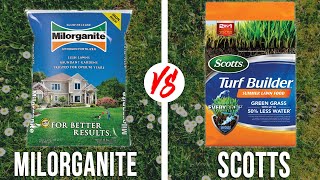
Application Schedule and Ease
Scotts recommends feeding every 6–8 weeks during the growing season (4–5 applications per year). Milorganite's slow release means every 10 weeks is sufficient (3–4 applications per year). Both apply with a standard broadcast spreader. Scotts requires watering in after application; Milorganite works with or without rain. For busy homeowners who forget to fertilize regularly, Milorganite's wider application window is more forgiving.
Cost Per 1,000 Square Feet
Scotts Turf Builder 12.5 lb bag ($20.14) covers 5,000 sq ft = $4.03 per 1,000 sq ft. Milorganite 32 lb bag ($17.29) covers 2,500 sq ft = $6.92 per 1,000 sq ft. Scotts wins on cost-per-application, but Milorganite's fewer required applications per year roughly equalizes the annual cost. Scotts Triple Action ($32.27 for 5,000 sq ft) adds weed control value that's expensive to replicate with separate products.
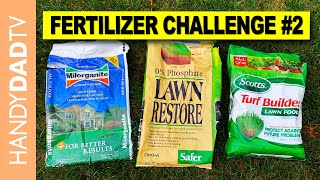
Get Scotts If / Get Milorganite If
Get Scotts Turf Builder if you want fast visible green-up, need weed control combined with feeding, or are on a tight fertilization budget. Get Milorganite if you have pets or young children on the lawn, want a truly burn-proof application, or prefer improving soil health over time rather than just feeding grass.
How We Picked These Models
We focused on core lawn fertilizer products from both brands — excluding grass seed, mulch, and specialized products outside the fertilizer category. Rankings reflect NPK balance, coverage per bag, safety profile, and overall value for homeowners with warm-season and cool-season grasses.
Watch Before You Buy
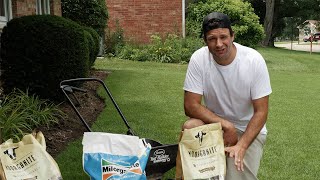
“The Scotts Turf Builder Lawn Food Fertilizer 5000 sq ft 12.5 lb features 5000 sq ft. 4.6 stars from 7,757 Amazon reviews signal consistent reliability.”
See Today’s Price →What we like
- 5000 sq ft
- 12.5 lb
- Scotts quality
- Quick-release nitrogen
Watch out for
- Nitrogen-heavy formula can burn lawn if applied in hot, dry conditions or applied too heavily
- granules must be watered in immediately after application
- adds seasonal cost for multiple applications
Read Full Analysis
Scotts Turf Builder's quick-release nitrogen delivers fast visible greening — the nitrogen activates rapidly after watering in, producing noticeable color improvement within days of application. This speed is the defining characteristic that separates Scotts' synthetic quick-release approach from Milorganite's slow-release organic nitrogen on this page: Scotts produces results faster; Milorganite feeds more gradually without burn risk. At $20.14 for 5,000 sq ft on this Scotts vs Milorganite comparison, the cost-per-coverage is close to Milorganite's $17.29 for comparable coverage. The burn risk is the main Scotts limitation: granules must be watered in immediately after application, and applying in hot dry conditions or at excess rate can cause nitrogen burn — yellow-brown scorching at the application point. Milorganite's organic nitrogen releases gradually regardless of temperature and moisture conditions, making it significantly less technique-sensitive. Best for lawns where fast green-up is the goal, applied in favorable conditions — cooler temperatures, watered in promptly, at the label rate. Skip it in high heat or if precise application rate is uncertain; Milorganite's burn-resistant formula is the safer choice in those scenarios.

“Kills weeds and feeds lawn in one application. 4.3 stars from 35,230 Amazon reviews signal consistent reliability.”
See Today’s Price →What we like
- Kills weeds and feeds lawn in one application
- Covers 5,000 sq ft per bag
- Kills dandelions, clover, chickweed, plantain
- Works with any broadcast spreader
Watch out for
- Must be applied when lawn is wet for weed killer absorption
- Do not apply to newly seeded grass or it will kill new seedlings
Read Full Analysis
The Weed & Feed3 adds a weed-control layer that Milorganite's organic formula cannot replicate — Milorganite feeds only, while this Scotts product kills broadleaf weeds (dandelions, clover, chickweed, plantain) in the same pass. At $22.49 for 5,000 sq ft, the per-square-foot cost is nearly identical to Milorganite's organic bags, but you trade Milorganite's soil-building benefits for targeted weed elimination. Application timing matters: apply when grass is wet so granules stick to weed leaves, making early morning after dew the ideal window. Unlike Milorganite's forgiving anytime-safe application, Scotts Weed & Feed3 has a hard restriction against newly seeded areas — it kills germinating grass seed. For established lawns with active broadleaf weed pressure, it is the practical choice over the Milorganite fertilize-only options on this page. Skip it if you prefer organic inputs, have a lawn with recent overseeding, or need pets back on the grass immediately after treatment.
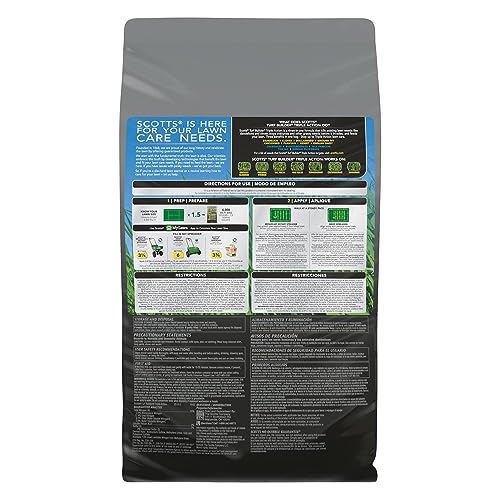
“3-in-1: kills weeds, prevents crabgrass, fertilizes. 4.4 stars from 1,883 Amazon reviews signal consistent reliability.”
See Today’s Price →What we like
- 3-in-1: kills weeds, prevents crabgrass, fertilizes
- Granular — easy broadcast spreader application
- Prevents crabgrass for 4 months
- Feeds lawn while killing weeds
Watch out for
- Granular requires spreader
- Works best when lawn is wet/dew present
- Not for newly seeded lawns
Read Full Analysis
The Triple Action1 is Scotts' most comprehensive single-product solution on this page, doing three things no Milorganite product does: killing existing broadleaf weeds, preventing crabgrass for four months, and fertilizing simultaneously. At $32.27 it is the highest-priced option here, but it eliminates the need to buy a separate pre-emergent crabgrass preventer — a product that can easily match or exceed this price on its own. The granular format requires a broadcast spreader, which Milorganite also uses, so application method is not a differentiator. The timing window is narrower than either: apply before soil temperatures reach 55°F for crabgrass prevention to work, and when grass is wet for weed kill. Miss the spring window and you have paid for Triple Action but received only basic fertilizer. For lawns with a documented crabgrass history, the prevention component makes this worth the premium over Scotts' cheaper options and all Milorganite formulas. For weed-free established lawns, the standard Milorganite organic option is more economical.
“Slow-release feeds for 8-10 weeks per application. 4.6 stars from 3,296 Amazon reviews signal consistent reliability.”
See Today’s Price →What we like
- Slow-release feeds for 8-10 weeks per application
- Non-burning — safe to apply in heat or after rain
- OMRI-listed for organic lawn programs
- Improves soil microbe health over time
Watch out for
- Slower visible green-up than quick-release synthetic
- Requires more volume per 1000 sq ft than synthetic
Read Full Analysis
The Milorganite 0636400 is the foundational Milorganite product on this page — slow-release organic nitrogen that feeds for 8-10 weeks without any burn risk. Where Scotts products use synthetic nitrogen for rapid green-up, this Milorganite formula's biosolid-derived nitrogen feeds soil microbes as it breaks down, improving long-term soil biology rather than just pushing top growth. At $17.29 for 32 lbs it is the lowest-priced option here. Application rate is higher than Scotts synthetics (covers roughly 2,500 sq ft vs Scotts Turf Builder's 5,000 sq ft per bag), but the non-burning formula allows application any time — no wet-lawn requirement, no newly seeded restrictions, no heat windows to dodge. Pet and child safety after application is a practical edge over Scotts' weed-control products. Choose this over the Scotts options if you are building soil health across multiple seasons or managing a lawn where occupants need access soon after treatment. If fast visible results or weed elimination are the priority, the Scotts synthetic formulas are the better fit.
Frequently Asked Questions
Is Milorganite safe for dogs?
Can I use Scotts and Milorganite together?
Does Milorganite really prevent fertilizer burn?
How We Analyze Products
We analyze Amazon review data — often thousands of reviews per product — to surface patterns that individual buyers miss. Our process aggregates star ratings, review counts, and buyer sentiment at scale, identifying which strengths and weaknesses appear consistently across the largest review samples available.
Each product earned its placement through data: total review volume, average rating, and the specific praise and complaints that repeat most often across buyers. No manufacturer paid for placement on this page. Products appear here because buyers endorsed them at scale, not because a company asked us to feature them.
We use AI to summarize review sentiment — not to fabricate opinions, but to condense what thousands of buyers actually wrote into a readable format. The pros and cons you see reflect the most common themes found in verified purchaser reviews, paraphrased for clarity. We do not claim to have accessed Reddit, YouTube, or specific publications in generating these summaries.
Prices shown reflect Amazon pricing at the time this page was last generated. Click “See Today’s Price” to get the current live price on Amazon. Read our full methodology →
Product specs from Amazon listings and manufacturer label data. Pricing current as of April 2026.