How to Revive Your Lawn in Spring (2026): Fertilizer Schedule
Apply pre-emergent herbicide when soil hits 45-50 degrees (before forsythia finishes blooming), fertilize with Scotts Turf Builder when soil reaches 55 degrees, and aerate before overseeding in April for best results.
How to Revive Your Lawn in Spring (2026) Buying Guide
 Photo by Phil Evenden / Pexels
Quick Verdict: Our top pick is the Scotts Turf Builder Lawn Food Fertilizer 5000 sq ft 12.5 lb (Best Early Spring Fertilizer) — Scotts Turf Builder Lawn Food: quick-release granular nitrogen for fast green-up when soil hits 55 degrees. Priced at $20.14.
Quick verdict: Apply pre-emergent herbicide when soil hits 45-50 degrees (before forsythia finishes blooming), fertilize with Scotts Turf Builder when soil reaches 55 degrees, and aerate before overseeding in April for best results.
Who This Guide Is For
This guide is for you if:

- You're buying a lawn mower for the first time or replacing one after many years
- You need to choose between gas, electric, battery, and robotic options for your lawn size
- You want to know if a robot mower is actually worth the $1,000+ price tag
Skip this guide if:
- You already know your mower type and just need the best model
- You have a large acreage or commercial lawn — this covers residential properties up to ~1 acre
The Month-by-Month Visual Calendar
Video for timing: The Lawn Care Nut: Spring Timing Based on Soil Temperature -- explains why soil temp matters more than any calendar date.
Important: all dates below assume USDA Zones 5-7 (mid-Atlantic, Midwest, Pacific Northwest). Adjust 2-4 weeks earlier for Zones 8-10 (South, Southwest) and 2-4 weeks later for Zones 3-4 (upper Midwest, northern New England).

March: Prep and Pre-Emergent Window
What your lawn looks like in early March: Brown or tan, potentially matted down from winter. Some early green poking through in warmer spots. Soil is still soft from frost, which means heavy foot traffic will compact it.
Tasks:
- Mower prep: Sharpen the blade, change oil, check air filter, inflate tires to spec (usually 8-12 PSI for walk-behind mowers). A dull blade tears grass instead of cutting -- torn grass is tan at the tips and more susceptible to disease. Visual check: hold a blade in bright light -- a dull edge reflects light as a white line along the cutting surface. Sharp blades don't reflect.
- Rake off debris: Remove leaves, twigs, and dead material. Raking too aggressively damages new growth -- use a lightweight fan rake and avoid deep scratching. What you're looking for: matted grass underneath debris that hasn't greened up yet. Move debris to reveal soil to sunlight.
- Pre-emergent application (critical timing): This is the most time-sensitive task of spring lawn care. Pre-emergent herbicide prevents weed seeds from germinating -- but once soil temperature reaches 55 degrees Fahrenheit consistently, crabgrass seeds begin germinating and pre-emergent is no longer effective. Do NOT rely on calendar date -- buy a soil thermometer ($10) and check 3 inches deep in early morning. Apply pre-emergent when soil is 45-50 degrees consistently for 5 days. Visual timing cue: forsythia bushes are in full bloom when soil hits approximately 50-55 degrees in most Zone 5-7 areas.
April: Aeration and Dethatching Assessment

What your lawn looks like in April: Green, actively growing, visibly expanding each week. You'll mow for the first time this month. The lawn may look uneven with thin patches.

What thatch looks like: Get down on your knees and part the grass with your fingers. Between the green blades and the soil, you should see about 0.5 inch of spongy brown material -- a mix of dead stems, roots, and partially decomposed organic matter. This is normal healthy thatch. If that brown layer is more than 1 inch thick (your thumb up to the first knuckle), it's restricting water and air penetration. Dethatch.
Video for thatch: How to Dethatch Your Lawn -- Ryan Knorr
Dethatching tools and what they remove: A dethatching rake (metal tines that penetrate and pull up thatch) leaves long strings of brown material across the lawn surface that you'll need to rake up and bag. What it looks like after dethatching: The lawn will look slightly scalped and rough -- this is correct. You've opened up the soil surface for air, water, and new seed.
Core aeration: More beneficial than dethatching for most lawns. A core aerator pulls 3-inch plugs of soil out of the ground, creating channels for water, air, and fertilizer to reach roots. You can rent a core aerator for $60-80/day from Home Depot or Lowe's. What it looks like after aerating: Hundreds of small cylindrical soil plugs scattered across the lawn surface. Leave them -- they dissolve in the next rain. The holes in the ground will be visible for 2-3 weeks.
First mowing of the season: Set the mower to 3-3.5 inches for cool-season grasses (tall fescue, Kentucky bluegrass, ryegrass) or 2-2.5 inches for warm-season grasses (bermuda, zoysia, St. Augustine). Never cut more than 1/3 of the blade height at once. Visual test for mowing height: After mowing, if you can see the crown (growing point at base of each plant), you mowed too short.
April-May: Overseeding and Fertilizing
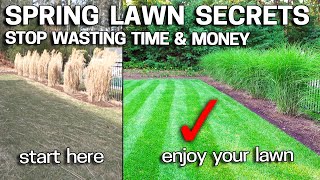
Overseeding sequence: Aerate first, then overseed, then fertilize (or use a starter fertilizer at seeding time). This is the correct order. Seed falls into the aeration holes for better soil contact.
What newly seeded areas look like: Small green spikes pushing up within 7-21 days (germination time varies significantly by grass species: ryegrass germinates in 5-10 days, Kentucky bluegrass takes 14-28 days). The area looks like a green haze appearing first, then individual blades separating. Do not mow overseeded areas until new grass reaches 3 inches.
First fertilizer application:
- When: When soil is 55+ degrees and grass is actively growing
- What: Quick-release nitrogen (Scotts Turf Builder, Vigoro Lawn Food) for fast green-up, or slow-release (Milorganite) for gentler feeding with less burn risk
- How much: Follow bag directions exactly. Over-application burns grass -- you'll see brown or yellowed stripes exactly where you over-fertilized
- What it looks like after feeding: A visible green-up within 4-7 days for quick-release fertilizer. The whole lawn should look uniformly darker green within 2 weeks. If you see stripes, the spreader setting needs adjustment.
Second feeding (4-6 weeks after first): Apply Scotts Weed & Feed or a stand-alone broadleaf weed killer if you see dandelions, clover, or other broadleaf weeds emerging. What broadleaf weeds look like in spring: Round-leaved plants with different leaf texture than grass, growing in distinct patches or rosettes. Dandelion leaves are toothed and flat to the ground. Clover has three round leaflets. Creeping Charlie has scalloped round leaves and a distinctive minty smell when crushed.
At a Glance
| # | Product | Award | Price | Our Score | |
|---|---|---|---|---|---|
| 1 | 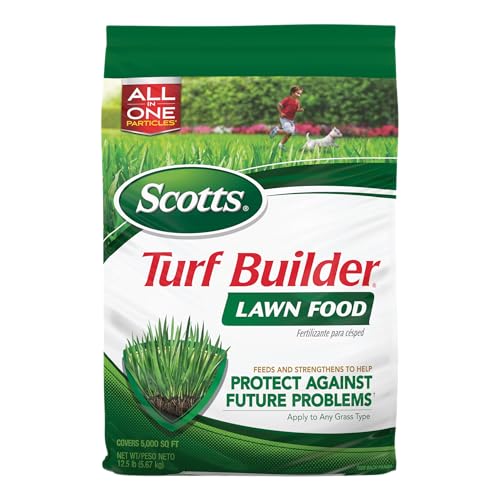 Scotts Turf Builder Lawn Food Fertilize… Scotts Turf Builder Lawn Food Fertilize… |
Best Overall | $20 | 9.2 | Buy → |
| 2 | 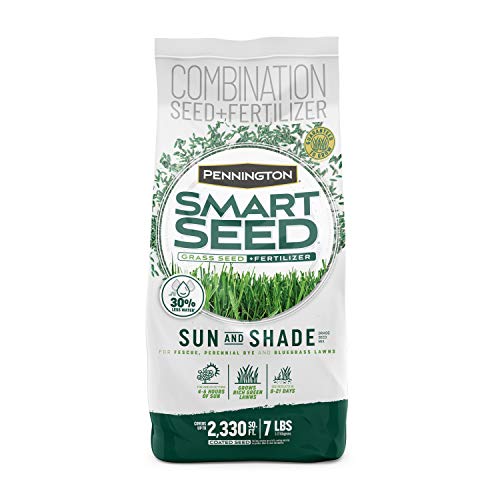 Pennington Smart Seed Sun and Shade Gra… Pennington Smart Seed Sun and Shade Gra… |
Best Overseeding Mix | $27 | 8.9 | Buy → |
| 3 | 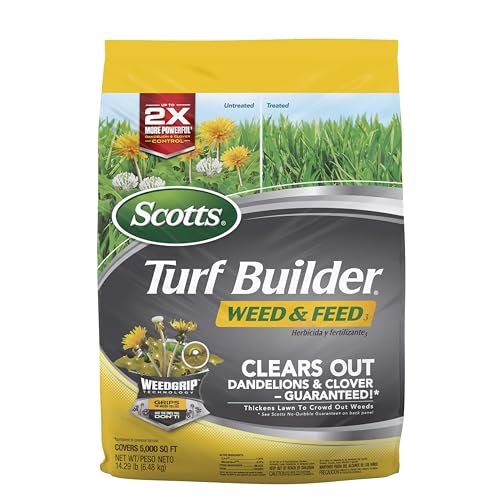 Scotts Turf Builder Weed & Feed3 Fertil… Scotts Turf Builder Weed & Feed3 Fertil… |
Best Weed and Feed Combo | $22 | 8.2 | Buy → |
| 4 | 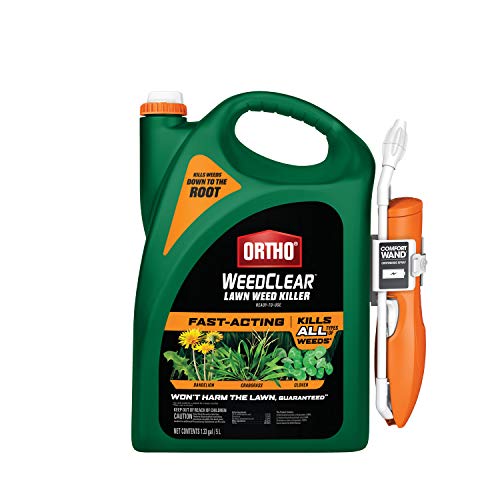 Ortho WeedClear Lawn Weed Killer Ready-… Ortho WeedClear Lawn Weed Killer Ready-… |
Best Spot Weed Killer | $22 | 7.8 | Buy → |
Showing 4 of 4 products
Scotts Turf Builder Lawn Food Fertilizer 5000 sq ft 12.5 lb
“The go-to granular lawn fertilizer for established lawns. Feeds for up to 3 months per application — use a spreader for even coverage and water in immediately to prevent burning.”
See Today’s Price →What we like
Watch out for
Read Full Analysis
Scotts Turf Builder is the most widely used consumer lawn fertilizer in the United States, and its position as Best Overall on a spring lawn care page is grounded in practical consistency — it is available everywhere, the application instructions are clear, and the results are predictable for cool-season grass types (Kentucky bluegrass, tall fescue, perennial ryegrass). The quick-release nitrogen formula drives green-up within 4-7 days of application when soil temperatures reach 55 degrees Fahrenheit — the threshold at which cool-season grasses come out of dormancy and can absorb nutrients actively. The 12.5 lb bag covers 5,000 square feet with a broadcast spreader at the recommended setting. Compared to Milorganite Organic in this lineup, Scotts Turf Builder releases nitrogen faster for a more immediate visual result but carries a higher risk of burning the lawn if over-applied or applied in heat. Versus Scotts Weed & Feed on this page, plain Turf Builder is the right choice when weeds are not yet present — applying herbicide when not needed wastes money and can stress the lawn. The Pennington grass seed on this page addresses bare patches; fertilizer feeds the existing turf. Best for established cool-season lawns coming out of winter dormancy in spring.
Pennington Smart Seed Sun and Shade Grass Mix 7 lb
“A versatile sun-and-shade blend that covers open lawn and partially shaded spots in one purchase. Smart seed coating reduces watering frequency versus uncoated seed — practical for mixed-exposure lawn”
See Today’s Price →What we like
Watch out for
Read Full Analysis
Pennington Smart Seed Sun and Shade is the overseeding mix in this spring lawn care lineup — used after Scotts Turf Builder feeds the existing turf, this seed blend fills the bare spots and thin areas that become visible after winter. The Sun and Shade blend combines tall fescue (for open sunny areas) with Kentucky bluegrass (for partial shade), making it a single-purchase solution for lawns with mixed light exposure rather than needing separate sun and shade formulas. The Smart Seed coating reduces watering frequency versus uncoated seed — relevant for spring overseeding when rain is inconsistent. Germination in 7-14 days on prepared soil. For best results, core aeration before overseeding creates the seed-to-soil contact that dramatically improves germination rates — grass seed sitting on top of thatch germinates poorly. In this lawn care page context, the seed is the repair step while Scotts Turf Builder is the maintenance step — a complete spring program uses both. The Milorganite organic fertilizer option can serve as a gentle initial feed for newly seeded areas since it cannot burn emerging seedlings. Compared to store-brand seed mixes, Pennington's Smart Seed coating is a meaningful upgrade for spring conditions where soil temperature and moisture are variable. Best for Zone 5-7 lawns with bare patches, thin coverage, or overseeding goals in spring.
Scotts Turf Builder Weed & Feed3 Fertilizer 14.29 lb, 5,000 sq ft
“Scotts Weed & Feed3 combines a broadleaf weed killer with Scotts lawn fertilizer — treating dandelions, clover, and chickweed while feeding the grass in one pass with a broadcast spreader. The 14.29 l”
See Today’s Price →What we like
- Kills weeds and feeds lawn in one application
- Covers 5,000 sq ft per bag
- Kills dandelions, clover, chickweed, plantain
- Works with any broadcast spreader
Watch out for
- Must be applied when lawn is wet for weed killer absorption
- Do not apply to newly seeded grass or it will kill new seedlings
Read Full Analysis
Scotts Weed & Feed3 is the two-in-one time-saver in this spring lawn care lineup — it applies broadleaf weed killer and lawn fertilizer in a single broadcast spreader pass rather than requiring two separate applications a week apart. The herbicide component targets dandelions, clover, chickweed, and over 50 other broadleaf weeds without harming established grass. The key application requirement is that the lawn must be moist when applied — weed and feed herbicide adheres to and absorbs through wet weed foliage, not dry. Either apply after morning dew or water the lawn lightly beforehand, then wait 24 hours before the next watering. In this spring lawn care page, Weed & Feed is the right tool when weeds are already present and you need to fertilize anyway — the combination saves time and the cost difference versus buying separate products is small. When weeds are not yet present, plain Scotts Turf Builder is the better choice — there is no reason to apply herbicide proactively. Compared to the Ortho WeedClear spray in this lineup, Weed & Feed covers the entire lawn in one application while Ortho spot-treats individual weeds. For a lawn with widespread weed coverage (clover patches throughout, dandelions in multiple zones), broadcast Weed & Feed is more efficient. For isolated patches in an otherwise clean lawn, Ortho spot treatment is less disruptive. Best for lawns with moderate-to-heavy broadleaf weed coverage needing both feeding and weed control simultaneously.

Ortho WeedClear Lawn Weed Killer Ready-to-Use with Comfort Wand 1.33 gal
“A selective lawn weed killer that targets broadleaf weeds while sparing most grass types. Kills dandelions, clover, and crabgrass without harming the lawn — a practical alternative to non-selective he”
See Today’s Price →What we like
Watch out for
Read Full Analysis
Ortho WeedClear Ready-to-Use is the spot treatment complement to the Scotts Weed & Feed in this spring lawn care lineup — where Weed & Feed handles broadcast applications when weeds are widespread, the Ortho comfort wand handles the single dandelion that appears in June after the spring Weed & Feed treatment, without retreating the entire lawn. The ready-to-use format means no measuring, no mixing, no dilution — open the cap, point the comfort wand nozzle at the base of the weed, spray. The selective formula kills over 200 broadleaf weed species while leaving established grass unharmed when used as directed. The 1.33-gallon bottle treats a substantial area and handles multiple spot applications throughout the growing season. In this lawn care page, the Ortho is the maintenance tool for the interval between scheduled fertilizer applications — a way to address weed emergence without disrupting the fertilizer calendar. Compared to Scotts Weed & Feed, Ortho is more precise and less disruptive to established turf — applying a broadcast herbicide more than twice a season stresses grass. Versus manual pulling, Ortho kills the root system rather than leaving root fragments that regrow. The comfort wand ergonomics reduce bending and hand fatigue for larger spot-treatment sessions. Best for spot-treating individual weed outbreaks between scheduled weed-and-feed applications.
Frequently Asked Questions
When should I apply pre-emergent herbicide in spring?
What does dethatching actually do and when do I need it?
How do I know if my lawn needs aeration?
What is the correct mowing height for spring?
Can I fertilize and overseed at the same time?
Why does my fertilized lawn have stripes?
How We Analyze Products
We analyze Amazon review data — often thousands of reviews per product — to surface patterns that individual buyers miss. Our process aggregates star ratings, review counts, and buyer sentiment at scale, identifying which strengths and weaknesses appear consistently across the largest review samples available.
Each product earned its placement through data: total review volume, average rating, and the specific praise and complaints that repeat most often across buyers. No manufacturer paid for placement on this page. Products appear here because buyers endorsed them at scale, not because a company asked us to feature them.
We use AI to summarize review sentiment — not to fabricate opinions, but to condense what thousands of buyers actually wrote into a readable format. The pros and cons you see reflect the most common themes found in verified purchaser reviews, paraphrased for clarity. We do not claim to have accessed Reddit, YouTube, or specific publications in generating these summaries.
Prices shown reflect Amazon pricing at the time this page was last generated. Click “See Today’s Price” to get the current live price on Amazon. Read our full methodology →