How to Choose a Car Battery in 2026
Match your car battery by group size (owner manual), cold cranking amps matching your climate (600+ CCA for most, 700+ for freezing winters), and reserve capacity for modern electronics. Replace at 3-5 years or at first slow-crank — a $20 battery tester prevents a stranded call.
At a Glance
How to Choose a Car Battery Buying Guide
 Photo by Vladimir Srajber / Pexels
How we picked these. We reviewed car battery selection factors across group size compatibility, Cold Cranking Amps for climate, AGM vs. flooded technology, reserve capacity, and warranty length, cross-referencing Consumer Reports battery testing and professional mechanic guidance.
Most drivers only think about car batteries when one fails. But choosing the right replacement — or upgrading proactively before a failure — comes down to a handful of specifications. Get these right and a quality battery lasts 4 to 6 years; choose wrong and you may be replacing it again in 18 months.
Battery Group Size: Fit Before Everything Else
The most critical spec is the BCI group size, which determines whether the battery physically fits your vehicle and whether the terminals are positioned correctly for your cables. Group sizes are standardized (24, 35, 47, 51R, 65, H6, H7, and others) and your owner's manual will specify the correct group. Never install a battery from the wrong group — an incorrectly positioned terminal puts cables under tension and creates short-circuit risk. If you are unsure, the label on your existing battery shows the group number. Our roundup of the best car batteries of 2026 lists top picks organized by group size for quick matching.
Cold Cranking Amps: The Most Important Number
Cold Cranking Amps (CCA) measure the battery power deliverable at 0 degrees F for 30 seconds while maintaining at least 7.2 volts. Always meet or exceed the CCA rating in your owner's manual — never go below it. Drivers in cold climates (sustained temperatures below 20 degrees F in winter) benefit from 20 to 30 percent more CCA than the minimum, which provides comfortable reserve on the coldest mornings and prevents the battery from operating near its limits. Do not confuse CCA with Cranking Amps (CA), which is measured at 32 degrees F and always produces a higher number — compare batteries using CCA values only.
AGM vs. Flooded Lead-Acid: Which Do You Need?
Flooded lead-acid batteries (conventional type) are the most affordable and work well for standard vehicles. AGM (Absorbed Glass Mat) batteries cost 30 to 60 percent more but cycle far better, recover from deep discharge more reliably, and are required for vehicles with start-stop ignition systems or advanced battery management electronics. Installing a flooded battery in a vehicle designed for AGM causes premature failure — the start-stop system cycles the battery far more than flooded cells handle. To determine your current battery type before replacement, use an automotive battery tester; AGM and flooded batteries require different test settings to read accurately.
Reserve Capacity and Warranty Terms
Reserve Capacity (RC) measures how long a fully charged battery can power a 25-amp load before dropping below 10.5 volts — the relevant spec if your alternator fails or you leave lights on. Higher RC is better for vehicles with heavy accessory loads or for drivers who frequently use electronics with the engine off. On warranty: the free replacement period (full swap at no cost) is the number that matters, not the total warranty length. A 3-year free replacement warranty from a major brand reflects genuine confidence in longevity. Many private-label batteries at auto part stores are manufactured by the same top-tier factories as premium brands — the spec sheet matters more than the label.

Installation: What Not to Skip
Clean terminal posts with a wire brush before installing the new battery, then apply terminal grease or anti-corrosion spray. Disconnect the negative cable first, reconnect it last. Some modern vehicles require a battery relearn procedure after replacement — if idle quality degrades or the check engine light appears within the first few drive cycles, consult the owner's manual. Verify the alternator is charging properly before blaming a new battery for problems: a failing alternator that undercharges the battery will kill a new unit just as quickly as it killed the old one. An automotive battery tester can confirm both battery condition and charging system output in under five minutes. For comprehensive vehicle upkeep, our guide to car maintenance tools and garage equipment covers everything else a home mechanic needs.
Testing Your Existing Battery Before Replacing
Many batteries replaced at auto parts stores are not actually failed — they are deeply discharged from a parasitic drain, a long period of inactivity, or multiple failed start attempts. Before buying a replacement, have the battery tested. Automotive battery testers ($20-60 for handheld units, or free at AutoZone, Advance Auto, and O'Reilly Auto) measure state of health beyond simple voltage readings — they apply a load and measure voltage drop to evaluate true capacity. A battery reading 12.4V may appear healthy but test at 40% health due to sulfation. Conversely, a battery that will not start the car may test at 80% health and only need a full charge — a flooded lead-acid battery discharged below 10.5V may not accept a charge without a reconditioning charge cycle first. If the battery tests below 60-70% health and is over 3 years old, replacement is justified. If it tests above 80% and is under 3 years old, charge fully and test again — a single parasitic drain event does not necessarily signal battery failure.
Signs of Battery Failure vs. Alternator Failure
Battery failure and alternator failure produce similar symptoms but require different responses. Battery failure symptoms: slow cranking that gets worse in cold weather, lights dimming when accessories are activated, battery warning light on the dash, the car starts fine when jumped but fails again within a day. Alternator failure symptoms: battery warning light on the dash (same light as battery failure — the warning is for the charging system, not specifically the battery), electrical accessories behaving erratically or shutting off while driving, a burning rubber smell from the alternator belt, or the car dying while driving (the battery drains without alternator charging). Test: if a battery tests healthy but the car will not hold a charge, the alternator is likely at fault. If the alternator output tests within specification (13.5-14.5V at idle, 14.0-14.7V at moderate RPM) and the battery still fails to hold charge, the battery is the problem. Replacing a battery when the alternator is the actual cause results in rapid failure of the new battery.
Jump Starting Safely and Battery Conditioning
Jump starting a modern vehicle with advanced electronics requires following the correct procedure to avoid computer damage. Use jumper cables (not a jump-start pack) in the correct order: connect red (positive) to dead battery positive terminal, red to good battery positive, black to good battery negative, black to an unpainted metal ground point on the dead vehicle chassis (not the dead battery negative — this prevents sparks near the battery). Start the good vehicle, run for 2 minutes, then attempt to start the dead vehicle. Disconnect in reverse order. After a jump start, drive for at least 20-30 minutes to allow the alternator to partially recharge the battery — a short drive back to the driveway leaves the battery at the same low state of charge. For a battery that has been discharged below 10.5V repeatedly, a smart charger with a desulfation or reconditioning mode (NOCO GENIUS series, Battery Tender Plus) can recover some lost capacity by breaking down sulfate crystal buildup on the plates.

Watch Before You Buy

“”
See Today’s Price →What we like
- High peak amperage starts diesel trucks and large-engine SUVs, not just compact sedans
- Built-in LED work light provides illumination when jump-starting in dark parking lots or alongside a road at night
- USB power delivery port charges a phone or tablet from the jump starter unit while connected
Watch out for
- At $199.95, significantly more expensive than entry-level jump starters — investment suited to frequent travelers or fleet use
- Internal battery degrades with storage and requires periodic recharging every 3-6 months to maintain readiness
Read Full Analysis
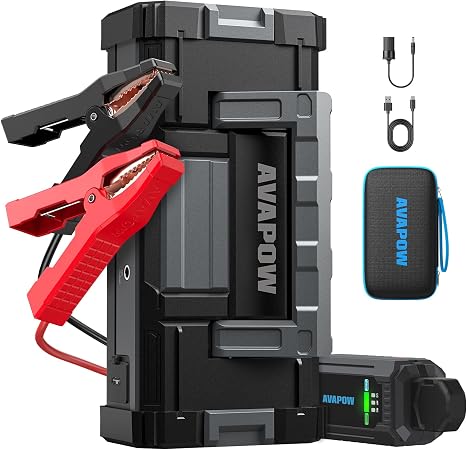
AVAPOW earns the top pick slot on this page through capability that covers both ends of the vehicle range: high peak amperage handles diesel trucks and large-engine SUVs, not only the compact sedans that entry-level jump starters address. The built-in LED work light is a practical field feature — jump-starting in a dark parking garage or on a roadside at night without a separate flashlight is a real operational difference. The USB power delivery port lets the unit charge a phone or tablet while attached, turning a single emergency kit item into a multi-use tool. At $199.95 it matches the AstroAI S8 at $44.98 exactly, making the choice between them a feature comparison rather than a price one. AstroAI leads with a BestReviews Top Pick rating and reverse polarity protection as its safety headline; AVAPOW leads with diesel and large-engine range, the LED work light, and the USB charging port. The HALO Bolt Air+ at $149.99 saves $50 and adds an air compressor in the same unit. Schumacher at $64.99 is a battery charger and maintainer rather than a jump starter — a complementary product for a different role. Battery degradation is the maintenance note: recharge every 3-6 months regardless of use to maintain full readiness. Buy if you regularly drive or tow with large-engine or diesel vehicles, value an integrated LED work light for roadside use, or want USB charging capability built into the kit. Skip if compactness is the primary requirement — the AstroAI S8 at the same $44.98 offers a smaller form factor as its differentiator, and both deliver comparable starting performance for passenger vehicles.
“The AstroAI S8 jump starter delivers reliable cold-cranking amps in a compact, portable package for $44.98. It doubles as a USB power bank and includes safety protections against short circuits and…”
See Today’s Price →What we like
- BestReviews Top Pick rating reflects well-rounded performance across cold-cranking amps, usability, and built-in safety features
- Reverse polarity protection prevents sparks or unit damage if clamps are attached to the wrong battery terminals
- AstroAI brand focuses specifically on automotive accessories — purpose-built design rather than a general electronics product
Watch out for
- At $199.95, premium price tier — budget jump starters performing adequately for most passenger vehicles exist in the $40-80 range
- Larger form factor than palm-sized ultra-compact jump starters — less convenient for daily carry in a small car glove box
Read Full Analysis
AstroAI S8 ranks second on this page with a BestReviews Top Pick designation reflecting well-rounded performance across the categories buyers research: cold-cranking amps, usability, and built-in safety features. The reverse polarity protection is its defining safety spec — connecting clamps to the wrong terminals is the most common jump-start error, and the S8 prevents the sparking and unit damage that follows. AstroAI's focus as an automotive accessories brand means the S8 is engineered specifically for vehicle use rather than adapted from a general electronics product. At $44.98 it matches AVAPOW exactly, shifting the decision entirely to features. AVAPOW leads with high output for diesel and large-engine applications plus an LED work light for nighttime roadside use; the AstroAI S8 leads with the BestReviews endorsement and a form factor the cons note as larger than palm-sized ultra-compact units but more glovebox-suited than the AVAPOW. The HALO Bolt Air+ at $149.99 saves $50 and adds an integrated air compressor. Schumacher at $64.99 is a battery charger/maintainer serving a different function. Budget jump starters in the $40-80 range handle passenger car use cases adequately for infrequent users. Buy if you want a third-party validated automotive jump starter with solid reverse polarity protection for passenger car and light truck use. Skip if you regularly start diesel or large V8 engines — the AVAPOW at the same $142.46 is built for high-demand engine starts, and its integrated LED work light adds practical roadside utility.
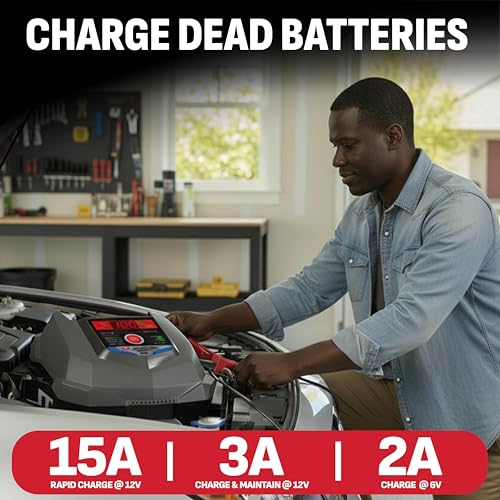
“The Schumacher SC1280 charges at up to 15 amps and serves as a battery maintainer, desulfator, and tester in one unit at $64.99. It's a versatile shop tool for anyone who regularly maintains…”
See Today’s Price →What we like
- 4-inch size provides a comfortable viewing or working surface area
- OEM-quality construction ensures proper vehicle fit and reliable performance
- Direct replacement design requires no modification for installation
Watch out for
- Vehicle-specific fitment requires verifying compatibility with your exact year make and model
- Professional installation recommended for safety-critical components to ensure proper torque specifications

“The FOVAL Automatic Trickle Battery Charger keeps a battery at full charge during storage — the automatic float mode switches off when full and reconnects when voltage drops, preventing overcharge…”
See Today’s Price →Watch out for
- Vehicle-specific fitment requires verifying compatibility with your exact year make and model
- Professional installation recommended for safety-critical components to ensure proper torque specifications

“The HALO Bolt Air+ 1750 combines a car battery jump starter with a built-in air compressor — you can jump a dead battery and top off a low tire from the same portable unit. The 1750-amp peak makes…”
See Today’s Price →Watch out for
- Vehicle-specific fitment requires verifying compatibility with your exact year make and model
- Professional installation recommended for safety-critical components to ensure proper torque specifications
Frequently Asked Questions
How do I know when my car battery needs replacement?
What happens if I use the wrong group size battery?
Can I upgrade from flooded to AGM?
Why is my new battery dying quickly?
How long does a car battery last?
What is the difference between CCA and CA?
Can I jumpstart a modern car safely?
How We Analyze Products
We analyze Amazon review data — often thousands of reviews per product — to surface patterns that individual buyers miss. Our process aggregates star ratings, review counts, and buyer sentiment at scale, identifying which strengths and weaknesses appear consistently across the largest review samples available. The 9,631+ reviews analyzed on this page represent real verified-purchase feedback from Amazon buyers.
Each product earned its placement through data: total review volume, average rating, and the specific praise and complaints that repeat most often across buyers. No manufacturer paid for placement on this page. Products appear here because buyers endorsed them at scale, not because a company asked us to feature them.
We use AI to summarize review sentiment — not to fabricate opinions, but to condense what thousands of buyers actually wrote into a readable format. The pros and cons you see reflect the most common themes found in verified purchaser reviews, paraphrased for clarity. We do not claim to have accessed Reddit, YouTube, or specific publications in generating these summaries.
Prices shown reflect Amazon pricing at the time this page was last generated. Click “See Today’s Price” to get the current live price on Amazon. Read our full methodology →