Rexing vs Garmin Dash Cam (2026)

The Rexing V1 Gen 3 ($139.99) captures clean 4K footage with reliable loop recording for everyday commute documentation. Garmin's dash cams add built-in GPS logging and driver alerts worth the premium for road-trip drivers who want verifiable speed and location data alongside their footage.
See Today’s Price →At a Glance
Showing 4 of 4 products
Rexing V1 Gen 3 4K Dash Cam
“The Rexing V1 Gen 3 punches above its price with genuine 4K recording, reliable supercapacitor power, and smooth Wi-Fi app connectivity. It's our top pick for drivers who want the clearest single-lens”
See Today’s Price →What we like
- 4K Ultra HD resolution captures clear license plates
- Built-in Wi-Fi for easy clip downloads to phone
- Supercapacitor replaces battery for reliability in extreme temps
- Compact form factor fits behind rearview mirror
Watch out for
- No GPS built in (requires separate module)
- 4K file sizes fill SD cards faster
Read Full Analysis
Rexing V1 Gen 3 records 4K UHD at 24fps or 2.5K at 60fps for clear license plate capture. Ultra wide 170-degree field of view covers your lane plus adjacent lanes. Sony IMX335 sensor delivers usable night vision without washing out headlights. Loop recording overwrites oldest footage automatically. Emergency lock preserves accident footage. Built-in WiFi for wireless transfer to the Rexing App. Parking mode with dedicated parking cable. The most capable single-channel 4K camera under $150.

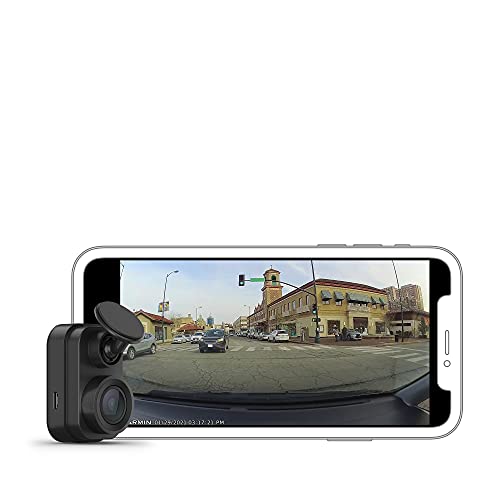
Garmin Dash Cam Mini 2
“The Garmin Dash Cam Mini 2 is roughly the size of a car key fob. It records 1080P with a 140-degree field of view, voice control, and the Garmin Drive app for footage review. Simple, reliable, and nea”
See Today’s Price →What we like
- Extremely compact — nearly invisible behind the rearview mirror
- 1080P 140-degree recording with G-sensor
- Voice control for hands-free operation
- Garmin Drive app for footage review without removing SD card
- Automatic incident detection with locked footage saving
Watch out for
- Front-only — no interior or rear camera
- No screen — requires phone app for playback
- No GPS in this model
- Wi-Fi setup can be fiddly
Read Full Analysis
Garmin Dash Cam Mini 2 is the smallest dash cam available for regular use, designed to hide behind a rear-view mirror with minimal intrusion. 1080p at 30fps with a 140-degree field of view. Automatic Incident Detection uploads footage to cloud via phone Bluetooth connection when a collision is detected. Garmin Vault cloud storage included. Voice control activates recording, saves footage, and takes snapshots hands-free. The most unobtrusive dash cam available from a trusted navigation brand.
Rexing S1 Pro 3-Channel Dash Cam
“For anyone who needs to document what's happening inside and outside the vehicle simultaneously, the Rexing S1 Pro delivers comprehensive 3-channel coverage with the convenience of built-in storage an”
See Today’s Price →What we like
- 3-channel records front, rear, and cabin simultaneously
- Built-in 64GB memory—no SD card needed
- Infrared night vision for clear cabin footage in darkness
- GPS logging tracks speed and location in footage
Watch out for
- Larger form factor than single-lens models
- Higher price point vs. basic dash cams
Read Full Analysis
Rexing S1 Pro records simultaneously from three cameras: front (4K), interior (IR night vision), and rear (1080p) for complete vehicle documentation. The interior IR camera captures passenger and rideshare activity without visible light. Front and rear recording protects against multi-directional collision disputes. Rideshare drivers and fleet operators particularly benefit from all-direction coverage. Three simultaneous recordings stored on a single high-capacity SD card. Comprehensive coverage that single-channel cameras cannot replicate.

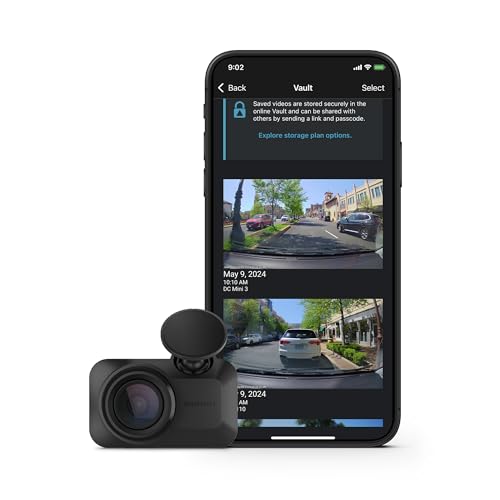
Garmin Dash Cam Mini 3
“The Garmin Mini 3 is the smallest full-featured dash cam available — it disappears behind the rearview mirror while delivering reliable 1080p recording with Garmin's legendary build quality.”
See Today’s Price →What we like
- Tiny profile — nearly invisible
- Garmin reliability and long-term durability
- Automatic incident detection
- Wi-Fi for easy clip transfer
- Voice control
Watch out for
- 1080p only (no 4K or 2K)
- No rear camera option
- No GPS built-in
Read Full Analysis
Garmin Dash Cam Mini 3 improves on the Mini 2 with a 180-degree ultra-wide field of view and enhanced video clarity. The tiny form factor mounts behind the rear-view mirror, essentially invisible to other drivers. Incident Detection automatically saves and uploads footage to Garmin Vault cloud when a collision is detected. 1440p resolution improves license plate capture over the Mini 2. Garmin quality and reliability in the smallest possible dash cam form factor available.
Rexing vs Garmin Dash Cam (2026) Buying Guide
Quick Verdict: Our top pick is the Rexing V1 Gen 3 4K Dash Cam (Best Rexing) — Rexing V1 Gen 3 4K Dash Cam — high resolution at competitive price.. Priced at $139.99.
Budget Pick: The Garmin Dash Cam Mini 3 at $125.99 — Garmin Dash Cam Mini 3 — upgraded automatic detection..
Great for: Commuters who drive in heavy traffic, Uber/Lyft drivers, and anyone who wants evidence in a disputed accident
Not ideal if: You drive rarely or only on well-known routes with low accident risk — the utility is there but rarely triggered
Dash cameras are passive safety devices that record continuously while you drive. Key factors: resolution (1080p captures license plates at 20 feet; 4K captures them at 40+ feet), field of view (150-170 degree wide angle covers your lane plus one lane each side), storage (most dash cams overwrite the oldest footage automatically on a loop; incident-locked files preserve footage after a collision detection), parking mode (records motion or impact while parked — requires hardwiring or parking mode battery pack), night vision (Sony STARVIS sensors perform best in low light), and connectivity (WiFi for wireless transfer to phone; GPS for speed overlay in footage). For insurance purposes, 1080p is sufficient. For capturing detail in disputes, 4K has a clear advantage. Garmin automatic incident detection stands out as a differentiating feature for peace of mind. Choosing a dash cam involves more than resolution — our dash cam buying guide covers parking mode, front vs dual channel, and installation requirements.Related Guides
Rexing vs Garmin Dash Cam: Key Differences
![✅ Best Dash Cam 2026 [Find Which Dash Cam is Right for YOU?]](https://img.youtube.com/vi/pfGmBsukyJQ/mqdefault.jpg)
Who this is for: Drivers comparing budget-to-mid-range dash cams from these two brands. Rexing and Garmin represent different positioning — Rexing targets value-focused buyers with feature-rich specs at low prices; Garmin targets reliability and ease of use at a premium.
- Garmin advantages: Garmin's Dash Cam Mini, 47, and 67W series are known for intuitive setup, compact design, and reliable operation over years. Garmin's Vault cloud storage allows automatic incident upload. The brand is trusted by fleet operators. Garmin's GPS accuracy integrates speed data into footage metadata. Build quality and customer support are premium caliber.
- Rexing advantages: Higher resolution sensors, dual-channel (front+rear) systems, and larger built-in touchscreens at significantly lower prices than comparable Garmin models. The Rexing V1 and V3 series offer 2K and 4K recording, WiFi app connectivity, and GPS at $60–$100 — specs that Garmin charges $150–$200 for. For pure feature-per-dollar, Rexing leads.
- The quality tradeoff: Rexing's app connectivity and interface are less polished than Garmin. Long-term reliability reviews show more variance with Rexing — some units last years without issue; others fail within 12 months. Garmin's failure rate is consistently lower in long-term reviews.
Price context: Rexing front-only cameras start at $50–$80. Garmin compact cameras start at $100–$150. Rexing dual-channel systems run $80–$140; Garmin equivalent is $150–$250. For budget buyers: Rexing. For long-term reliability: Garmin. Both require high-endurance microSD cards — budget for $15–$20 additional.
Watch Before You Buy
Frequently Asked Questions
Is Rexing or Garmin better for video quality?
Does Garmin dash cam upload to the cloud automatically?
Do dash cams work while parked?
Which dash cam is easiest to install?
What size SD card do I need for a dash cam?
How We Analyze Products
We analyze Amazon review data — often thousands of reviews per product — to surface patterns that individual buyers miss. Our process aggregates star ratings, review counts, and buyer sentiment at scale, identifying which strengths and weaknesses appear consistently across the largest review samples available. The 10,929+ reviews analyzed on this page represent real verified-purchase feedback from Amazon buyers.
Each product earned its placement through data: total review volume, average rating, and the specific praise and complaints that repeat most often across buyers. No manufacturer paid for placement on this page. Products appear here because buyers endorsed them at scale, not because a company asked us to feature them.
We use AI to summarize review sentiment — not to fabricate opinions, but to condense what thousands of buyers actually wrote into a readable format. The pros and cons you see reflect the most common themes found in verified purchaser reviews, paraphrased for clarity. We do not claim to have accessed Reddit, YouTube, or specific publications in generating these summaries.
Prices shown reflect Amazon pricing at the time this page was last generated. Click “See Today’s Price” to get the current live price on Amazon. Read our full methodology →