German vs Japanese Kitchen Knives: Complete Steel Guide (2026)
German knives (Wusthof, Henckels) are thicker, softer steel (56-58 HRC), more durable, easier to sharpen at home, and handle abuse like a pro. Japanese knives (Shun, MAC, Global) use harder steel (60-67 HRC) that takes a thinner, sharper edge — better for precision cuts, but more brittle and demanding of maintenance. Most Western home cooks do better with German. Cooks who prioritize edge sharpness and care for their tools gravitate Japanese.
German vs Japanese Kitchen Knives Buying Guide

Quick Verdict: Our top pick is the Victorinox Fibrox Pro 8-Inch Chef's Knife (Best Overall) — consistently top-rated in its category. Priced at $46.78.
This guide is for you if:
-
You want to understand the real difference between German and Japanese knives before spending $150+
-
You're buying your first serious chef's knife and want to know what actually matters
-
Your knives feel dull and you're not sure whether they need honing, sharpening, or replacement
Skip this guide if:

-
You already know your knife preference and just need a product recommendation
-
You're a professional cook — home kitchen trade-offs differ from restaurant use
Quick verdict: German knives (Wusthof, Henckels) are thicker, softer steel (56-58 HRC), more durable, easier to sharpen at home, and handle abuse like a pro. Japanese knives (Shun, MAC, Global) use harder steel (60-67 HRC) that takes a thinner, sharper edge — better for precision cuts, but more brittle and demanding of maintenance.


Most people buy a knife based on how it looks, what a friend recommended, or which brand they've heard of. This works fine until you realize your knife is dull after three months, or chips every time it touches a cutting board that's less than perfectly smooth, or that sharpening it requires equipment you don't have.
Understanding knife steel — even at a basic level — means you'll buy the right knife for your actual cooking style, know how to maintain it, and understand what you're paying for as price goes up.
The Steel Science: Hardness, Carbon, and Alloys
The core variable in knife steel is hardness, measured on the Rockwell C scale (HRC). Harder steel:
-
Is harder to sharpen (requires finer abrasives)
The "right" hardness is not the highest one — it's the one that matches how you actually use and care for your knives.
All knife steel is iron with added carbon. Carbon increases hardness. Low-carbon stainless steel (like a cheap chef's knife or a machete) won't hold a sharp edge for long. High-carbon steel holds an edge beautifully but rusts without maintenance.
Most quality kitchen knives use high-carbon stainless steel — the addition of chromium (for rust resistance) while maintaining enough carbon for a quality edge. The art is in the alloying: balancing hardness, toughness, rust resistance, and sharpenability.
The dominant German knife steel is X50CrMoV15 — the industry standard alloy used by Wusthof, Zwilling J.A. Henckels, Messermeister, and most German/European knife manufacturers.
Breaking down the designation:
- X = stainless (chromium content over 11%)
- 50 = 0.50% carbon content
- Cr = chromium (~15%)
- Mo = molybdenum (for edge retention)
- V = vanadium (for wear resistance)
- 15 = 15% chromium content
Hardness: 56-58 HRC (the range varies slightly by manufacturer and heat treatment) Edge retention: Good. A properly sharpened German knife holds an edge through regular home cooking use for weeks to months between touch-ups on a honing rod. Toughness: Excellent. The lower hardness means the steel has more flexibility and ductility. It bends slightly under stress rather than chipping. This makes German knives far more forgiving of cutting board contact, bone contact, and general rough handling. Sharpening: Easy. 56-58 HRC steel responds well to medium-grit whetstones (800-1200 grit), ceramic honing rods, and pull-through sharpeners. You don't need specialized Japanese water stones or expert technique. Rust resistance: Very good. The high chromium content means German knives resist rust even with occasional improper drying. Not dishwasher-safe (no knife is), but far more forgiving of moisture than carbon steel.
Beyond steel, German knives are designed with a specific philosophy:
- Thicker spine (2-3mm vs 1-2mm for Japanese)
- Curved belly that enables rocking cuts
- Full bolster on most models (the thick junction between blade and handle) — adds weight and a natural finger guard
- Edge angle: 14-16° per side (Wusthof sharpens to 14°, others at 15-16°)
The thicker geometry makes German knives slightly less keen at the edge than Japanese knives, but significantly more durable. The rocking motion it encourages (tip on board, rocking back) suits the fast prep work most Western cooks use.
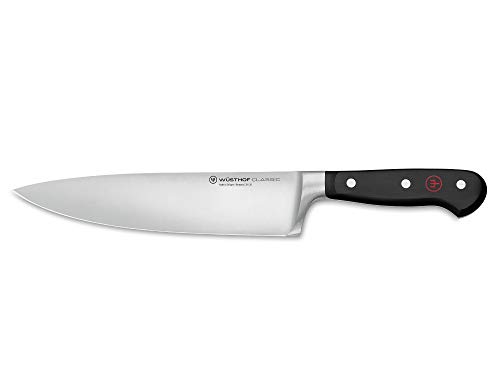
Wusthof Classic: The benchmark. Made in Solingen, Germany since 1814. The Classic line uses X50CrMoV15, full bolster, and Wusthof's laser-controlled edge (14° per side). About $150-190 for an 8-inch chef's knife. Zwilling J.A. Henckels: The other Solingen giant. The Pro and Professional "S" lines use the same X50CrMoV15 at 57 HRC. The "S" stamped models (like Five Star) are stamped rather than forged — similar steel, lower cost. Victorinox Fibrox Pro: Swiss-made with a similar alloy at around 56 HRC. The professional workhorse of culinary schools. At $40-50 for an 8-inch, it outperforms knives costing three times as much in terms of value. Not as refined as Wusthof but performs excellently for the price. Messermeister: Less well-known, makes excellent forged German knives, often with slightly higher hardness specs (58-59 HRC) than Wusthof.
Watch Before You Buy
At a Glance


Showing 4 of 4 products
Victorinox Fibrox Pro 8-Inch Chef's Knife
“The Victorinox Fibrox Pro is the best value chef knife in existence. At $38, it out-performs knives costing 5x more on practical cutting tasks and is used in professional kitchens worldwide.”
See Today’s Price →What we like
- Best price-to-performance chef knife on market
- Slip-resistant Fibrox handle
- NSF certified for commercial use
- Extremely sharp from the box
- Lightweight at 5.8oz
Watch out for
- Stamped not forged — less bolster weight
- Handle is utilitarian, not elegant
- Requires more frequent honing than forged knives
Read Full Analysis
Victorinox Fibrox Pro 8-Inch Chef's Knife is the food service industry standard — used in commercial kitchens worldwide because it provides reliable sharpness, comfort, and durability at a price that makes replacement practical. The stamped steel blade (rather than forged) is thinner and lighter than the Wusthof Classic, with a textured fibrox handle that provides grip during wet food preparation. Victorinox factory sharpness is competitive with any knife at any price point out of the box; the steel's slightly softer HRC means it requires more frequent edge touch-ups than German forged alternatives but is easy to sharpen when needed. Against Wusthof Classic, Victorinox Fibrox is lighter and far less expensive — the rational choice for buyers who want a capable, reliable kitchen knife without the investment in forged German steel. For cooking schools, culinary students, and households that want a workhorse knife without premium pricing, Fibrox Pro is the most recommended budget chef's knife in the industry.
MAC Professional 8" Chef's Knife with Dimples MTH-80
“The MAC MTH-80 delivers the sharpest, longest-lasting edge in this comparison for cooks willing to learn proper Japanese knife maintenance.”
See Today’s Price →What we like
- MAC Original steel at 59-61 HRC holds an edge significantly longer than German knives
- Dimples (Granton edge) measurably reduce food sticking when slicing
- Western-style handle bridges comfort between European and Japanese designs
- Made in Japan with consistently tight manufacturing tolerances
Watch out for
- Requires a water whetstone for proper sharpening—honing rods don't work well on harder steel
- More chip-prone than German knives if used on hard foods or bones
Read Full Analysis
MAC Professional 8-Inch Chef's Knife with Dimples (MTH-80) is the Japanese-German hybrid that appeals to cooks who want Japanese sharpness in a more forgiving Western profile. The dimples along the blade reduce food adhesion — thinly sliced vegetables and proteins release from the blade rather than sticking and stacking. The 59 HRC hardness is between typical German (58) and harder Japanese steels (61+), providing sharper edge retention than German knives while being less prone to chipping than harder Japanese alternatives. Against Wusthof Classic, MAC MTH-80 is lighter with a noticeably sharper factory edge but requires more careful use on bones and frozen foods where German steel's thickness provides more protection. Against Shun Classic, MAC is thicker and more forgiving for aggressive use. For cooks who have used German knives and want to experience Japanese sharpness without the full commitment to Japanese knife technique, the MAC MTH-80 is the recommended bridge knife among culinary educators.

Frequently Asked Questions
What is Rockwell hardness and why does it matter for knives?
What steel does Wusthof use?
What is VG-10 steel?
Can I use a honing rod on a Japanese knife?
Is a more expensive knife always sharper?
What's the best knife for a beginner?
German vs Japanese: which cuts better?
What's Damascus steel in knives?
How We Analyze Products
We analyze Amazon review data — often thousands of reviews per product — to surface patterns that individual buyers miss. Our process aggregates star ratings, review counts, and buyer sentiment at scale, identifying which strengths and weaknesses appear consistently across the largest review samples available. The 19,547+ reviews analyzed on this page represent real verified-purchase feedback from Amazon buyers.
Each product earned its placement through data: total review volume, average rating, and the specific praise and complaints that repeat most often across buyers. No manufacturer paid for placement on this page. Products appear here because buyers endorsed them at scale, not because a company asked us to feature them.
We use AI to summarize review sentiment — not to fabricate opinions, but to condense what thousands of buyers actually wrote into a readable format. The pros and cons you see reflect the most common themes found in verified purchaser reviews, paraphrased for clarity. We do not claim to have accessed Reddit, YouTube, or specific publications in generating these summaries.
Prices shown reflect Amazon pricing at the time this page was last generated. Click “See Today’s Price” to get the current live price on Amazon. Read our full methodology →