Sous Vide Temperature Guide: Time and Temp for Every Protein (2026)
The Anova Culinary Sous Vide 3.0 Pro at $114.99 is the best sous vide device — 1200W heats large pots fast, Wi-Fi app control starts cooks remotely, and the clamp fits any pot. Reference temps: chicken thighs 165F for 1-4 hours, steak medium-rare 130F for 1-4 hours, salmon 125F for 45 minutes.
At a Glance
| # | Product | Award | Price |
|---|---|---|---|
| 1 | Best WiFi | $95.99 Buy → |
|
| 2 |  Anova Culinary Sous Vide Precisio… Anova Culinary Sous Vide Precisio…Anova Culinary |
Our Top Pick | $114.99 Buy → |
| 3 |  Monoprice Sous Vide Immersion Coo… Monoprice Sous Vide Immersion Coo…Monoprice |
Worth Considering | $43.49 Buy → |
| 4 |  Greater Goods Kitchen Sous Vide M… Greater Goods Kitchen Sous Vide M…Greater Goods |
Best Mid-Range | $89.99 Buy → |
| 5 | 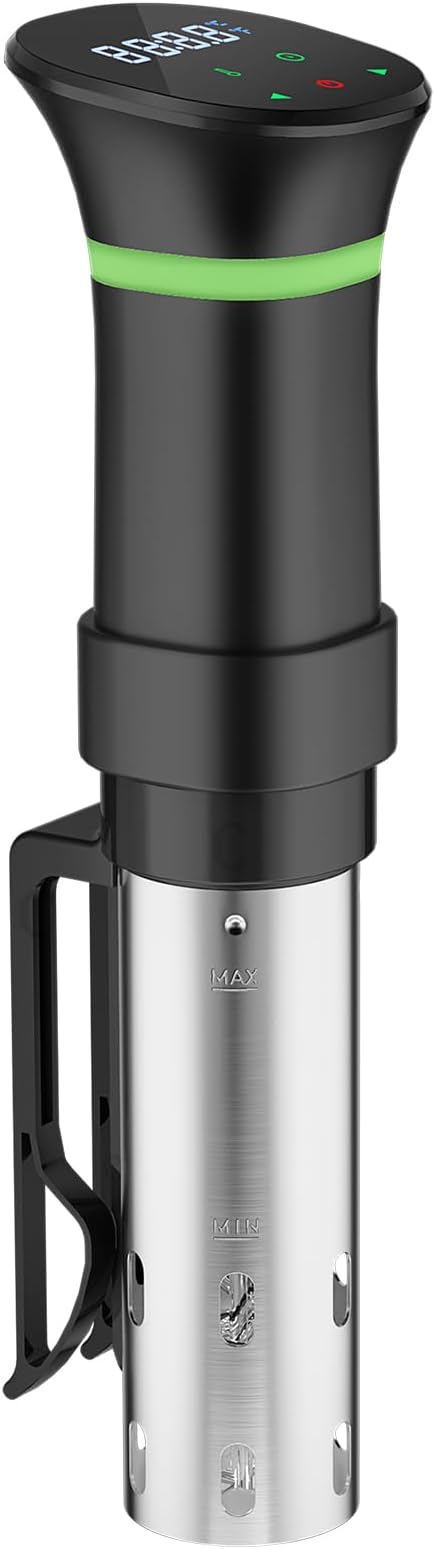 Sous Vide Machines, Sous Vide Coo… Sous Vide Machines, Sous Vide Coo…Vpcok Direct |
Best Budget | $49.99 Buy → |
Sous Vide Temperature Guide Buying Guide
 Photo by Ronaldo Guiraldelli / Pexels
Sous vide (French for "under vacuum") cooks food sealed in a bag submerged in temperature-controlled water. The precision means proteins cook evenly edge-to-edge, never drying out from overshooting temperature. The tradeoff is time — sous vide takes longer than traditional methods, but most of that time is passive. This guide covers the temperatures and times that produce the best results.
Steak Temperatures and Times
Steak is where sous vide's advantage over traditional cooking is most dramatic. An overcooked edge-to-center gradient disappears — the entire steak is the same temperature throughout.
125°F (52°C) — Rare: Bright red, very soft. 1–3 hours. For those who genuinely like rare steak; the center will be consistent red throughout, unlike pan-seared rare which has a warm center but hot surface.
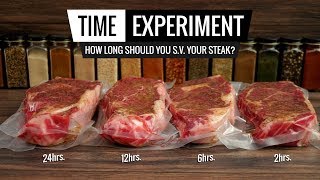
129–130°F (54°C) — Medium-Rare: The most popular target. Pink, tender, maximum juiciness. 1–4 hours. Most steak cuts peak at 1.5–2 hours; longer does not improve results for cuts under 1.5 inches. Ribeye at 129°F for 2 hours, finished in a screaming-hot cast iron for 60 seconds per side, is often cited as the best steak achievable at home.
135°F (57°C) — Medium: Pink-to-gray gradient beginning. 1–4 hours. Slightly firmer than medium-rare, still very juicy.
145°F (63°C) — Medium-Well: Mostly gray, firmer. The USDA's "safe" temperature for whole-muscle steak (though medium-rare at 130°F held for sufficient time is also safe by pasteurization tables). 1–3 hours.
Finishing: Pat completely dry (moisture prevents browning), sear in a screaming-hot pan (cast iron or carbon steel) with high smoke-point oil for 45–90 seconds per side. The sear is essential — sous vide alone produces no crust. Some people use a kitchen torch for finishing; the pan produces better Maillard reaction.
Minimum thickness: Sous vide is most effective for steaks 1 inch or thicker. Thin steaks cook so quickly in a pan that the precision advantage is minimal.
Chicken Temperatures and Times
Sous vide transforms chicken breast from a dried-out protein into something genuinely juicy — this may be the single biggest use case.
The USDA vs. pasteurization table discrepancy: USDA says cook chicken to 165°F. This is an instant-kill temperature. But chicken is also safe when held at lower temperatures for longer — 145°F for 9.2 minutes pasteurizes chicken. Sous vide enables this: cook at 145°F for 1.5 hours, and the chicken is food-safe AND far juicier than 165°F chicken.
140°F (60°C): The controversial low end. Very juicy, slightly custardy texture. Requires holding at temperature for at least 30 minutes for food safety. Popular with food safety-aware home cooks.
145°F (63°C): The recommended sweet spot. Juicy, safe with proper holding time, still notably better than oven-cooked. 1.5–3 hours. This is the default recommendation for most home cooks.
150°F (66°C): More traditional texture, still juicy by traditional standards. Safe quickly. 1–3 hours. Best for people who find 145°F texture slightly unfamiliar.
165°F+ (74°C): USDA instant-safe temperature. Produces dry chicken — no advantage over oven cooking. Don't use sous vide for this temperature; it eliminates the method's entire benefit.
Chicken thighs: 165°F for 1–4 hours — thighs have collagen that benefits from higher temperature; the 145°F sweet spot is for breasts only.

Pork, Fish, and Other Proteins
Pork chops (1-inch): 140°F for 1–4 hours. Modern USDA standard is 145°F (reduced from the old 160°F recommendation in 2011). At 140°F with proper holding time, pork chops are safe and notably juicier than traditionally cooked. Finish in a hot pan like steak.
Pork tenderloin: 140°F for 1–2 hours. The most improved protein from sous vide — pork tenderloin is notoriously easy to overcook traditionally.
Salmon fillet: 120–125°F for 30–45 minutes. At 125°F, salmon is translucent at the center and extremely silky — different from traditional pan-seared salmon but preferred by many. For more traditional texture: 130°F for 30 min. Don't exceed 135°F or the texture becomes chalky.
Shrimp: 135°F for 30–45 minutes. Keeps shrimp plump and snappy rather than rubbery.
Duck breast: 135°F for 1–4 hours. The high fat content benefits from longer cook time. Finish skin-side down in a cold pan, bring to high heat to render fat — produces restaurant-quality crispy duck skin.
Lamb chops: 130°F for 1–2 hours for medium-rare.
Eggs and Vegetables
Soft-boiled (onsen tamago, Japanese style): 167°F for 13 minutes. White is barely set, yolk is jammy/runny. The classic ramen egg temperature. No bag needed — cook eggs directly in water.
Custard-style (63°C egg): 145°F for 45–75 minutes. Whites barely set, yolk completely liquid but warm. Classic French bistro presentation.
Pasteurized raw egg: 135°F for 75 minutes. Safe for Caesar dressing, mayo, and other raw egg preparations. No visible change in appearance but bacteria killed.
Vegetables: Sous vide vegetables cook at higher temperatures than proteins. Carrots: 185°F for 1 hour. Potatoes: 190°F for 1–2 hours. Corn: 183°F for 30–45 min. Asparagus: 180°F for 10–15 min. The advantage over blanching: vegetables cook in their own juices inside the bag, concentrating flavor.

Equipment: Circulators and Bags
Immersion circulators: The water heating and circulation device. Anova Precision Cooker Nano ($99–$130): the best entry-level circulator — accurate, reliable, compact, app-controlled. Anova Precision Cooker Pro ($114.99): commercial-grade for heavy users. Joule by Breville ($200–$250): smaller and more powerful, app-only control (requires smartphone). all five are accurate to ±0.1°F — more than sufficient.
Container: Any pot or container 4+ quarts works. A Cambro 12-quart container with a lid ($20–$25) is the standard sous vide vessel — tall enough for most proteins, clear so you can monitor, and cheap.
Bags: Vacuum sealer bags provide the best seal, but the water displacement method (seal Ziploc gallon bag until only a small opening remains, submerge to push out air, seal) works well for most proteins under 4 hours. FoodSaver vacuum sealer ($60–$80) with bags ($0.15–$0.25 each) is the step-up. See our best vacuum sealers for recommendations. For thermometers to verify sear temperatures, see meat thermometers.
Watch Before You Buy
“WiFi app control with 14 preset recipes. 4.4 stars from 5,266 Amazon reviews signal consistent reliability.”
See Today’s Price →What we like
- WiFi app control with 14 preset recipes
- 1000W heats water fast
- ±0.1°C temperature accuracy
- Ultra-quiet under 40dB
Watch out for
- App required for full feature access
- 2.4GHz WiFi only — no 5GHz
- Clamp can slip on thin pot edges
- No companion container included
Read Full Analysis
The Inkbird ISV-100W positions itself as the feature-rich mid-tier alternative to the Anova Pro at $114.99 — roughly $50 less, with WiFi app control, 14 preset recipes, ±0.1°C temperature accuracy, and a noise floor under 40dB that makes it quieter than many competitors. The app-guided preset recipes function similarly to the Anova ecosystem for common sous vide tasks, reducing the reference-table lookup that manual-only units require for new users. The 2.4GHz-only WiFi limitation is worth noting for households that have migrated to dual-band or 5GHz-preferred networks — setup may require temporarily connecting to the 2.4GHz band during pairing. The clamp is a minor concern on thin-walled containers where it has difficulty locking securely; a standard stock pot or cambro works without issues. At $168.96 with 1000W output versus the Anova's 1200W, the Inkbird heats water slightly slower under equivalent load but maintains temperature with equivalent precision once at target. The 4.4-star rating from 5,266 reviews indicates consistent real-world performance. For buyers who want WiFi connectivity and recipe guidance without the Anova price premium, the Inkbird is the direct alternative at a $50 discount.
“1200W output delivers substantial power for demanding tasks. Best suited for enthusiast buyers: home cooks who want reliable everyday kitchen performance from a practical well-built appliance.”
See Today’s Price →What we like
- 1200W output delivers substantial power for demanding tasks
- Easy to clean with dishwasher-safe or wipe-down components
- Compact countertop footprint fits most kitchen sizes
Watch out for
- Hand-wash recommended for some parts to extend coating or surface lifespan
- Counter space commitment may be challenging in very small kitchens
Read Full Analysis
The Anova Precision Cooker 3.0 Pro at $114.99 represents the professional-grade benchmark in the consumer sous vide market. The 1200W output is the highest on this page — a meaningful spec for batch cooking large cuts, multiple steaks simultaneously, or bringing a full container of water to temperature quickly from a cold start. Anova is the brand that popularized sous vide for home cooks, and the Pro model reflects that accumulated design knowledge: the clamp system fits a wider range of container walls securely, the flow rate keeps water circulating evenly without creating cold spots, and the build quality is rated for sustained professional use. Connectivity is a genuine asset on the Anova Pro. WiFi and Bluetooth connectivity links to the Anova app, which includes a large recipe library with pre-set time and temperature parameters — removing the uncertainty of finding the right temperature for a particular thickness of steak or chicken breast. For new sous vide users, the app-guided approach flattens the learning curve that makes the method intimidating. At $219, the investment is substantially above the Inkbird ($95.99) and Vpcok ($50) options on this page. The justification is build quality, brand reliability, the strength of the Anova cooking community and recipe ecosystem, and the 1200W output that outperforms the 1000W alternatives under load. Experienced cooks who already know their time-temperature targets will use the connectivity less, but the build and output hold up regardless. For a long-term primary sous vide setup, the Anova Pro is the safe choice that does not need replacement.
“Accurate circulator at $79.21 with ±0.1°C temperature precision — the Monoprice for sous vide cooks who want reliable performance without the Anova or Breville premium. WiFi app control; quiet motor…”
See Today’s Price →Watch out for
- Hand-wash recommended for some parts to extend coating or surface lifespan
- Counter space commitment may be challenging in very small kitchens
Read Full Analysis
The Monoprice Sous Vide Immersion Cooker at $43.49 delivers ±0.1°C temperature precision and WiFi app control at $50 below the Anova Culinary Precision Cooker on this page. The quiet motor circulates water consistently through multi-hour cooks without significant temperature drift — critical for proteins requiring sustained low-temperature holds of 12–24 hours. App control lets you monitor and adjust temperature remotely without returning to the kitchen, a practical advantage for long unattended cooks. Rank 3 on this page reflects the established Anova brand above it while the Monoprice holds the best-value WiFi-enabled position. At $43.49, the Monoprice ties the Inkbird ISV-100W WiFi model at the same price — two app-connected circulators at identical cost, both $50 below the Anova at $114.99. The Inkbird is newer and less brand-established; Monoprice carries broader recognition in budget tech hardware. The Vpcok at $50 on this page is the budget entry point but lacks app control. The $50 savings over the Anova delivers equivalent core functionality for users whose priority is precision and WiFi monitoring; the Anova adds value through brand support, a larger recipe community, and a more refined app ecosystem. Buy the Monoprice if you want WiFi-enabled sous vide precision without paying the Anova premium and are comfortable with a lesser-known brand. The ±0.1°C accuracy covers all standard sous vide applications from eggs to steak to fish. Skip it in favor of the Anova if brand reliability and long-term manufacturer support matter over a 5+ year circulator life — the $50 difference is a reasonable premium for peace of mind. The Inkbird at the same price is the other viable alternative if app connectivity is the deciding factor.
“Physical dial controls for cooks who prefer direct settings over app dependency — the Greater Goods for straightforward sous vide use without phone pairing. Compact design clamps to any pot from…”
See Today’s Price →Watch out for
- Hand-wash recommended for some parts to extend coating or surface lifespan
- Counter space commitment may be challenging in very small kitchens
“1000W output delivers substantial power for demanding tasks. Best suited for value-focused buyers: home cooks who want reliable everyday kitchen performance from a practical well-built appliance.”
See Today’s Price →What we like
- 1000W output delivers substantial power for demanding tasks
- Easy to clean with dishwasher-safe or wipe-down components
- Compact countertop footprint fits most kitchen sizes
Watch out for
- Hand-wash recommended for some parts to extend coating or surface lifespan
- Counter space commitment may be challenging in very small kitchens
Read Full Analysis
The Vpcok at $50 is the entry-level argument for sous vide — the lowest-cost way to determine whether the method fits your cooking style before committing to an Anova or Inkbird investment. The 1000W output is sufficient for standard home portions: a single steak, a couple of chicken breasts, or a batch of eggs. Temperature accuracy for basic sous vide tasks is adequate at this tier, though the Vpcok lacks the ±0.1°C precision and app connectivity of the Inkbird and Anova options. The honest case against the Vpcok is that sous vide at $50 tends to produce a good experience that immediately makes you want to spend more on a better unit — and at $50, you are halfway to the Inkbird at $95.99. For households that already know they want sous vide as a regular cooking method, the Inkbird or Anova provide meaningfully better build quality, connectivity, and long-term reliability. The Vpcok makes most sense as a gift, a trial purchase for an uncertain buyer, or a secondary unit for a dedicated cook who wants a backup without committing to a full-price second machine. At sous vide's standard low temperatures (129-165°F), a reliable budget unit like the Vpcok does produce proper results — the accuracy and build gap widens under sustained long-cook use and edge temperature scenarios.
Frequently Asked Questions
What temperature is sous vide steak medium rare?
Is sous vide chicken safe at 145°F?
Do you need a vacuum sealer for sous vide?
How long does sous vide take?
What equipment do I need to start sous vide?
Can you overcook food with sous vide?
How We Analyze Products
We analyze Amazon review data — often thousands of reviews per product — to surface patterns that individual buyers miss. Our process aggregates star ratings, review counts, and buyer sentiment at scale, identifying which strengths and weaknesses appear consistently across the largest review samples available. The 21,494+ reviews analyzed on this page represent real verified-purchase feedback from Amazon buyers.
Each product earned its placement through data: total review volume, average rating, and the specific praise and complaints that repeat most often across buyers. No manufacturer paid for placement on this page. Products appear here because buyers endorsed them at scale, not because a company asked us to feature them.
We use AI to summarize review sentiment — not to fabricate opinions, but to condense what thousands of buyers actually wrote into a readable format. The pros and cons you see reflect the most common themes found in verified purchaser reviews, paraphrased for clarity. We do not claim to have accessed Reddit, YouTube, or specific publications in generating these summaries.
Prices shown reflect Amazon pricing at the time this page was last generated. Click “See Today’s Price” to get the current live price on Amazon. Read our full methodology →