Best Guitar Pedalboards of 2026: Mini, Full & Power Supply

For players with 5+ pedals who gig regularly, the STRICH 15x11 Pedalboard with Power Supply ($79) is the best complete solution — the integrated power supply alone would cost $50-80 separately. For 3-5 pedal setups, the compact 15x5 version ($59) keeps the rig portable without sacrificing build quality. The 3-Loop True Bypass Switcher ($44) is worth adding for any player who changes multiple effects simultaneously between songs.
See Today’s Price →At a Glance


Showing 3 of 3 products
STRICH Guitar Pedal Board with Power Supply 15x11 in Aluminum 2.17 lb
“The larger STRICH board gives serious gigging guitarists a clean, powered platform for a full pedal rig.”
See Today’s Price →What we like
Watch out for
Read Full Analysis
The STRICH Guitar Pedal Board at 15x11 inches with Power Supply is the definitive answer for guitarists who have accumulated enough pedals to need organization. The aluminum construction is both rigid and lightweight — it won't flex under heavy pedals and won't add unnecessary weight to an already heavy live rig. The included power supply is the killer feature: most pedalboards require purchasing a separate power brick (Strymon Zuma, Voodoo Lab, etc.) which often costs more than the board itself. The integrated supply handles up to 8 pedals with isolated outputs — preventing the noise and ground loop issues that plague daisy-chain power cables. The 15x11 surface fits 6-8 standard-sized pedals depending on layout. At $79 it delivers a complete, gigging-ready board-plus-power solution at a price where comparable competitor setups would cost $150-200+. Best for: active gigging musicians and players with 5+ pedals.

STRICH Guitar Pedal Board with Power Supply 15x5 in Aluminum
“A tidy compact board with integrated power that eliminates a wall wart and cable mess for small rigs.”
See Today’s Price →What we like
Watch out for
Read Full Analysis
The STRICH Guitar Pedal Board at 15x5 inches with Power Supply is the compact alternative for guitarists who run 3-5 pedals and don't want to carry a half-empty large board. The 15x5 footprint handles a tuner, overdrive, delay, and reverb — the core four that most gigging players use — with room for one or two more smaller-format pedals. The same aluminum construction and integrated power supply as the larger model makes this a genuine quality compact option rather than a budget compromise. The narrower footprint also matters for stage use: less floor real estate means more playing room and easier positioning in tight stage configurations. At $59 it's $20 less than the full-size model for players who genuinely don't need the extra space. Best for: players with 3-5 pedals, weekend gigging, home studio use, and rehearsal setups where portability matters.

3-Loop True Bypass Guitar Effects Loop Switcher Pedal Channel Selector
“A clean true bypass loop switcher that fixes the tone-sucking problem of running many pedals in series.”
See Today’s Price →What we like
Watch out for
Read Full Analysis
The 3-Loop True Bypass Guitar Effects Loop Switcher Pedal Channel Switcher solves a specific problem that players with complex pedalboards face: turning multiple pedals on and off simultaneously between song sections. Instead of stomping 3-4 individual pedals between verse and chorus, a loop switcher routes multiple pedals through each loop and activates them with a single tap. True bypass is the critical qualifier: in bypass mode, the signal passes through the switcher without any electronic circuitry in the signal path — no tone coloration, no added noise. The 3-loop design handles the most common use cases: a rhythm loop, a lead loop, and a specialty effect loop. At $44 it's an upgrade that experienced players immediately recognize as useful; beginners may need to build their rig before the value becomes apparent. Best for: players who change their pedal configuration multiple times per set.
Guitar Pedalboards of Buying Guide
 Photo by Dominik Gryzbon / Pexels
Why Pedalboard Organization Matters
A disorganized collection of individual pedals on the floor creates real problems: cables get stepped on, power adapters unplug mid-set, pedals shift position causing wrong-pedal stomps, and setup time between venues becomes unreasonable. A proper pedalboard solves all of these: pedals are velcro-secured in fixed positions, cables are managed underneath the board, and a single power strip handles all power — the whole board plugs in with one IEC cable.
Pedalboard Sizing Guide

Match the board size to your pedal count:
- Under 12 inches wide: 2-3 standard pedals. Tuner + overdrive or two effects.
- 15x5 (compact): 3-5 standard pedals. The core four plus one specialty.
- 15x11 (mid-size): 6-8 standard pedals. Full gigging rig for most players.
- 18x12+ (large): 8-12+ pedals. Complex rigs with multiple overdrives, modulation, and utility pedals.
Buy one size up from your current pedal count — rigs tend to grow, and starting with a board that's already full is frustrating.
Power Supplies: Why Isolated Outputs Matter
The two types of pedal power:
- Daisy-chain cables: One power source splits into multiple connectors. Cheap and simple, but pedals share ground — creating noise, buzz, and ground loops that are nearly impossible to troubleshoot on a live stage.
- Isolated outputs: Each pedal gets its own independent power source from the supply. No shared ground, no noise bleed. The only way to guarantee a quiet rig.
The integrated power supplies in both STRICH boards provide isolated outputs. This is the primary reason they represent genuine value — isolated power supplies from brands like Strymon or Voodoo Lab cost $100-200 standalone.
True Bypass vs. Buffered Bypass Explained
When a pedal is switched off, its bypass circuit determines how your signal passes through it:
- True bypass: Signal passes through a mechanical switch with no electronic circuitry in the path. Preserves your original tone in bypass — but many true bypass pedals chained together can cause high-frequency signal loss from cable capacitance.
- Buffered bypass: Signal passes through a buffer circuit in bypass. Preserves signal integrity over long cable runs, but adds circuitry to the path — quality buffers are transparent; cheap ones color your tone.
For most players with 5-8 pedals and standard cable runs, both work fine. True bypass switchers are valuable because they allow you to add buffered pedals to loops while keeping the switcher itself transparent.
Signal Chain Order for Pedalboards
Standard signal chain order (guitar → pedals → amp):
- Tuner (mutes the signal, always first)
- Dynamics: compressor, noise gate
- Gain: overdrive, distortion, fuzz (in order of gain level)
- Modulation: chorus, flanger, phaser, tremolo
- Delay and reverb (always last — you want these after all other processing)
This is the convention, not a law — many players intentionally break this order for specific effects. Fuzz before a wah creates a different sound than wah before fuzz. Experiment deliberately rather than following the chain blindly.
Velcro Application Tips for Pedalboards
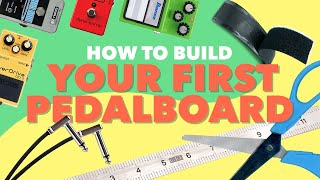
Most pedalboards come with loop-and-hook velcro for attaching pedals. Apply hook tape (rough side) to the board; apply loop tape (soft side) to pedals. Common mistakes: not cleaning the pedal bottom before applying velcro (oil and dust prevent adhesion), applying too little velcro (two small strips won't hold a heavy overdrive under stage vibration), and not pressing firmly for 30+ seconds when applying. For heavy or oversized pedals, a velcro tie-down through the pedalboard shelf adds security beyond adhesion alone.
Related Guides

Frequently Asked Questions
Do I need an integrated power supply or can I use individual power adapters?
What's true bypass and why does it matter?
How many pedals fit on a 15x11 pedalboard?
What's an effects loop switcher and who needs one?
Should I start with a pedalboard before buying pedals, or buy pedals first?
How We Analyze Products
We analyze Amazon review data — often thousands of reviews per product — to surface patterns that individual buyers miss. Our process aggregates star ratings, review counts, and buyer sentiment at scale, identifying which strengths and weaknesses appear consistently across the largest review samples available.
Each product earned its placement through data: total review volume, average rating, and the specific praise and complaints that repeat most often across buyers. No manufacturer paid for placement on this page. Products appear here because buyers endorsed them at scale, not because a company asked us to feature them.
We use AI to summarize review sentiment — not to fabricate opinions, but to condense what thousands of buyers actually wrote into a readable format. The pros and cons you see reflect the most common themes found in verified purchaser reviews, paraphrased for clarity. We do not claim to have accessed Reddit, YouTube, or specific publications in generating these summaries.
Prices shown reflect Amazon pricing at the time this page was last generated. Click “See Today’s Price” to get the current live price on Amazon. Read our full methodology →