How to Choose Running Shoes: Foot Type x Terrain x Distance Guide
Wet test your foot (wet it, step on paper, look at the print) to find your arch type, then match to a shoe category: flat feet to motion control, neutral arch to neutral shoe, high arch to cushioned. Road shoes for pavement, trail shoes for dirt. More weekly miles = more cushion.
How to Choose Running Shoes Buying Guide
 Photo by Jason Morrison / Pexels
This guide is for you if:
-
You're getting into running and need your first serious pair of running shoes
-
You've had knee or foot pain from running and suspect your footwear is the cause
-
You want to understand pronation types and cushion levels before buying a $150 shoe
Skip this guide if:
-
You're an experienced runner who already knows your foot type and preferences
-
You're looking for racing flats — this covers everyday training shoes
Quick verdict: Wet test your foot (wet it, step on paper, look at the print) to find your arch type, then match to a shoe category: flat feet to motion control, neutral arch to neutral shoe, high arch to cushioned. Road shoes for pavement, trail shoes for dirt.
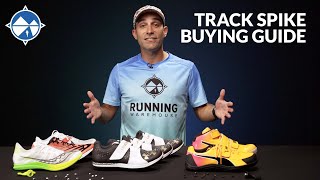
| Best For | |||||
| Foot Type | |||||
| Heel Drop | |||||
| Stack Height | |||||
| Outsole | |||||
| Price Range | |||||
| Our Pick |
## The Three-Variable Framework
Every poor running shoe purchase shares a common root cause: the buyer optimized for one variable and ignored the other two. They bought the shoe a training partner recommended (ignoring their own foot type). They bought road shoes and immediately took them on a muddy trail (ignoring terrain). They bought minimalist racing shoes for a daily 40-mile training week (ignoring distance and mileage demands).
The three variables are independent and multiplicative — a mistake in any one of them produces a suboptimal result regardless of how well you optimized the other two. A neutral shoe on a neutral foot is correct, but put that on a technical trail and you lose grip and rock protection. The same neutral shoe on a trail in moderate mileage works, but not at 50 miles per week where midsole compression becomes a fatigue and injury factor.
This guide works through each variable systematically and shows you how to match all five before spending money on footwear.
Variable 1: Foot type — determines what kind of support and cushion distribution you need. Variable 2: Terrain — determines outsole pattern, midsole stiffness, and upper durability requirements. Variable 3: Distance and weekly mileage — determines how much midsole cushioning and durability investment is justified.
## Foot Type: The Wet Test and What It Means
Your foot type is determined primarily by your arch height, which affects how your foot contacts the ground and rolls through each stride. The wet test is the most accessible diagnostic tool available outside a podiatrist office or specialty running store gait analysis.
How to perform the wet test: 1. Fill a pan or sink with about an inch of water. 2. Wet the bottom of one foot. 3. Step firmly onto a piece of cardboard, brown paper bag, or dark-colored towel. 4. Step off and look at the footprint.
Reading your footprint:
Full footprint (no arch gap, or very small gap): Your entire foot is making contact with the ground. This indicates a flat arch. Flat arches are associated with overpronation — the foot rolls inward excessively during the gait cycle. Overpronation is not necessarily a problem, but it means your foot needs medial support to prevent the excessive inward roll from stressing the ankle, knee, and hip over time.
Shoe match: Stability or motion control shoes. Stability shoes have a firmer foam section on the medial (inner) side of the midsole that limits inward roll. Motion control shoes are the most aggressive correction, appropriate for severe overpronation. For more detail on pronation-specific shoe selection, see our running shoe pronation guide.
Moderate arch (roughly half the foot width showing in the arch area): This is the neutral foot type. Most runners fall into this category. The foot pronates a normal amount during the gait cycle — enough to absorb shock, not so much that it stresses the joints.
Shoe match: Neutral cushioned shoes. The Brooks Ghost 16 is the benchmark neutral road shoe — consistent fit, reliable cushioning, appropriate for most runners logging 20-40 miles per week on road surfaces.
Very narrow arch connection (almost no band connecting heel and ball), or no contact in the arch area: This indicates a high arch. High-arch feet typically underpronate (also called supination) — the foot does not roll inward enough during the gait cycle, which means it absorbs shock less effectively through the arch and more through the outer edge of the foot and the joints.
Shoe match: Neutral to maximally cushioned shoes with flexible soles. High-arch feet need the shoe to do more of the shock absorption work. Stiff midsoles and motion control elements are actively harmful here — they prevent the foot from pronating at all, which makes the shock absorption problem worse. For specific options, see our best shoes for supination guide.
A note on gait analysis: The wet test gives you an arch-type indicator, not a complete gait analysis. Arch height predicts but does not guarantee pronation pattern. Some flat-footed runners are neutral in their gait; some normal-arch runners overpronate due to muscle weakness or previous injury. If you have a history of running injuries or significant knee, hip, or ankle pain during running, a treadmill gait analysis at a specialty running store is worth the 10 minutes it takes. Most stores do it free as part of the fitting process.
## Terrain: Road, Trail, and Track
Terrain determines the mechanical demands on the outsole and midsole of your shoe. Road and trail are fundamentally different environments, and a shoe optimized for one performs poorly in the other.
Road running shoes
Road shoes are designed for consistent, predictable surfaces: pavement, concrete, asphalt, treadmill belts. The design priorities are:
-
Smooth or lightly textured outsole for low rolling resistance on hard surfaces
-
Thick, consistent midsole cushioning to absorb repeated impact on hard surfaces
-
Lightweight upper materials optimized for breathability and fit, not abrasion resistance
-
Consistent heel-to-toe transition geometry for efficient forward propulsion
The Brooks Ghost 16 exemplifies the neutral road shoe: DNA Loft v3 foam throughout the midsole, moderate heel-to-toe drop (12mm), a roomy toe box that accommodates foot swell during long runs, and an engineered mesh upper that breathes well in warm conditions.
Watch Before You Buy

At a Glance
| # | Product | Award | Price | Our Score | |
|---|---|---|---|---|---|
| 1 |  Brooks Ghost 16 Men's Neutral Running Shoe Brooks Ghost 16 Men's Neutral Running Shoe |
Best Overall | $139 | 9.2 | Buy → |
| 2 |  Hoka Women's Bondi 8 Running Shoes White Hoka Women's Bondi 8 Running Shoes White |
Maximum Cushion | $165 | 8.9 | Buy → |
| 3 |  ASICS Gel-Nimbus 26 Running Shoe ASICS Gel-Nimbus 26 Running Shoe |
Best Stability | $74 | 8.7 | Buy → |
| 4 |  Brooks Cascadia 16 Trail Running Shoe Brooks Cascadia 16 Trail Running Shoe |
Best Trail | $109 | 8.5 | Buy → |
| 5 | 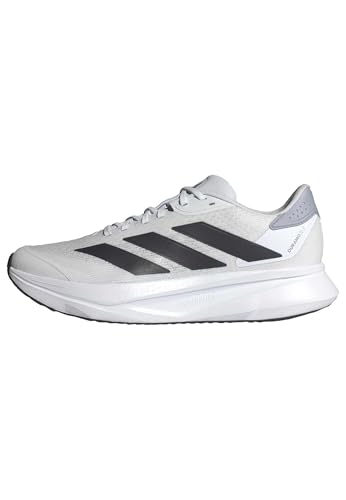 adidas Men's Duramo Sl 2 Running Shoe adidas Men's Duramo Sl 2 Running Shoe |
Best Budget | $52 | 8.1 | Buy → |
Showing 5 of 5 products

Brooks Ghost 16 Men's Neutral Running Shoe
“The most recommended men's running shoe — Brooks Ghost 16 is the trusted neutral trainer for everyday training miles.”
See Today’s Price →What we like
- Most trusted neutral trainer in running specialty stores
- DNA LOFT v2 cushioning balances cushion and responsiveness
- Consistent fit and quality across versions
- 300-500 mile durability confirmed by runners
Watch out for
- Not the lightest trainer (10.0 oz)
- May feel firm for max-cushioning seekers
Read Full Analysis
The Brooks Ghost 16 at $139.95 is the neutral training shoe that running specialty stores recommend to more customers than any other model — the recommendation persists because the shoe earns it. DNA Loft v3 cushioning absorbs impact without feeling soft underfoot, maintaining energy return for faster training paces while remaining comfortable for easy days. The segmented crash pad smooths heel-to-toe transition for overstrike and midfoot strikers alike. At 9.5 oz for a men's 9, it is not a lightweight speed shoe but is not heavy enough to fatigue legs on longer runs. Updated in the 16th iteration with a more breathable engineered mesh upper versus the Ghost 15, the fit through the toebox is slightly roomier — relevant for runners who found previous Ghost versions slightly narrow. For consistent 20-40 mile training weeks across a variety of paces, the Ghost 16 is the most reliable all-rounder in the $140 range.

Hoka Women's Bondi 8 Running Shoes White
“The Hoka Bondi 8 provides the highest cushioning level in the Hoka lineup — the widest, most protective stack for long training days, recovery runs, and extended standing. Extended Achilles Heel Prote”
See Today’s Price →What we like
- Maximum cushioning in the Hoka lineup
- Extended Achilles Heel Protector for reduced strain
- Wide base adds stability for longer standing and walking
- Full-length cushioning for all-day wear comfort
Watch out for
- Heaviest Hoka model — less responsive than Clifton
- Very high stack height — not suited for speed workouts
Read Full Analysis
The Hoka Bondi 8 at $165 is the maximum-cushion daily trainer — 39mm of stack height in the heel provides more underfoot protection than any other mainstream running shoe. For runners managing plantar fasciitis, knee pain, or recovering from injury, the Bondi's foam depth reduces peak impact forces meaningfully compared to standard-cushion alternatives. The extended heel protector reduces Achilles tendon strain for heel strikers and walkers who spend extended time on their feet. Despite the large stack, the rocker geometry maintains forward momentum naturally rather than forcing a flat-footed gait. At 10.8 oz for a women's 8, it is heavier than the Ghost 16 and not the right shoe for speed work or racing. The Bondi 8 is a daily trainer and recovery shoe for high-mileage runners, walkers, nurses, and anyone whose primary need is maximum underfoot protection for long days on their feet — for that use case specifically, nothing in the mainstream market offers more at $165.
ASICS Gel-Nimbus 26 Running Shoe
“The Gel-Nimbus 26 is ASICS' top-of-the-line daily trainer, engineered for runners who log serious miles and need maximum protection.”
See Today’s Price →What we like
- FF BLAST+ MAX foam delivers exceptional energy return
- PureGEL technology absorbs high-impact shock
- Engineered mesh upper provides targeted breathability
Watch out for
- Premium price point
- Stiff break-in period

Brooks Cascadia 16 Trail Running Shoe
“One of the most durable all-terrain trail running shoes for muddy, rooted, and rocky conditions. A reliable choice for trail races up to 50K in variable mountain terrain.”
See Today’s Price →
adidas Men's Duramo Sl 2 Running Shoe
“A reliable everyday training shoe from adidas at a competitive price — the Duramo SL 2 delivers lightweight comfort for gym sessions and casual running.”
See Today’s Price →Frequently Asked Questions
How do I know if I overpronate?
Should beginners buy stability or neutral shoes?
What is heel-to-toe drop and does it matter?
How many miles do running shoes last?
Is it worth spending $150+ on running shoes?
Can I use road running shoes for trail running?
How We Analyze Products
We analyze Amazon review data — often thousands of reviews per product — to surface patterns that individual buyers miss. Our process aggregates star ratings, review counts, and buyer sentiment at scale, identifying which strengths and weaknesses appear consistently across the largest review samples available. The 7,531+ reviews analyzed on this page represent real verified-purchase feedback from Amazon buyers.
Each product earned its placement through data: total review volume, average rating, and the specific praise and complaints that repeat most often across buyers. No manufacturer paid for placement on this page. Products appear here because buyers endorsed them at scale, not because a company asked us to feature them.
We use AI to summarize review sentiment — not to fabricate opinions, but to condense what thousands of buyers actually wrote into a readable format. The pros and cons you see reflect the most common themes found in verified purchaser reviews, paraphrased for clarity. We do not claim to have accessed Reddit, YouTube, or specific publications in generating these summaries.
Prices shown reflect Amazon pricing at the time this page was last generated. Click “See Today’s Price” to get the current live price on Amazon. Read our full methodology →