Best Ethernet Cables (2026)

Amazon Basics Cat 6 is the best ethernet cable for most homes: bare copper conductors, snagless RJ45 plugs and a 10 Gbps rating that already exceeds most home internet plans. Choose the Mediabridge Cat 6 instead if the cable has to run inside a wall - its CM-grade jacket is UL listed for in-wall installation.
See Today’s Price →At a Glance
| # | Product | Award | Price | Score |
|---|---|---|---|---|
| 1 | Amazon Basics RJ45 Cat 6 Ethernet… Amazon Basics |
Our Top Pick | $7.33 as of Nov 16, 2:14 PM CT details Buy → |
6.4 |
| 2 |  Mediabridge CAT6 Ethernet Patch C… Mediabridge |
Best for In-Wall Runs | $6.99 as of Nov 16, 1:59 PM CT details Buy → |
6.0 |
| 3 | Best Shielded | $7.99 as of Nov 16, 2:00 PM CT details Buy → |
6.1 | |
| 4 | Best Cat 8 | $13.99 as of Nov 16, 2:14 PM CT details Buy → |
6.1 | |
| 5 |  CableGeeker Cat 6 Flat Ethernet C… CableGeeker |
Best for Long Runs | $16.09 as of Nov 16, 2:01 PM CT details Buy → |
5.9 |
Score Breakdown
| Amazon Basics RJ45 Ca… | Mediabridge CAT6 Ethe… | UGREEN Cat 7 Ethernet… | Orbram Cat 8 Ethernet… | CableGeeker Cat 6 Fla… | |
|---|---|---|---|---|---|
| Overall | 6.4 | 6.0 | 6.1 | 6.1 | 5.9 |
| Range | 65 | – | 65 | 65 | 73 |
| Speed | 73 | – | 78 | 78 | 65 |
| Reliability | 55 | – | 40 | 40 | 40 |
Scores 0–100 from published specifications and independent reviewers' measurements. Amazon star ratings are shown separately and are never part of a score. 0 = feature not present. – = insufficient data. How we score →
Ethernet Cables (2026) Buying Guide
 Photo by Ann H / Pexels
Ethernet cables are the least exciting tech purchase you'll make, but they're also the easiest to get wrong. The category number (Cat 6, Cat 7, Cat 8) determines maximum speed and shielding level — not all are equal despite looking identical.
Cat 5e vs Cat 6 vs Cat 7 vs Cat 8
Cat 5e handles 1 Gbps at 100 meters — sufficient for gigabit internet. Cat 6 handles 1 Gbps at 100 meters and 10 Gbps at 37 meters — the right choice for most homes. Cat 7 adds individual pair shielding for 10 Gbps at 100 meters, but uses a non-standard connector that may not fit all devices. Cat 8 supports 25-40 Gbps for datacenter use — overkill for residential internet, but future-proof. For standard 1 Gbps home networks, a plain Cat 6 cable is the correct and cost-effective choice.
Shielded vs Unshielded Cables
Unshielded twisted pair (UTP) — Cat 5e and most Cat 6 — works fine in residential environments where cables don't run near power lines. Shielded cables (STP, SFTP) like Cat 7 and Cat 8 are valuable in commercial settings with dense electrical equipment. At home, unless you're routing ethernet cables inside walls alongside electrical wiring, unshielded Cat 6 performs identically to shielded alternatives at half the price.
Who Should Buy What
For gaming consoles, streaming boxes, and smart TVs: a standard Cat 6 cable such as Amazon Basics has no functional difference from a more expensive cable on gigabit internet. For home offices with long desk-to-router runs: CableGeeker's flat Cat 6 in a longer length routes cleanly along a wall. For NAS drives, 10G switches, or multi-gig internet plans: Orbram's Cat 8 gives you future headroom. For a run inside a wall: Mediabridge's Cat 6, whose jacket is UL listed for in-wall installation. For runs through electrical-dense areas: UGREEN's shielded Cat 7 provides noise immunity.
Length Matters
Measure twice before ordering. Ethernet cable works at full speed up to 100 meters (328 feet) — you will never exceed this in a home. Order 10-15% more than you think you need to allow for routing around corners and furniture. Cable lengths available: 1ft patch cables for switch connections, 6ft for desk setups, 25-50ft for room-to-room runs, 100ft+ for cross-home installations.
What to Avoid
Avoid copper-clad aluminum (CCA) cables sold on marketplaces as Cat 6 — they use aluminum cores with copper coating, which degrades over time. Look for "solid copper" or "bare copper conductor" in the product listing. Avoid cables without category certification marks on the jacket. Some Cat 7 cables use GG45 connectors that need adapters; the UGREEN Cat 7 here uses standard RJ45 plugs. We compared each cable here on its own listed category rating, shielding and length options, and Amazon customer ratings shown as Amazon's; we have not tested these cables in hand.
Watch Before You Buy


“Amazon Basics Cat 6 is the default ethernet cable for most homes - bare copper conductors, snagless gold-plated RJ45 plugs and a 10 Gbps rating.”
See Today’s Price →What we like
- Standard RJ45 connector fits all routers, modems, switches, and wall plates without adapters
- Cat 6 spec delivers 1 Gbps at the full 100-meter run — handles gigabit internet reliably
- Solid copper conductors (not copper-clad aluminum) for consistent signal at longer distances
- Available in multiple lengths from 3 to 100 feet for any setup
Watch out for
- Not future-proofed for 10 Gbps beyond 37-meter runs — standard Cat 6 limitation
- Basic jacket without snagless boot on shortest lengths
Read Full Analysis
Amazon Basics Cat 6 is the cable most homes need: unshielded Cat 6 with bare copper conductors and gold-plated contacts, rated to 10 Gbps at 250 MHz, which is more than any standard home internet plan delivers. The snagless plug design protects the latch when you plug and unplug, and the standard RJ45 connector fits every router, modem, switch and wall plate without an adapter. This listing is 15 feet. A shielded cable such as UGREEN's Cat 7 adds protection against electrical interference, and a Cat 8 cable such as Orbram's adds headroom for future hardware; neither changes anything on a standard 1 Gbps home network.
Skip this if: You are future-proofing for a multi-gigabit internet plan
“Mediabridge Cat 6, 25 feet - rated to 10 Gbps, with a CM-grade jacket that is UL listed for in-wall installation and gold-plated RJ45 contacts.”
See Today’s Price →What we like
- Rated to 10 Gbps, for gigabit and 10-gigabit Ethernet
- CM-grade PVC jacket that is UL listed for in-wall installation
- 24AWG stranded conductors, with polyethylene cross-insulation between the pairs to cut crosstalk
- Gold-plated RJ45 contacts, backwards compatible with Cat5 jacks
Watch out for
- Unshielded - a shielded cable suits runs right beside power lines better
Read Full Analysis
Mediabridge's Cat 6 cable is the pick when the run goes inside a wall: its CM-grade PVC jacket is UL listed and safe for in-wall installation, and it complies with TIA/EIA 568B.2. It is rated to 10 Gbps, so it handles gigabit and 10-gigabit Ethernet, and each of its four twisted pairs is separated by polyethylene cross-insulation to reduce crosstalk. The 24AWG stranded conductors keep it flexible, and the gold-plated RJ45 contacts resist corrosion and work with older Cat5 jacks. This listing is 25 feet. For a short desk run any Cat 6 cable here will do; for a run beside power cables, the shielded UGREEN Cat 7 adds protection.
Skip this if: The run sits right beside power cables - the shielded UGREEN Cat 7 suits that better

“UGREEN's Cat 7 cable adds SSTP shielding around each wire pair -- useful for runs near power cables or in environments with electrical interference.”
See Today’s Price →What we like
- Individual pair shielding (SSTP) eliminates crosstalk and interference in multi-cable runs
- Gold-plated RJ45 contacts resist corrosion for long-term connection reliability
- 10 Gbps capacity handles next-generation multi-gig internet infrastructure
- Flat cable design threads easily under rugs and along baseboards
Watch out for
- Non-standard Cat 7 GG45 connectors on some models — verify RJ45 compatibility before buying
- Grounding may be needed in certain environments to avoid interference from the shielding itself
Read Full Analysis
UGREEN's Cat 7 cable is the shielded pick: each of its four twisted pairs is shielded (STP), which cuts interference and crosstalk in runs beside power cables or in cable-dense home offices and home theaters. It is made of 100% pure copper wire with gold-plated RJ45 connectors - standard RJ45 plugs, so no adapter is needed - and it is rated to 10 Gbps at 600 MHz. The flat, thin cable threads under rugs and along baseboards. The shielding is the reason to choose it over a plain Cat 6 cable; for a short desktop run away from power cables, a plain Cat 6 handles gigabit with no shielding needed.
Skip this if: You just need a short, simple desktop run on standard gigabit internet
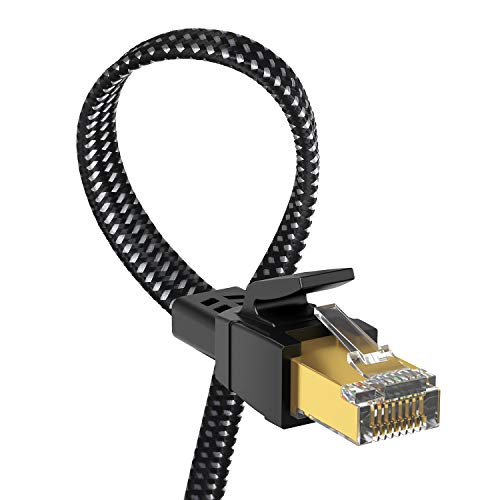
“Orbram's Cat 8 cables (a 6-foot two-pack) handle 40 Gbps with S/FTP shielding and a double-braided nylon jacket.”
See Today’s Price →What we like
- 40 Gbps capacity future-proofs home networks for next-generation multi-gig routers
- SFTP double shielding completely eliminates EMI crosstalk even in dense cable environments
- Gold-plated 50-micron RJ45 contacts rated for 2,000+ insertion cycles
- Standard RJ45 compatibility drops into any existing home network without new hardware
Watch out for
- 40 Gbps benefit requires matching Cat 8-capable network gear — most home routers cap at 1 Gbps
- Stiffer and harder to route around corners compared to Cat 6
Read Full Analysis
Orbram's Cat 8 cable is the Cat 8 pick: 40 Gbps at 2000 MHz over four shielded, foiled twisted pairs (S/FTP), with 24K gold-plated RJ45 connectors and a double-braided nylon jacket that Orbram says survives at least 10,000 bends. This listing is a two-pack of 6-foot flat cables, backward-compatible with Cat5, Cat5e, Cat6 and Cat6A gear. The 40 Gbps rating far exceeds home internet speeds - the value is headroom for multi-gig hardware and network-attached storage, so on a standard 1 Gbps plan a plain Cat 6 cable does the same job.
Skip this if: You only need a short desk patch cable on a standard gigabit connection
“CableGeeker flat Cat 6 cable, 100 feet - long enough for a router-to-room run, with 35 cable clips and 4 straps in the box.”
See Today’s Price →What we like
- Flat, flexible design for runs under carpet and around doors
- Rated for 10 Gbps at 550 MHz (Cat 6, TIA/EIA 568-C.2)
- Snagless, gold-plated RJ45 plugs with molded strain relief
- 35 cable clips and 4 straps included
Watch out for
- Unshielded (UTP), so it is not the cable to run beside heavy electrical equipment
Read Full Analysis
CableGeeker's flat Cat 6 cable is the long-run pick: this listing is 100 feet, flat and flexible enough to run under carpets and around doors, with snagless gold-plated RJ45 plugs and bare copper conductors rated to 10 Gbps and 550 MHz. It ships with 35 cable clips and 4 straps for routing along walls and baseboards. Its thin 30 AWG conductors are what keep it flat and flexible, and it meets the Category 6 standard (TIA/EIA 568-C.2) for gigabit devices. A short desktop run does not need its length - a plain Cat 6 patch cable covers that case.
Skip this if: You only need a short desktop patch cable
Frequently Asked Questions
Does ethernet cable type actually matter for gaming?
What is the difference between Cat 6 and Cat 8?
How long can an ethernet cable be before losing speed?
Is Cat 6 enough for gigabit internet?
Should I get a flat or round ethernet cable?
How We Chose These Products
We compare each product’s Amazon listing, the manufacturer’s published specifications and Amazon customer ratings, shown with their review counts as Amazon’s data, and rank the products on how well they answer this page’s question. We do not test products in hand and we do not run our own analysis of review text. A publication or expert is named only where we cite its published findings about that product. No manufacturer paid for placement on this page.
A price appears only when Amazon’s API supplied it at a recent daily refresh, with the date and time beside it, and is withdrawn at 4 AM Central on the day after it turns 24 hours old; otherwise use “Check price on Amazon” for the live price. Read our full methodology →
How We Score These Products
Each dimension score comes from evidence about the exact model listed — a published specification, a measurement by a named independent reviewer, or that product’s own buyer reviews, as described for each dimension below — not from a similar product in the same range. We do not test products ourselves, and we do not score a dimension we could not evidence. A dash means no evidence was found for that product, not that it performed badly.
Range: From evidence about this exact model (specification, named reviewer or its own reviews).
Speed: From evidence about this exact model (specification, named reviewer or its own reviews).
Reliability: From evidence about this exact model (specification, named reviewer or its own reviews).
The overall score is the mean of the dimensions we could evidence for that product, on a 10-point scale. Price is shown separately and is never folded into a score. Amazon star ratings are shown separately and are never part of any score.