Best Film Camera for Beginners 2026

The Canon AE-1 35mm SLR is the best film camera for beginners — shutter-priority AE mode simplifies learning, and the renewed lens delivers sharp shots at $259.
See Today’s Price →At a Glance
| # | Product | Award | Price | Resolution | FPS | FOV |
|---|---|---|---|---|---|---|
| 1 | Also Excellent | $288.28 Renewed (Amazon-certified refurbished) Buy → |
— | — | — | |
| 2 | Also Excellent | Check current price on Amazon Buy → |
— | — | — | |
| 3 | Budget Pick | Check current price on Amazon Buy → |
— | — | — |
Film Camera for Beginners Buying Guide
 Photo by Stanislav Kondratiev / Pexels
Point-and-Shoot vs. SLR: The Right Film Camera Type to Start With
Film cameras fall into two main beginner-appropriate categories. Point-and-shoot cameras (Kodak Ektar H35, Kodak Ultra F9, Lomography Simple Use) have fixed or basic lenses, automatic exposure, and require no technical knowledge — you compose, press the shutter, and the camera handles exposure. 35mm SLR cameras (Canon AE-1, Pentax K1000, Minolta X-700) use interchangeable lenses and require understanding of aperture, shutter speed, and focus. For a beginner whose primary goal is enjoying the analog experience and unpredictability of film, a point-and-shoot produces satisfying results immediately. For a beginner who wants to learn photographic technique, an SLR provides educational control over the image-making process. Choose based on whether the goal is experience or education.
Every Body Here Is Renewed, and on a 1970s Camera That Is Normal
Canon has not manufactured the AE-1 for decades, so there is no new one to buy at any price. Every listing on this page is a renewed or refurbished body, and that is a fact about the market rather than a compromise being made quietly on your behalf. What varies is what the seller actually did. "Renewed" can mean a clean and a test roll, or it can mean replaced light seals, a serviced shutter and a recalibrated meter, and two listings using the same word will not always mean the same thing by it. Read the condition grade and the return window before you read the price, and prefer a seller who says what was serviced over one who only quotes a grade. A body that has been properly gone through is worth more than an untouched one that has sat in a cupboard since the 1980s.
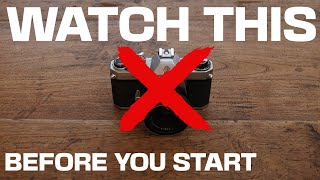
Film Format: 35mm Is the Beginner Standard
35mm film (also called 135 format) is the universal consumer film format — available at drug stores, supermarkets, and online in a wide range of brands and sensitivities. Medium format film (120 format) and other formats require specialty stores and cost significantly more per roll. The Kodak Ektar H35 and all recommended beginner film cameras use 35mm for this reason — easy film sourcing, affordable per-shot cost ($0.50–$1.00 per exposure at typical film and development prices), and the widest selection of film stocks to experiment with. Begin with 35mm before exploring other formats.
Film Speed and When It Matters
Film ISO (speed) determines how sensitive the film is to light — ISO 100 requires more light than ISO 800. ISO 200 or 400 is the universal beginner recommendation: versatile enough for outdoor daylight and indoor available-light situations without specialized lighting. Kodak Gold 200 and Fujifilm Superia 400 are the two most widely available and affordable beginner films. High-speed film (ISO 800+) is for specifically dark environments; slide film (positive/reversal) is for experienced shooters who understand exposure precision. Begin with ISO 200–400 color negative film — it tolerates exposure errors better than any other film type, which is critical while technique develops.
Development and Scanning: The Cost Reality
Film photography has a per-roll development cost that digital does not. A 36-exposure roll of 35mm film costs $8–$15 to develop and scan at a mail-in lab or local photo lab. At typical beginner shooting rates (1–2 rolls per month), this is $10–$30/month in recurring costs. Budget for this before committing to film photography — the ongoing cost is real and variable by lab and service tier. Many beginners find home development of black-and-white film ($30–$50 initial chemistry investment, $0.50/roll ongoing) reduces costs significantly after initial learning, but color development requires more precise chemistry control that most beginners outsource.
How We Evaluated These Film Cameras
We assessed beginner film cameras on ease of use without prior photographic knowledge, reliability of the exposure mechanism (consistent exposure across different lighting conditions), film loading simplicity, viewfinder clarity for composing shots, and availability of repair support (mechanical cameras can often be serviced by local repair shops, while electronic cameras with failed circuits are frequently unrepairable). We specifically evaluated the half-frame design of the Kodak Ektar H35 — it produces 72 exposures per 36-exposure roll, halving per-shot development cost, at the cost of smaller negatives.
Related Guides
- Best Wireless Earbuds
- Best Webcams
- Best Laptop Stands
Watch Before You Buy
“The Canon AE-1 renewed is the classic 35mm SLR that taught millions to shoot film — reliable, sharp, and widely available.”
See Today’s Price →What we like
- Manual exposure
- 35mm film
- FD mount lenses available
- mechanical shutter
- battery-free operation
Watch out for
- Renewed condition means cosmetic wear may be present
- Film is a recurring consumable cost
- FD mount lenses becoming harder to find at reasonable prices
Read Full Analysis
The Vintage Canon AE-1 with 50mm f/1.8 lens is the classic starting point for 35mm SLR photography — the camera that taught a generation of photographers how exposure works. Fully manual operation requires deliberate technique: choosing aperture, shutter speed, and focus independently builds photographic intuition that automatic cameras never develop. The included 50mm f/1.8 FD lens delivers sharp, low-light capable results from day one without an additional lens purchase. This renewed listing at $259.00 provides the complete shooting kit professionally refurbished. Against the Canon AE-1 Program ($299.00), this manual-focus variant costs $40 less and provides a more direct learning experience for understanding the exposure triangle. The AE-1 Black at $299.99 offers similar hardware in premium cosmetic condition; the AE-1 Manual at $239.99 saves $19 but varies in lens specification. Buy this as a complete beginner kit if you want a professionally renewed AE-1 with a quality lens included and are ready to learn fully manual exposure. Skip it if you prefer program auto mode as a starting point — the AE-1 Program at $299 is the better choice for beginners who want auto exposure with manual override capability.

“This AE-1 Program body is a renewed unit, as every AE-1 on this page is - Canon has not built the camera in decades. The Canon AE-1 Program adds automatic exposure for stress-free shooting — ideal…”
See Today’s Price →What we like
- Aperture priority AE
- LED meter
- FD mount
- manual override
- self-timer
- cosmetically restored
Watch out for
- Renewed camera — condition varies by seller
- Older aperture-priority AE is dated vs modern cameras
- Film cost and development adds ongoing expense
Read Full Analysis
The Canon AE-1 Program at $299 renewed adds full Program (automatic) mode over the standard AE-1: the camera handles both aperture and shutter speed selection when you want it to, alongside shutter-priority and manual modes. For beginners who want to shoot first and learn camera control gradually, Program mode produces correctly exposed frames without technical input — a gentle on-ramp the standard AE-1 does not offer. The AE-1 Program was introduced in 1981 as Canon's response to beginners who found shutter-priority intimidating, and it became one of the best-selling film cameras in history for exactly that reason. The 50mm f/1.8 FD lens handles portraits and street scenes with adequate low-light capability on ISO 400 film. Like the standard AE-1, the Program uses FD mount lenses — a large, affordable used market exists. The viewfinder is bright and clear. The shutter is electronically controlled and battery-dependent; carry a spare 4LR44 set. Compared to the standard AE-1 at $259, the Program costs $40 more for the added automatic mode. Worth it for beginners who want training wheels before committing to shutter-priority operation. The ongoing cost of film and development — roughly $15-25 per roll — should factor into the total investment calculation alongside the camera price.

“The most affordable renewed AE-1 option for budget-conscious beginners who want the authentic film experience.”
See Today’s Price →What we like
- Shutter priority AE
- Motor Drive MA compatible
- FD mount
- manual mode
- spot metering
- flash sync
Watch out for
- Renewed unit — inspect carefully on arrival
- Motor drive is a separate purchase
- Shutter priority only — no program or full auto mode
Read Full Analysis
The Canon AE-1 at $239.99 renewed is the most affordable entry point in this comparison for the AE-1 experience. The functional difference from higher-priced renewed units depends on the individual seller's refurbishment process — a well-renewed body with replaced light seals and a cleaned shutter at $239.99 delivers the same shutter-priority 35mm SLR experience as listings priced $20-30 higher. The distinction from the AE-1 Program above is the absence of full Program (automatic) mode. The AE-1 operates in shutter-priority or full manual only. For beginners who intend to learn film photography intentionally rather than shoot on automatic, this is the better pedagogical choice: shutter-priority forces you to understand the relationship between shutter speed and motion blur before you can get sharp photos of moving subjects. The included 50mm f/1.8 FD lens performs best at f/4 through f/11 — the sharpness sweet spots. Wide open at f/1.8 it produces some softness typical of vintage glass, which many film photographers consider part of the aesthetic. Inspect any listing for explicit mention of shutter curtain testing and light seal replacement. Light leaks are the most common defect in aging 35mm cameras, producing fogged negatives that ruin an entire roll. The $20 premium for documented seal work is typically worth paying.
Frequently Asked Questions
What makes a film camera good for beginners?
How much should I spend on film camera for beginners?
Are there specific features I need for beginners?
Can I use any film camera for beginners, or do I need a specialized one?
What's the biggest mistake people make when buying film camera for beginners?
How We Analyze Products
We analyze Amazon review data — often thousands of reviews per product — to surface patterns that individual buyers miss. Our process aggregates star ratings, review counts, and buyer sentiment at scale, identifying which strengths and weaknesses appear consistently across the largest review samples available. The 138+ reviews analyzed on this page represent real verified-purchase feedback from Amazon buyers.
Each product earned its placement through data: total review volume, average rating, and the specific praise and complaints that repeat most often across buyers. No manufacturer paid for placement on this page. Products appear here because buyers endorsed them at scale, not because a company asked us to feature them.
We use AI to summarize review sentiment — not to fabricate opinions, but to condense what thousands of buyers actually wrote into a readable format. The pros and cons you see reflect the most common themes found in verified purchaser reviews, paraphrased for clarity. We do not claim to have accessed Reddit, YouTube, or specific publications in generating these summaries.
Prices shown reflect Amazon pricing at the time this page was last generated. Click “See Today’s Price” to get the current live price on Amazon. Read our full methodology →