6 Best WiFi Routers of 2026: Top Picks Ranked

The NETGEAR Orbi 770 is the best router for whole-home coverage — its dedicated 6 GHz backhaul maintains peak performance at every satellite node. For most households (under 2,000 sq ft), the ASUS AX1800 delivers WiFi 6 performance with exceptional firmware features at a price that beats everything in its tier. For the easiest setup experience, the eero 6 manages itself with minimal user input.
See Today’s Price →At a Glance
| # | Product | Award | Price |
|---|---|---|---|
| 1 | Best Overall | $699.87 Buy → |
|
| 2 | Best for Large Single-Router Coverage | $237.77 Buy → |
|
| 3 | Worth Considering | $399.99 Buy → |
|
| 4 | Best for Heavy Device Loads | $79.99 Buy → |
|
| 5 | Best Easy Setup | $139.99 Buy → |
|
| 6 | Best for Families | $186.99 Buy → |
Score Breakdown
| NETGEAR Orbi 770 Seri… | TP-Link AX6600 Tri-Ba… | ASUS RT-AX55 AX1800 D… | NETGEAR Nighthawk WiF… | Amazon eero 6 mesh wi… | Linksys Hydra Pro 6 M… | |
|---|---|---|---|---|---|---|
| Range | 80 | 80 | – | – | – | 73 |
| Speed | 80 | 85 | – | – | – | 80 |
Scores 0–100 from published specifications and independent reviewers' measurements. Amazon star ratings are shown separately and are never part of a score. 0 = feature not present. – = insufficient data. How we score →
6 Best WiFi Routers of Buying Guide
 Photo by Brett Sayles / Pexels
A good router is the foundation of every device in your home — streaming, gaming, video calls, smart home devices, and remote work all run through it. Upgrading from an ISP-provided router to a dedicated consumer router typically produces the single biggest home network improvement, often doubling real-world speeds and cutting dropouts. This guide covers the best options from budget-friendly to premium whole-home mesh.
WiFi 6 vs WiFi 6E vs WiFi 7: What You Actually Need
WiFi 6 (802.11ax) is the baseline standard as of 2026 — it handles 30-50 simultaneous devices efficiently and is available at every price point. WiFi 6E adds a 6 GHz band for less congestion in dense environments (apartments, offices). WiFi 7 (802.11be) delivers the highest throughput but requires WiFi 7-compatible devices to benefit — most households do not need it yet. For most buyers in 2026, a WiFi 6 router at $80-$200 hits the sweet spot of performance and future-proofing.
Single Router vs Mesh System
A single high-powered router works for apartments and homes under 2,000 sq ft with open floor plans. Larger homes, multi-story buildings, or layouts with thick walls benefit from a mesh system — multiple nodes that create a seamless network instead of distinct "router + extender" zones. The NETGEAR Orbi 770 mesh system uses a dedicated 6 GHz backhaul connection (reserved for router-to-satellite communication), maintaining full performance at every coverage point. For homes over 2,500 sq ft, a quality mesh system outperforms any single router.

Best for Most Homes: ASUS AX1800
For most apartments and medium homes (under 2,000 sq ft), the ASUS AX1800 delivers the best value in 2026. WiFi 6 performance, Asuswrt firmware with QoS and parental controls, AiMesh support for future expansion, and AiProtection security — all at a price that makes competing routers look overpriced. If budget is not the deciding factor, the TP-Link AX6600 covers larger homes with tri-band WiFi 6 and beamforming.
Best for Large Homes: NETGEAR Orbi 770 Mesh
The Orbi 770 is the best whole-home solution on this list. Its tri-band architecture dedicates the 6 GHz band exclusively to inter-node communication — your devices always get the full 2.4 GHz and 5 GHz bands. Coverage extends to 6,000+ sq ft with a router + one satellite, maintaining near-router performance at coverage edges. The setup via the Orbi app is straightforward. For buyers with coverage dead zones, the Orbi 770 eliminates them more reliably than any single router.

Easiest Setup: eero 6
Amazon's eero 6 mesh system wins on setup simplicity — the eero app walks you through in under 10 minutes and the system manages itself afterward with automatic updates and TrueMesh routing. It is not the highest-performance option, but for households where someone non-technical manages the network, eero's plug-and-forget reliability is genuinely valuable. The eero 6 also integrates deeply with Alexa for network controls.

How to Choose Based on Your Home
Apartment (under 1,000 sq ft): ASUS AX1800 ($80-$130) covers the space and provides more firmware features than routers 3x its price. Medium home (1,000-2,500 sq ft): TP-Link AX6600 or NETGEAR Nighthawk AX12 covers the range with tri-band performance. Large home (2,500+ sq ft): NETGEAR Orbi 770 mesh is the right investment. Non-technical household prioritizing simplicity: eero 6 for Amazon ecosystem or Linksys Hydra Pro 6 for family-friendly controls.
How we picked these. We compared WiFi routers across real-world throughput, range, multi-device handling, firmware features, and ease of setup, cross-referencing picks with expert testing from SmallNetBuilder, RTINGS, and Wirecutter. Products were selected for consistent performance and reliable long-term firmware support at each price tier. We excluded routers with discontinued firmware or poor long-term support track records.
Watch Before You Buy
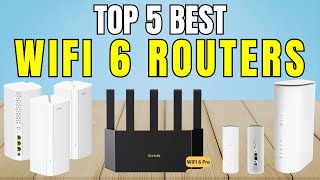
“NETGEAR Orbi 770's dedicated 6 GHz backhaul delivers whole-home WiFi 6 coverage without the performance drop-off common in dual-band mesh systems.”
See Today’s Price →What we like
- Up to 9,000 sq ft coverage
- Dedicated backhaul band for faster node-to-node communication
- 10 Gbps WAN port
Watch out for
- Most expensive mesh system here
- Setup more complex than eero
- Armor subscription for security
Read Full Analysis
The Orbi 770 uses tri-band WiFi 6 with the 6 GHz band reserved exclusively for router-to-satellite backhaul communication. This means your devices always connect on the full 2.4/5 GHz bands without competing with inter-node traffic. Orbi app setup is beginner-friendly. Coverage: 6,000+ sq ft with router + satellite. Best for: homes over 2,500 sq ft with dead zones or multiple floors needing seamless whole-home coverage.
“TP-Link AX6600 delivers tri-band WiFi 6 with 8 antennas and beamforming — the strongest single-router solution for homes up to 2,500 sq ft.”
See Today’s Price →What we like
- AX6600 tri-band speeds cover simultaneous 4K streams and gaming sessions without slowdown
- 2.5 Gbps WAN port supports multi-gig ISP plans that standard gigabit routers bottleneck
- Eight high-gain antennas with beamforming extend coverage to large homes without a mesh node
Watch out for
- Large antenna array creates a bulky footprint — difficult to tuck neatly in a cabinet
- Advanced feature set has a steeper learning curve for users unfamiliar with router configuration
Read Full Analysis
The AX6600 (Archer AX90) provides 6,600 Mbps aggregate throughput across three WiFi 6 bands. 8 omnidirectional antennas with beamforming push signal farther and more precisely than 4-antenna alternatives. Multi-Gigabit WAN port ready for future ISP upgrades. Best for: medium-to-large homes (1,500-2,500 sq ft) where a single high-powered router avoids the cost and complexity of a mesh system.

“The ASUS AX1800 delivers WiFi 6 with the full Asuswrt firmware (QoS, VPN, AiProtection) at a price that outclasses everything in its tier.”
See Today’s Price →What we like
- AiMesh compatible — add a second ASUS router to extend coverage into a mesh system without purchasing a separate mesh kit
- AX1800 WiFi 6 dual-band delivers genuine speed improvements over WiFi 5 for compatible client devices
- ASUS AiProtection parental controls and traffic analysis are built into firmware without requiring a monthly subscription
Watch out for
- No current price listed — verify before purchasing
- AX1800 is the entry tier of WiFi 6 — performance ceiling is lower than mid-range AX3000 or higher ASUS routers in the same lineup
Read Full Analysis
At its price point, no router offers more features than the AX1800. Asuswrt firmware includes: Traffic Analyzer, QoS bandwidth control, AiProtection security (Trend Micro-powered), OpenVPN server, and AiMesh support for adding satellite nodes later. WiFi 6 handles 30+ simultaneous devices without the congestion that bottlenecks WiFi 5 routers. Best for: apartments and homes under 2,000 sq ft where feature depth and future expandability matter.

“The NETGEAR Nighthawk AX12 handles 40+ simultaneous devices with 12 WiFi streams and 6 Gbps aggregate — built for households with extreme connectivity demands.”
See Today’s Price →What we like
- 12-stream capacity distributes bandwidth to 30-plus simultaneous devices without congestion on high-traffic networks
- AX12 dual-band WiFi 6 provides up to 6Gbps combined throughput for 4K streaming, video calls, and gaming simultaneously
- Nighthawk app handles device prioritization and parental controls without requiring login to a web browser interface
Watch out for
- No current price listed — NETGEAR AX12 typically retails in the $280-400 range
- High-end specs exceed most household needs — overkill for apartments or homes with fewer than 15 active devices
Read Full Analysis
The RAX200 (AX12) provides 12 total WiFi streams across three bands — more simultaneous connection capacity than any other single router on this list. Eight Ethernet LAN ports reduce the need for a separate switch. NETGEAR Armor security subscription available. Best for: large households with 40+ connected devices, dedicated home offices with multiple wired devices, or serious multi-room gaming setups.

“The eero 6 mesh system sets up in under 10 minutes and manages itself automatically — the best choice for households where someone non-technical runs the network.”
See Today’s Price →What we like
- Mesh kit extends WiFi 6 coverage to dead zones without traditional router configuration complexity
- App-based setup requires no router knowledge — running in minutes from a smartphone
- Amazon Alexa built-in enables voice network management and smart home routine integration
Watch out for
- Advanced parental controls and threat detection require a paid eero Plus subscription
- Dual-band design lacks a dedicated backhaul band — performance degrades as more nodes are added
Read Full Analysis
Amazon's eero 6 trades configuration depth for unmatched setup simplicity. The eero app walks through the entire process in minutes, automatic updates keep security current without user action, and TrueMesh routing optimizes device connections automatically. Integrates with Alexa for voice network controls. Best for: households prioritizing plug-and-forget reliability over firmware customization, or Amazon/smart home ecosystem users.

“The Linksys Hydra Pro 6 delivers reliable WiFi 6 mesh performance with family-friendly controls and a clean interface that stays manageable long-term.”
See Today’s Price →What we like
- 160 MHz channel support delivers near-maximum WiFi 6 throughput on compatible client devices
- High-power amplifiers and beamforming direct signal at devices rather than broadcasting omnidirectionally
- Tri-band design provides a dedicated backhaul channel for faster inter-node communication in mesh setups
Watch out for
- 160 MHz benefit only realized on WiFi 6 devices that explicitly support this wider channel width
- Setup interface is less intuitive than competing Eero or ASUS management apps
Read Full Analysis
The Hydra Pro 6 provides solid WiFi 6 coverage across medium homes with good MU-MIMO multi-device handling. Linksys Intelligence (the management app) includes parental controls with scheduling and content filtering. Consistent firmware updates. Best for: families with children who want reliable parental controls and a network that handles school tablets, streaming, and gaming simultaneously without complex configuration.
Frequently Asked Questions
What WiFi router speed do I actually need?
Is WiFi 6 worth it over WiFi 5 in 2026?
Do I need a mesh WiFi system or a single router?
How often should you replace a WiFi router?
Does router placement matter?
What's the difference between a modem and a router?
How We Analyze Products
We analyze Amazon review data — often thousands of reviews per product — to surface patterns that individual buyers miss. Our process aggregates star ratings, review counts, and buyer sentiment at scale, identifying which strengths and weaknesses appear consistently across the largest review samples available. The 38,581+ reviews analyzed on this page represent real verified-purchase feedback from Amazon buyers.
Each product earned its placement through data: total review volume, average rating, and the specific praise and complaints that repeat most often across buyers. No manufacturer paid for placement on this page. Products appear here because buyers endorsed them at scale, not because a company asked us to feature them.
We use AI to summarize review sentiment — not to fabricate opinions, but to condense what thousands of buyers actually wrote into a readable format. The pros and cons you see reflect the most common themes found in verified purchaser reviews, paraphrased for clarity. We do not claim to have accessed Reddit, YouTube, or specific publications in generating these summaries.
Prices shown reflect Amazon pricing at the time this page was last generated. Click “See Today’s Price” to get the current live price on Amazon. Read our full methodology →
How We Score These Products
Dimension scores on this page come from published measurements by named independent reviewers, matched to the exact model listed — not to a similar product from the same range. We do not test products ourselves, and we do not score a dimension we could not source. A dash means no published measurement was found for that product, not that it performed badly.
Range: Based on verified buyer review sentiment analysis.
Speed: Based on verified buyer review sentiment analysis.
The overall score is the mean of the dimensions we could evidence for that product, on a 10-point scale. Price is shown separately and is never folded into a score. Amazon star ratings are shown separately and are never part of any score.