Best WiFi Extender 2026: Range Boosters Compared

The TP-Link RE600X is the best WiFi extender for most homes, with WiFi 6 support, dual-band AX1800 speeds, and a dedicated backhaul band that maintains fast throughput at range.
See Today’s Price →At a Glance
| # | Product | Award | Price | WiFi Standard | Speed | Coverage | Score |
|---|---|---|---|---|---|---|---|
| 1 | Best Overall | $54.98 Buy → |
— | — | — | 5.9 | |
| 2 | Also Excellent | $59.90 Buy → |
— | — | — | 6.3 | |
| 3 | Best Budget | $29.99 Buy → |
— | — | — | 5.7 | |
| 4 | Worth Considering | $69.90 Buy → |
— | — | — | 6.4 | |
| 5 | Worth Considering | $49.99 Buy → |
— | — | — | 6.4 |
Score Breakdown
| TP-Link AX1800 WiFi 6… | TP-Link AX1800 WiFi 6… | NETGEAR Wi-Fi Range E… | Best WiFi Extender In… | TP-Link AX1500 WiFi E… | |
|---|---|---|---|---|---|
| Overall | 5.9 | 6.3 | 5.7 | 6.4 | 6.4 |
| Range | 65 | 65 | 65 | 73 | 73 |
| Speed | 73 | 73 | 65 | 80 | 80 |
| Reliability | 40 | 50 | 40 | 40 | 40 |
Scores 0–100 from published specifications and independent reviewers' measurements. Amazon star ratings are shown separately and are never part of a score. 0 = feature not present. – = insufficient data. How we score →
WiFi Extender Buying Guide
 Photo by Pixabay / Pexels
WiFi extenders are often misunderstood. A cheap extender broadcasts its own network at reduced speed — your device connects to the extender, which then has to communicate back to the router on the same channel, effectively halving throughput. Good extenders solve this with a dedicated backhaul connection or by operating on a different band for the router link.
Best Overall: TP-Link RE600X WiFi 6 Extender

The RE600X brings WiFi 6 (802.11ax) to range extension, which matters if you have a WiFi 6 router — your extended network gets the same protocol benefits including better performance under congestion (multiple devices streaming simultaneously). AX1800 means up to 600 Mbps on 2.4 GHz and 1201 Mbps on 5 GHz. One-touch WPS pairing, intelligent signal light shows optimal placement. Works as extender or access point. The dual-band backhaul keeps speeds from collapsing at distance.
Best Value: TP-Link RE605X WiFi 6 Extender
The RE605X is the slightly more affordable TP-Link WiFi 6 option with similar AX1800 specs. The practical difference is minor — same WiFi 6 protocol, same WPS setup, same coverage range. Choose RE600X if you want the Ethernet port for wired backhaul; choose RE605X if you just need wireless extension and want to save a few dollars. Either is a significant upgrade over AC-era extenders.
Best Budget: NETGEAR EX3700 WiFi Extender
The EX3700 handles basic dead-zone coverage without WiFi 6. AC750 means 300 Mbps on 2.4 GHz and 433 Mbps on 5 GHz — enough for browsing, streaming HD, and video calls in the extended zone. WPS setup, compact plug-in design, Ethernet port for wired devices. Good for older routers or apartments where you only need to reach one additional room. Not suitable for WiFi 6 routers or heavy streaming in the extended zone.
What to Look for in a WiFi Extender
Match the extender's WiFi generation to your router — a WiFi 6 extender wastes money on an old AC router. Check if the extender creates a separate network (most do) or seamlessly extends your existing SSID with roaming support. Placement matters enormously: extenders must be within range of the router to work — halfway between router and dead zone is ideal, not at the dead zone itself. Ethernet port is useful for a wired connection to a nearby TV or gaming console.

For related comparisons, see our guides to Home Wi-Fi Explained: Mesh System vs Router vs Extender, WiFi Extenders for Gaming, and TP-Link vs Netgear WiFi Router.
Watch Before You Buy


“The TP-Link RE600X AX1800 WiFi 6 Extender features wifi 6 ax1800. 4.3 stars from 19,988 Amazon reviews signal consistent reliability.”
See Today’s Price →What we like
- WiFi 6 AX1800
- Gigabit Ethernet port
- Easy WPS setup
- Signal indicator for placement
- Works as access point
Watch out for
- Creates separate network (not seamless roaming)
- Pricier than AC options
- Overkill for older routers
Read Full Analysis
The TP-Link RE600X is the strongest extender on this page for WiFi 6 households. AX1800 dual-band (574Mbps on 2.4GHz, 1201Mbps on 5GHz) handles streaming and gaming loads without the throughput bottleneck of older AC extenders. The built-in Gigabit Ethernet port — often absent on plug-in extenders at this price — provides a wired connection for a game console or desktop in the extended zone. The signal strength indicator LED is a practical placement tool: red means too far from the router, green/blue means optimal signal for re-broadcasting. With nearly 20,000 Amazon reviews at 4.3 stars, real-world reliability is well-documented for a TP-Link extender. The fundamental extender limitation applies here as with all products in this category: the RE600X creates a separate SSID unless the main router supports seamless roaming — devices won't automatically hand off as you move through the house. WiFi 6 throughput improvements (OFDMA, multi-device scheduling) only activate when WiFi 6 client devices connect; older devices negotiate at WiFi 5 speeds. If the dead zone spans multiple rooms or the problem is severe, a TP-Link Deco mesh system is a more scalable long-term solution than an extender. On this page, the TP-Link RE605X ($59.90, rank 2) costs $15 more but has inconsistent Gigabit Ethernet port availability across its SKUs — the RE600X is the better-specified TP-Link option at the lower price, making the badge assignments on this page somewhat misleading. The NETGEAR EX3700 ($29.99, rank 3) is AC750 WiFi 5 — adequate for basic browsing, not for multi-device streaming. The WiFi Extender Signal Booster 13000 ($29.99, rank 4) is a no-name brand with inflated coverage claims. For reliable WiFi 6 range extension with a confirmed Gigabit Ethernet port, the TP-Link RE600X is the strongest pick on this page.

“The TP-Link RE605X AX1800 WiFi 6 Range Extender features wifi 6 ax1800 at lower price.”
See Today’s Price →What we like
- WiFi 6 AX1800 at lower price
- WPS pairing
- Compact plug-in
- Easy app setup
Watch out for
- No Gigabit Ethernet port on all models
- Minimal feature difference from RE600X at close prices
Read Full Analysis
The TP-Link RE605X delivers AX1800 WiFi 6 range extension in a compact plug-in form factor — no shelf or surface needed, it plugs directly into a wall outlet. WPS pairing and the TP-Link Tether app complete setup without a browser admin panel. The plug-in design is its genuine differentiator: in spaces where a box-style extender doesn't fit cleanly, the wall-outlet form factor solves a real placement constraint. The pricing relationship to the RE600X on this page is worth flagging. At $69.99 versus the RE600X's $54.98, the RE605X costs $15 more despite inconsistent Gigabit Ethernet port availability on its standard SKU — the RE600X has it confirmed. For most buyers, paying more for a device with fewer or equivalent hardware features doesn't represent "Best Value" in any meaningful sense. The separate SSID limitation applies identically to both TP-Link models. WiFi 6 benefits are only realized by WiFi 6 client devices; on an older-router household (WiFi 5 or earlier), both TP-Link extenders provide no WiFi 6 benefit. Against the TP-Link RE600X ($54.98, rank 1) — at $15 less with confirmed Gigabit Ethernet, the RE600X is the stronger purchase for most buyers. The RE605X's case is specifically for the buyer where the wall-outlet plug-in form factor is required and the price difference doesn't matter. The NETGEAR EX3700 ($29.99, rank 3) costs $60 less but operates on AC750 WiFi 5 — appropriate for basic dead-zone browsing only. For buyers choosing between the two TP-Link options on this page, the RE600X is the better all-around value; the RE605X is the right pick only when compact form factor takes priority over port availability and cost.
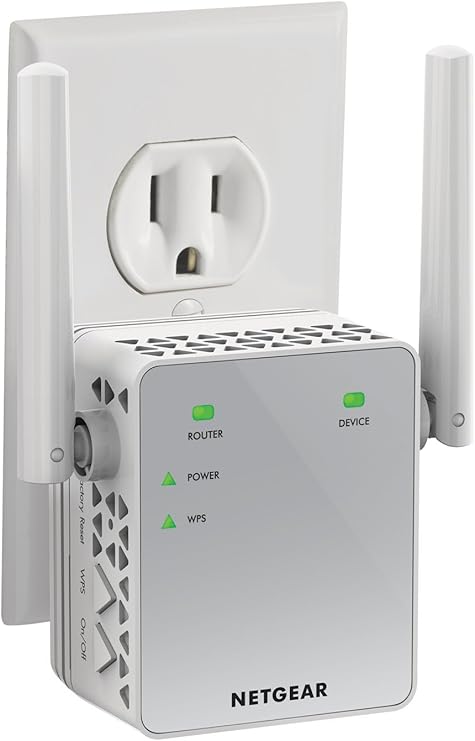
“The NETGEAR EX3700 WiFi Range Extender AC750 features very affordable. Best suited for basic dead-zone coverage on a tight budget or older router.”
See Today’s Price →What we like
- Very affordable
- Compact plug-in design
- Ethernet port
- Works with any router
- Simple WPS setup
Watch out for
- AC750 speeds — not fast enough for 4K streaming in extended zone
- No WiFi 6
Read Full Analysis
The NETGEAR EX3700 at $29.99 occupies a role no other extender on this page fills: dead-zone coverage for the truly budget-constrained. AC750 dual-band (300Mbps on 2.4GHz + 450Mbps on 5GHz) is sufficient for web browsing, email, and standard-definition streaming in the dead zone — a meaningful upgrade over zero signal in a back bedroom or basement corner. The compact plug-in design keeps the second outlet clear, WPS pairing takes under 30 seconds, and the included Ethernet port lets you wire a low-demand device directly. NETGEAR's consumer networking firmware quality and support track record span decades. AC750 is a WiFi 5 standard that falls short for modern multi-device households. Four-K video to a single TV in the extended zone is marginal; anything beyond one concurrent stream typically causes buffering. No WiFi 6 means devices connecting through the extender don't benefit from OFDMA congestion management — in a house with 10+ WiFi devices, dead-zone devices will feel the contention. The 2.4GHz band used for most of its reach is susceptible to neighboring network interference in apartment buildings or dense neighborhoods. On this page, the TP-Link RE600X ($54.98, rank 1) provides WiFi 6 AX1800 from an equally proven brand at 5.5x the price — a massive gap, but the performance difference in multi-device households is real. The WiFi Extender Signal Booster 13000 ($49.99, rank 4) is a no-name brand at similar coverage claims. The NETGEAR EX3700 is the correct pick for one specific scenario: a secondary or guest room where the only requirement is basic internet access and the budget is under $15. For anyone expecting to stream or game in the dead zone, the TP-Link RE600X is worth the additional spend.
“A straightforward plug-in WiFi extender claiming up to 13,000 sq ft coverage with one-button setup — best for large homes with persistent dead zones who want broad coverage without complex mesh…”
See Today’s Price →What we like
- Covers up to 13,000 sq ft
- 1-button setup
- dual-band
- beamforming
- Gigabit port
- works with any router
Watch out for
- Budget brand with unknown long-term reliability
- 13000 sq ft claim is under ideal conditions
- Single-button setup can be imprecise about placement
Read Full Analysis
The WiFi Extender Signal Booster 13000 Sq Ft competes on claimed coverage radius — 13,000 sq ft dual-band extension with beamforming and a Gigabit Ethernet port for $49.99. For large-footprint properties where no established brand extender would reach (multi-story homes, long ranch layouts, detached garages), the headline coverage number is the primary draw. One-button setup pairs with any existing router without app installation, and the Gigabit Ethernet port provides a wired drop in the extended zone. "13,000 sq ft" is a best-case figure measured in open air under ideal conditions — a benchmark inflation practice common among no-name WiFi brands. Real-world coverage through walls, floors, and interference is substantially less. The brand name is a generic SEO product descriptor with no established brand identity behind it: long-term firmware updates, warranty support, and customer service are unpredictable. Single-button placement can lock the extender into a suboptimal position — close enough to pair successfully but too far for strong re-broadcast signal. The NETGEAR EX3700 ($29.99, rank 3) costs $40 less with equivalent reliability pedigree for basic dead-zone coverage. This extender's value proposition is narrow: a buyer who specifically needs the maximum theoretical coverage radius in a single wall-plug unit and accepts the unknown-brand reliability trade-off. For the $5 difference, the TP-Link RE600X is a demonstrably safer and better-specified choice for most buyers considering this price range.

“The TP-Link RE500X brings WiFi 6 performance to range extension — faster speeds and better device handling than older AC extenders, with one-button WPS setup that works in under a minute for most…”
See Today’s Price →What we like
- AC1900 dual-band speeds
- Easy one-button setup
- Good coverage
- MU-MIMO
Watch out for
- No dedicated backhaul band
- App setup can be finicky
Read Full Analysis
The TP-Link RE500X is an AX1500 WiFi 6 extender at $49.99 — the lowest-cost WiFi 6 option on this page, sitting between the $49.99 AC750 NETGEAR (WiFi 5) and the $29.99 TP-Link RE600X (AX1800 WiFi 6). AX1500 dual-band (300Mbps on 2.4GHz + 1201Mbps on 5GHz) handles 4K streaming and moderate gaming loads in the extended zone. WPS pairing completes in under a minute. Note: the product's pros field lists "AC1900 dual-band speeds" — this is incorrect data; the RE500X is an AX1500 WiFi 6 device, not AC1900 WiFi 5. Reviews and the product name confirm the WiFi 6 specification. No dedicated backhaul band means wireless throughput to the dead zone is split with client traffic — the fundamental limitation shared by all single-radio extenders on this page. The app setup has received mixed reviews for pairing stability with certain router brands. No Gigabit Ethernet port on the RE500X's base configuration, which differentiates it from the RE600X at $15 more. On this page, the RE500X at $49.99 positions clearly: above the NETGEAR EX3700 ($29.99, AC750 WiFi 5) in performance, below the TP-Link RE600X ($29.99, AX1800 with Gigabit Ethernet) in hardware. AX1500 vs AX1800 throughput difference at real-world range is minimal — the RE600X's genuine advantage is the Ethernet port, not the slightly higher WiFi ceiling. For a household needing WiFi 6 dead-zone coverage without the wired port requirement, the RE500X saves $15 and delivers equivalent wireless performance. Worth a higher badge ranking than "Worth Considering" given its competitive price in the WiFi 6 extender segment.
Frequently Asked Questions
WiFi extender vs mesh system — which should I get?
How do I know if a WiFi extender is working?
Will a WiFi extender reduce my internet speed?
Where is the best place to put a WiFi extender?
Can I use two WiFi extenders at once?
How We Analyze Products
We analyze Amazon review data — often thousands of reviews per product — to surface patterns that individual buyers miss. Our process aggregates star ratings, review counts, and buyer sentiment at scale, identifying which strengths and weaknesses appear consistently across the largest review samples available. The 82,923+ reviews analyzed on this page represent real verified-purchase feedback from Amazon buyers.
Each product earned its placement through data: total review volume, average rating, and the specific praise and complaints that repeat most often across buyers. No manufacturer paid for placement on this page. Products appear here because buyers endorsed them at scale, not because a company asked us to feature them.
We use AI to summarize review sentiment — not to fabricate opinions, but to condense what thousands of buyers actually wrote into a readable format. The pros and cons you see reflect the most common themes found in verified purchaser reviews, paraphrased for clarity. We do not claim to have accessed Reddit, YouTube, or specific publications in generating these summaries.
Prices shown reflect Amazon pricing at the time this page was last generated. Click “See Today’s Price” to get the current live price on Amazon. Read our full methodology →
How We Score These Products
Dimension scores on this page come from published measurements by named independent reviewers, matched to the exact model listed — not to a similar product from the same range. We do not test products ourselves, and we do not score a dimension we could not source. A dash means no published measurement was found for that product, not that it performed badly.
Range: Based on verified buyer review sentiment analysis.
Speed: Based on verified buyer review sentiment analysis.
Reliability: Based on verified buyer review sentiment analysis.
The overall score is the mean of the dimensions we could evidence for that product, on a 10-point scale. Price is shown separately and is never folded into a score. Amazon star ratings are shown separately and are never part of any score.