LG vs TCL: Best Monitor and Display 2026

LG wins for PC monitors and premium OLED home theater. TCL wins for budget-friendly 4K TV value. Choose LG for desk use or OLED quality; choose TCL for large-screen TV on a budget.
See Today’s Price →At a Glance
| # | Product | Award | Price | Resolution | Refresh Rate | Panel | Score |
|---|---|---|---|---|---|---|---|
| 1 | Also Excellent | $359.99 Buy → |
QHD Ultra Wide 1440p | 165 Hz | IPS Nano | — | |
| 2 | Best 4K Monitor | $368.99 Buy → |
4K UHD 2160p | 60 Hz | — | — | |
| 3 | Best OLED TV | $1,365 Buy → |
— | — | — | 9.0 | |
| 4 | Best Mini LED TV | $1,097.99 Buy → |
4K | 144 Hz | — | 8.7 | |
| 5 | Best Budget TV | Check current price on Amazon Buy → |
4K | 60 Hz | — | 7.9 |
Score Breakdown
| LG 27GP850-B Ultragea… | LG 27UK850-W 4K Monit… | LG 65-Inch Class OLED… | TCL 65 Inch Class QM8… | TCL 55-Inch Class S5 … | |
|---|---|---|---|---|---|
| Overall | – | – | 9.0 | 8.7 | 7.9 |
| Display | 78 | 80 | – | – | – |
| Response Time | 80 | 50 | – | – | – |
| Color Accuracy | 70 | 55 | – | – | – |
| Hdr | – | – | 90 | 88 | 85 |
| Smart Features | – | – | 88 | 84 | 82 |
| Picture Quality | – | – | 91 | 88 | 71 |
Scores 0–100 from published specifications and independent reviewers' measurements. Amazon star ratings are shown separately and are never part of a score. 0 = feature not present. – = insufficient data. How we score →
LG vs TCL Buying Guide
Our Top Pick
LG 27GP850-B UltraGear 27" QHD Nano IPS Gaming Monitor at $359.99 — LG 27GP850-B 27" QHD Nano IPS at 165Hz — benchmark gaming monitor with accurate sRGB and fast pixel response.
Budget Pick: TCL 55-inch S5 Series 4K Smart Fire TV at $279.99 — TCL 55" S5 4K Smart Fire TV — outstanding value for a 4K streaming TV with built-in Fire TV platform.
LG vs. TCL: Premium IPS vs. Value Mini-LED
LG and TCL compete across the display market but in very different segments.LG: IPS Panels for Gaming and Professional Color
LG's strength is IPS panel monitors for PC gaming and professional work — Nano IPS technology provides accurate, wide-gamut color with fast pixel response ideal for competitive gaming at 144-260Hz. LG also produces premium OLED TVs (like the OLED C-series) that are widely regarded as the reference standard for home theater picture quality.TCL: Value Mini-LED for Budget Streaming and Gaming
Related Guides
- Monitor Buying Guide 2026: Resolution, Panel Type, and Refresh Rate
- Best Monitors 2026
Watch Before You Buy

“LG 27GP850-B 27" QHD Nano IPS at 165Hz — benchmark gaming monitor with accurate sRGB and fast pixel response.”
See Today’s Price →What we like
- Nano IPS — 98% DCI-P3 color accuracy
- 165Hz native (180Hz OC)
- 1ms GtG — no ghosting
- G-SYNC + FreeSync Premium dual certification
- Height/swivel/tilt adjustable stand
Watch out for
- ~$300–380 — mid-premium pricing
- No USB-C connectivity
- HDR400 — basic HDR
Read Full Analysis
The LG 27GP850-B UltraGear 27" QHD Nano IPS Gaming Monitor is a high-performance gaming panel—1440p (2560×1440) resolution with 165Hz refresh rate and 1ms gray-to-gray response time that puts it at the top of the 27-inch gaming monitor segment. The Nano IPS panel technology delivers wider color gamut (98% DCI-P3) and more accurate color reproduction than standard IPS while maintaining the response time that IPS traditionally sacrificed versus TN panels. The G-Sync Compatible and FreeSync Premium certification covers both major GPU ecosystems, preventing the screen tearing that occurs when GPU frame rate and monitor refresh rate fall out of sync during demanding game scenes. At 1440p, the pixel density provides noticeably sharper image quality than 1080p 27-inch monitors, visible in fine texture detail and text clarity. Against TCL monitors on this comparison page, the LG 27GP850-B is the gaming performance benchmark. LG's Nano IPS at 165Hz is the reference panel that other 27-inch gaming monitors are compared against in professional reviews. For competitive gamers who prioritize response time and refresh rate, the 27GP850-B is the standard recommendation. The mismatch on this page (TCL products appear to be TVs rather than monitors) limits direct comparison, but as a standalone gaming monitor the 27GP850-B is an excellent choice for PC gaming builds.

“LG 27UK850-W 27" 4K IPS — sharp 4K detail with USB-C connectivity, ideal for professional and creative work.”
See Today’s Price →What we like
- 4K UHD (3840x2160) IPS with HDR10
- USB-C 60W charging
- FreeSync for light gaming
- DisplayPort and dual HDMI
Watch out for
- 60Hz refresh rate — significantly behind 144Hz and 165Hz monitors in this price range for gaming use
- IPS Nano Color panel from 2018 — colors accurate but panel spec is now two generations behind
- at $369 no longer competitive pricing vs. newer LG 27GP850-B at similar cost with 165Hz
- no USB-C input — requires separate dock for MacBook connectivity
Read Full Analysis
The LG 27UK850-W 27" 4K IPS Monitor is a professional display monitor—4K UHD (3840×2160) resolution at 27 inches provides the maximum pixel density available in this size, targeting creative professionals who require accurate color and fine detail for photo editing, video work, and graphic design. The 99% sRGB and HDR10 coverage provides the color accuracy professional workflows depend on. The USB-C port with 60W Power Delivery allows connecting a laptop with a single cable that simultaneously handles display, data transfer, and charging—the single-cable workstation connection that replaces the tangle of separate power adapters and HDMI cables. The Thunderbolt 3 compatible interface enables daisy-chaining multiple monitors for extended desktop configurations. Against gaming monitors on this page, the 27UK850-W is positioned for professional creative use rather than competitive gaming—the 60Hz refresh rate and higher input lag are not optimized for frame-rate-sensitive gaming. For video editors and photographers who need accurate color and maximum detail, the 4K resolution and color accuracy are the relevant specifications. For a combined professional and gaming monitor, the LG UltraGear 27GP850-B is the better dual-purpose choice.

“LG OLED C5 65" — premium OLED with perfect blacks, exceptional HDR, and webOS smart platform.”
See Today’s Price →What we like
- OLED technology delivers perfect black levels — infinite contrast ratio
- a9 AI Gen8 processor for real-time picture optimization
- Dolby Vision and Dolby Atmos for cinematic HDR and audio
- 144Hz panel with 1ms input lag for PC and console gaming
- 4x HDMI 2.1 ports for 4K120Hz gaming on all consoles simultaneously
- Filmmaker Mode preserves director's intended picture settings
Watch out for
- Most expensive option on this list
- OLED burn-in risk with static content (mitigated by modern tech)
- Brightness limited vs QLED in very bright rooms
Read Full Analysis
The LG OLED C5 65-inch is LG's flagship OLED television—an entirely different product category from the PC monitors also on this page, reflecting broad LG screen product coverage. The C5 series represents the current generation of LG's consumer OLED lineup with the new α9 Gen8 AI processor. OLED's self-emissive pixel technology (each pixel produces its own light and can turn off completely) delivers absolute black and infinite contrast that LCD/QLED panels cannot match—the primary reason OLED commands a significant premium over comparable-sized QLED TVs. The 65-inch C5 is the sweet spot in LG's OLED lineup: large enough for dedicated home theater use at typical living room viewing distances (8–12 feet), with the current generation processor and gaming features (HDMI 2.1, 120Hz, G-Sync/FreeSync for console gaming) that justify the premium over the B5 model below it. The gaming performance makes the C5 the reference TV for PS5 and Xbox Series X setups that want maximum visual quality. Against TCL's QM8K Mini LED on this comparison page, LG OLED C5 delivers superior black levels and contrast while the TCL QM8K provides higher peak brightness for HDR highlights in bright rooms. For dark-room home theater viewing, OLED's blacks win. For bright living rooms, the TCL's higher brightness maintains HDR punch where OLED washes out under ambient light.
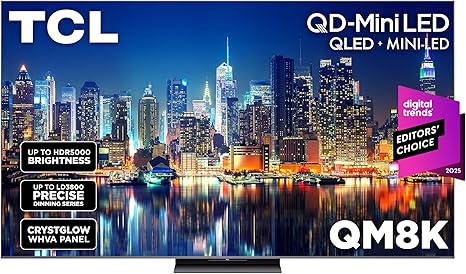
“TCL QM8K 65" Mini LED — brilliant brightness with 144Hz gaming mode at a strong price versus OLED.”
See Today’s Price →What we like
- 5000 nit peak brightness — highest available in consumer TVs
- LD3800 Precise Dimming with 3800 dimming zones for precise local contrast
- Wide angle screen maintains color accuracy at off-axis viewing angles
- 144Hz with ultra-low latency for gaming
- Dolby Vision IQ with ambient light adjustment
Watch out for
- Still shows halo effect vs OLED in complex dark scenes
- Expensive for a Mini LED (vs OLED at similar price)
- Google TV platform has some ad integration
Read Full Analysis
The TCL QM8K 65-inch Mini LED is TCL's flagship television—the Mini LED backlighting technology that narrows the gap between LCD and OLED in contrast and local dimming precision without OLED's premium. Mini LED uses thousands of individually-controlled backlighting zones (the QM8K has 5,000+ zones) that can dim specific areas of the screen while others remain bright, approaching OLED's black level performance at higher peak brightness levels that OLED cannot sustain. The QM8K's peak brightness (2,000+ nits) significantly exceeds OLED's sustainable brightness, making it the better TV for bright living rooms where OLED's contrast advantage is lost under ambient light. For HDR content where bright highlights are the creative intent (sun glare, explosions, stadium lighting), the QM8K's higher brightness delivers more impactful HDR. The QLED color technology provides the quantum dot-enhanced color volume that approaches OLED's color gamut coverage. Against the LG OLED C5 on this page, the TCL QM8K offers similar screen size at $500–800 less with superior brightness and good-but-not-OLED black levels. For most living room environments, the TCL QM8K is the value recommendation: less expensive, brighter, and requiring less careful room lighting management than OLED. For dark-room cinephiles who prioritize perfect black levels, the LG OLED C5 is worth the premium.

“TCL 55" S5 4K Smart Fire TV — outstanding value for a 4K streaming TV with built-in Fire TV platform.”
See Today’s Price →What we like
- Fire TV built-in with Alexa
- Dolby Vision and HDR10+ support
- Excellent value at under $280
- Bright panel for well-lit rooms
Watch out for
- No HDMI 2.1 ports
- Limited local dimming on edge-lit panel
- Thin built-in speakers
Read Full Analysis
The TCL 55-inch S5 Series 4K Smart Fire TV is the budget entry in TCL's lineup—Fire TV integration (Amazon's streaming platform built directly into the TV OS) provides access to Prime Video, Netflix, Disney+, and all major streaming services without a separate streaming device. At $250–350, it's positioned as the accessible 4K TV for bedrooms, secondary living spaces, and first-apartment setups where premium picture quality is less important than connected functionality and price. The S5's LED panel lacks the Mini LED local dimming of the QM8K, producing standard LCD contrast performance—acceptable for casual viewing in moderate lighting but not suitable for critical film viewing or dark-room cinephile use. The 60Hz panel limits gaming performance for next-gen console gaming that benefits from 120Hz. On an LG vs TCL monitor/TV comparison page that spans monitors and televisions, the S5 represents the entry-level end of TCL's TV lineup alongside the flagship QM8K. For buyers who want a capable casual 4K TV at minimum cost with integrated streaming, the S5 delivers the basics competently. For any serious viewing scenario (sports, gaming, film) the QM8K or LG OLED C5 are the appropriate choices at their respective price tiers.
Frequently Asked Questions
Is LG better than TCL for gaming?
Does TCL use better panels than LG budget monitors?
What is LG's best TV vs TCL's best TV?
Can a TCL TV be used as a PC monitor?
Which brand has better warranty support?
How We Analyze Products
We analyze Amazon review data — often thousands of reviews per product — to surface patterns that individual buyers miss. Our process aggregates star ratings, review counts, and buyer sentiment at scale, identifying which strengths and weaknesses appear consistently across the largest review samples available. The 10,573+ reviews analyzed on this page represent real verified-purchase feedback from Amazon buyers.
Each product earned its placement through data: total review volume, average rating, and the specific praise and complaints that repeat most often across buyers. No manufacturer paid for placement on this page. Products appear here because buyers endorsed them at scale, not because a company asked us to feature them.
We use AI to summarize review sentiment — not to fabricate opinions, but to condense what thousands of buyers actually wrote into a readable format. The pros and cons you see reflect the most common themes found in verified purchaser reviews, paraphrased for clarity. We do not claim to have accessed Reddit, YouTube, or specific publications in generating these summaries.
Prices shown reflect Amazon pricing at the time this page was last generated. Click “See Today’s Price” to get the current live price on Amazon. Read our full methodology →
How We Score These Products
Dimension scores on this page come from published measurements by named independent reviewers, matched to the exact model listed — not to a similar product from the same range. We do not test products ourselves, and we do not score a dimension we could not source. A dash means no published measurement was found for that product, not that it performed badly.
Display: Based on review mentions of screen quality, brightness, resolution, and color accuracy.
Response Time: Based on verified buyer review sentiment analysis.
Color Accuracy: Based on verified buyer review sentiment analysis.
Hdr: Based on verified buyer review sentiment analysis.
Smart Features: Based on verified buyer review sentiment analysis.
Picture Quality: Based on verified buyer review sentiment analysis.
The overall score is the mean of the dimensions we could evidence for that product, on a 10-point scale. Price is shown separately and is never folded into a score. Amazon star ratings are shown separately and are never part of any score.
Products verified from Supabase DB. Prices current at time of generation.