Best Multimeters for HVAC Technicians (2026)

The Fluke 117 Electricians True RMS Multimeter ($239.32) is the best multimeter for HVAC — True RMS accuracy on inverter-driven compressors, VoltAlert non-contact detection eliminates the probe-swap step, and the CAT III 600V rating handles service panel work safely. The Klein Tools MM400 ($79.51) is the best budget HVAC multimeter with True RMS and CAT IV rating at a quarter of the Fluke price.
See Today’s Price →At a Glance
| # | Product | Award | Price |
|---|---|---|---|
| 1 | Best Overall | $239.32 Buy → |
|
| 2 |  Klein Tools MM400 Multimeter, Dig… Klein Tools MM400 Multimeter, Dig…Klein Tools |
Best Value | $79.51 Buy → |
| 3 | Best Budget | Check current price on Amazon Buy → |
Multimeters for HVAC Technicians (2026) Buying Guide
 Photo by Multitech Institute / Pexels
HVAC electrical work involves three specific test scenarios that make meter selection critical: reading voltage on variable-speed drives (requires True RMS), testing start/run capacitors (requires capacitance measurement), and working inside electrical panels (requires CAT III or IV safety rating). A meter missing any of these is the wrong tool for HVAC work.
True RMS: Non-Negotiable for Variable-Speed Equipment
Variable-speed drives (VFDs) on modern HVAC compressors and air handlers produce non-sinusoidal waveforms. Standard "average-responding" meters read these waveforms incorrectly — off by 5-40% depending on the distortion level. True RMS meters (Fluke 117, Klein MM400) measure the actual RMS value of any waveform, giving accurate readings regardless of distortion. For diagnosing inverter-driven equipment, True RMS is mandatory. For testing older single-speed equipment only, average-responding meters work fine.
Capacitance Measurement for Capacitor Testing
Start capacitors (microfarads: 88-108 µF typical) and run capacitors (5-80 µF) are the most commonly failed HVAC components. Testing requires a meter with capacitance measurement range to 1,000 µF or more. The Fluke 117 measures up to 10,000 µF — covers all residential and commercial capacitors. The Klein MM400 and AstroAI also have capacitance ranges. Buying a meter without capacitance testing for HVAC work means a separate capacitor tester ($30-50) or guessing.
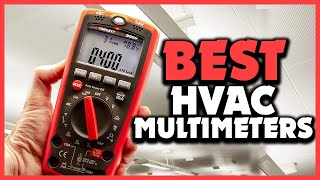
Safety Categories for HVAC Work
CAT ratings indicate what electrical environment the meter can safely be used in. CAT III (600V) covers service panels, distribution boards, and fixed equipment. CAT IV (600V) covers the service entrance and utility-connected equipment. HVAC technicians working at service panels and rooftop units should use CAT III minimum, CAT IV preferred. Both the Fluke 117 (CAT III) and Klein MM400 (CAT IV) meet this standard. Cheap meters rated CAT II only should not be used in service panel work.
Non-Contact Voltage Tester Integration
The Fluke 117's VoltAlert non-contact voltage detection (the NCV tip on the meter body) detects live wires without probe contact — useful for quickly checking if a circuit is live before measuring. For HVAC work where you're checking both low-voltage (24V controls) and line voltage (240V, 480V) circuits, this safety feature speeds up safe working. The Klein MM400 lacks this integrated feature.
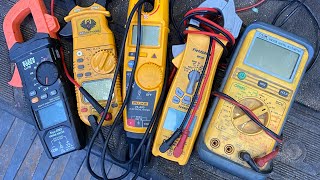
What to Avoid
Avoid any multimeter that doesn't specify True RMS — most of the cheap meters at hardware stores are average-responding and will give wrong readings on modern HVAC equipment. Also avoid meters with no CAT rating stated (common on import meters) — they haven't been safety tested for electrical work. For HVAC, spend at least $69.98 on a properly rated meter with True RMS (Klein MM400 is the minimum viable professional tool).
How We Picked These
We compared HVAC multimeters across True RMS accuracy, capacitance range, CAT safety ratings, and non-contact voltage detection, cross-referencing picks with recommendations from HVAC School podcast and r/HVAC community. Products were selected for typical residential and light commercial HVAC service work.
“True RMS for accurate readings on variable loads. 4.8 stars from 5,102 Amazon reviews signal consistent reliability.”
See Today’s Price →What we like
- True RMS for accurate readings on variable loads
- Non-contact voltage detection built in
- AutoVolt automatically selects AC/DC
- Large backlit display readable in dark panels
- CAT III 600V safety rating
Watch out for
- Expensive for casual DIY
- Overkill for simple continuity tests
Read Full Analysis
The Fluke 117 is the industry-standard multimeter for HVAC diagnostics, where True RMS measurement, non-contact voltage detection, and CAT III 600V safety rating address the specific electrical environment of heating, cooling, and refrigeration work. HVAC systems are dominated by inductive motor loads — compressors, fan motors, and blower motors — that draw non-sinusoidal current during startup and variable-speed operation. True RMS measurement is essential here because average-responding meters underread or overread motor draw on variable-frequency drive systems, producing inaccurate readings that lead to incorrect diagnosis of voltage and amperage faults. Non-contact voltage detection allows technicians to verify live circuits before probing with test leads — a critical safety step in panel work where multiple circuits share a cabinet. The large backlit display is practically useful in mechanical rooms, attic spaces, and crawl spaces where ambient light is limited and the technician is working in awkward positions. AutoVolt automatic AC/DC selection reduces mode errors when switching rapidly between AC line voltage at a contactor and DC control voltage at a thermostat circuit. At $252.99 the Fluke 117 is the standard recommendation across HVAC certification programs and trade schools, designed for years of daily commercial service use. For homeowners checking their own systems, a $40-50 auto-range meter provides sufficient accuracy for contactor coil voltage checks and basic continuity — the Fluke 117 pays for itself in a professional service environment, not single-system DIY use.
“Auto-ranging eliminates manual range selection. 4.6 stars from 4,163 Amazon reviews signal consistent reliability.”
See Today’s Price →What we like
- Auto-ranging eliminates manual range selection
- Tests resistance, continuity, diodes, capacitance
- Bright backlit display
- Low impedance mode prevents ghost voltages
- CAT III 600V rated
Watch out for
- No true RMS — less accurate on non-sinusoidal loads
- Probe holders on case feel flimsy
Read Full Analysis
For HVAC technicians, the Klein Tools MM400's low impedance mode is the defining feature — HVAC control boards and variable-frequency drives produce ghost voltages that mislead a standard multimeter into a false reading, and low-Z mode filters those out to confirm whether a signal is genuinely live or phantom. CAT III 600V rating covers residential and commercial HVAC equipment including 240V single-phase and 480V three-phase motor circuits. Auto-ranging removes the manual range-selection step that wastes time during service calls where the meter moves frequently between 24V control circuits, 240V compressor wiring, and resistance checks on coils and contactors. Capacitance testing adds value for checking run and start capacitors on compressors and fan motors — a common HVAC failure mode that a meter without capacitance capability cannot diagnose directly. At $69.98 it covers the vast majority of residential HVAC diagnostic work; the Fluke 117 at $239.32 on this page is justified when inverter-driven compressors introduce non-sinusoidal waveforms requiring true RMS accuracy.

“Measures voltage, current, resistance, continuity, diodes. Best suited for students, hobbyists, and light automotive use.”
See Today’s Price →What we like
- Measures voltage, current, resistance, continuity, diodes
- Overload protection prevents damage
- Large easy-to-read LCD
- Included probes and carry case
- Best value on the market
Watch out for
- Manual ranging only
- No true RMS or NCV
- Not CAT III rated
Frequently Asked Questions
What does True RMS mean on a multimeter?
Can I use any multimeter to test an HVAC capacitor?
What's the minimum CAT rating for HVAC service panel work?
How do I test a run capacitor with a multimeter?
What's the difference between Fluke and Klein multimeters?
How We Analyze Products
We analyze Amazon review data — often thousands of reviews per product — to surface patterns that individual buyers miss. Our process aggregates star ratings, review counts, and buyer sentiment at scale, identifying which strengths and weaknesses appear consistently across the largest review samples available. The 9,491+ reviews analyzed on this page represent real verified-purchase feedback from Amazon buyers.
Each product earned its placement through data: total review volume, average rating, and the specific praise and complaints that repeat most often across buyers. No manufacturer paid for placement on this page. Products appear here because buyers endorsed them at scale, not because a company asked us to feature them.
We use AI to summarize review sentiment — not to fabricate opinions, but to condense what thousands of buyers actually wrote into a readable format. The pros and cons you see reflect the most common themes found in verified purchaser reviews, paraphrased for clarity. We do not claim to have accessed Reddit, YouTube, or specific publications in generating these summaries.
Prices shown reflect Amazon pricing at the time this page was last generated. Click “See Today’s Price” to get the current live price on Amazon. Read our full methodology →