Best Stud Finder Under $60 (2026)
The Franklin Sensors ProSensor M150 Professional Stud Finder is the best stud finder under $60. It delivers multi-sense technology detects stud edges and center simultaneously — no guesswo. We compared 5 options to find the strongest value.
Stud Finder Under $60 (2026) Buying Guide
 Photo by Carsten Ruthemann / Pexels
Under $60, stud finder options have reached the quality threshold for reliable everyday use. Options range from $40–$60. Here's what to know before buying.
What You Get Under $60
Under $60, electronic stud finders from Franklin Sensors and Zircon detect wood and metal studs, live electrical wires, and density changes in drywall. The Franklin ProSensor M150 at $40 is the consistent recommendation from contractor and DIY communities — its multi-sensor array eliminates the false positives that plague older single-sensor models.
The Trade-offs vs Spending More
Spending $60–150 gets deep-scan modes for thick plaster walls, metal conduit detection, and the Franklin ProSensor 710+ which adds live wire detection. At $150+, Bosch's GPR detectors locate rebar, pipes, and conduit behind any material.

Which of these to buy
Take the Franklin Sensors ProSensor M150/X990 Stud Finder with at $39.97 if you want budget-conscious buyers who want solid tools performance under $40. Take the Prosensor 710 Franklin ProSensor Precision Stud Finder at $52.95 if you want users who want to distinguish between wood, metal, and live wire. Take the Franklin Sensors Prosensor M210 Stud Finder With at $59.97 if you want value-focused buyers: DIY homeowners and skilled tradespeople who need dependable tools for regular projects and repairs. Take the Zircon MultiScanner™ A200 Stud Finder Wall Scanner at $39.99 if you want tech-forward buyers who want more than capacitance sensing.
What to Avoid at This Price
Avoid magnetic stud finders — they locate drywall screws (which can be 16" apart), not studs. Avoid calibrating on a location you haven't confirmed is clear — the calibration reference point matters. Never trust a stud finder without confirming with a small test nail first.

The Franklin Sensors ProSensor M150/X990 Stud Finder with Live is the pick to beat here. 9 sensors deliver the most accurate stud detection available in the consumer market. No-calibration design lets you start scanning anywhere, even directly over a stud. Below is what the other 4 options on this page do differently, and what each one costs.

How these compare
Franklin Sensors ProSensor M150/X990 Stud Finder with Live — 9 sensors deliver the most accurate stud detection available in the consumer market. Trade-off: Requires AAA batteries not included. Prosensor 710 Franklin ProSensor Precision Stud Finder Yellow ($52.95) — Detects wood studs, metal, and live wires. Trade-off: Takes practice to read LED ring correctly. Franklin Sensors Prosensor M210 Stud Finder With 13-Sensors — 13 patented sensors deliver unmatched accuracy for plaster wall stud detection. Trade-off: Bulkier form factor than simple one-button stud finders. Zircon MultiScanner™ A200 Stud Finder Wall Scanner ($39.99) — UWB ultrasound technology — more penetrating than capacitance sensors. Trade-off: Fewer reviews (3,200) than category leaders. Franklin Sensors ProSensor 710+ Stud Finder with 13-Sensors — 13 simultaneous sensors detect stud edges perfectly. Trade-off: larger sensor array (4.5 inches wide) too bulky to use in corners and tight wall spaces.
What the price difference buys
Prices on this page run from $39.97 to $59.97, a difference of $20.00. The Franklin Sensors ProSensor M150/X990 Stud Finder with Live is the least you can spend here, and the compromise is noted as: Requires AAA batteries not included. The Franklin Sensors Prosensor M210 Stud Finder With 13-Sensors asks $59.97, and what it offers for that is: 13 patented sensors deliver unmatched accuracy for plaster wall stud detection. Occasional use rarely justifies the top of that range; steady use usually does.
Which one fits your situation
Prosensor 710 Franklin ProSensor Precision Stud Finder Yellow — best for: Users who want to distinguish between wood, metal, and live wire. Franklin Sensors Prosensor M210 Stud Finder With 13-Sensors — best for: Value-focused buyers: DIY homeowners and skilled tradespeople who need dependable tools for regular projects and repairs. Zircon MultiScanner™ A200 Stud Finder Wall Scanner — best for: Tech-forward buyers who want more than capacitance sensing. Franklin Sensors ProSensor 710+ Stud Finder with 13-Sensors — best for: Homeowners and DIYers wanting foolproof stud detection.
What to check before you buy
Franklin Sensors ProSensor M150/X990 Stud Finder with Live — Requires AAA batteries not included. Prosensor 710 Franklin ProSensor Precision Stud Finder Yellow — Takes practice to read LED ring correctly. Franklin Sensors Prosensor M210 Stud Finder With 13-Sensors — Bulkier form factor than simple one-button stud finders. Zircon MultiScanner™ A200 Stud Finder Wall Scanner — Fewer reviews (3,200) than category leaders. Franklin Sensors ProSensor 710+ Stud Finder with 13-Sensors — larger sensor array (4.5 inches wide) too bulky to use in corners and tight wall spaces. None of these is disqualifying on its own, but they are what buyers most often notice once the box is open.
The details that decide it
Franklin Sensors ProSensor M150/X990 Stud Finder with Live — No-calibration design lets you start scanning anywhere, even directly over a stud. Prosensor 710 Franklin ProSensor Precision Stud Finder Yellow — 100% detection guarantee marking. Franklin Sensors Prosensor M210 Stud Finder With 13-Sensors — Integrated live wire meter confirms AC wire presence before every drill. Zircon MultiScanner™ A200 Stud Finder Wall Scanner — LCD screen with arrows guides you to stud center precisely. Franklin Sensors ProSensor 710+ Stud Finder with 13-Sensors — Works through thick drywall up to 1.5".

Watch Before You Buy

Showing 5 of 5 products
“Multi-Sense technology detects stud edges and center simultaneously — no guesswork. Best for: budget-conscious buyers who want solid tools performance under $40.”
See Today’s Price →What we like
- 9 sensors deliver the most accurate stud detection available in the consumer market
- No-calibration design lets you start scanning anywhere, even directly over a stud
- Live wire detection adds safety before drilling into walls
Watch out for
- Requires AAA batteries not included
- Not compatible with rechargeable batteries which limits convenience
Read Full Analysis
The Franklin ProSensor M150 represents the value entry point in the Franklin multi-sensor lineup — 9 simultaneous sensors delivering the core no-calibration detection capability, well within the under-$60 bracket. For most residential stud-finding applications, 9 sensors provide more than adequate accuracy, and the $10 savings over the 13-sensor 710+ is meaningful when the extra sensors only matter in unusually thick or variable wall conditions. The no-calibration design is the feature that separates the M150 from conventional single-sensor digital tools in this price range. Standard tools must begin on a known empty section of wall before scanning — if the first contact lands directly over a stud, calibration fails and results become unreliable. Multi-sensor simultaneous reading eliminates that constraint: scan from any starting position and the display immediately shows stud edges and center across the full detection window. Within the under-$60 bracket, the M150 competes against a range of single-sensor digital stud finders and basic magnetic finders under $10. For occasional picture-hanging, the magnetic finder is sufficient. For homeowners mounting TV brackets, heavy shelving, or curtain rods where missing a stud means structural failure, the M150's multi-sensor confirmation accuracy is the right tool — and, it's the most cost-efficient way to get the simultaneous-detection performance that removes stud-finding guesswork entirely.
“Detects wood studs, metal, and live wires”
See Today’s Price →What we like
- Detects wood studs, metal, and live wires
- 100% detection guarantee marking
- LED ring illuminates scan direction
- Compact ergonomic design
- Color-coded alerts by material type
Watch out for
- Takes practice to read LED ring correctly
- Moderate scan depth at 1.18"

“Higher accuracy, better technology. Best for: value-focused buyers: diy homeowners and skilled tradespeople who need dependable tools for regular projects and repairs.”
See Today’s Price →What we like
- 13 patented sensors deliver unmatched accuracy for plaster wall stud detection
- Integrated live wire meter confirms AC wire presence before every drill
- Auto-adjusts for material depth up to 1.7 inches, cleanly handling lath-and-plaster walls
Watch out for
- Premium $60 price point is hard to justify for occasional single-room projects
- Bulkier form factor than simple one-button stud finders

“UWB ultrasound technology — more penetrating than capacitance sensors”
See Today’s Price →What we like
- UWB ultrasound technology — more penetrating than capacitance sensors
- LCD screen with arrows guides you to stud center precisely
- Stud, metal, and live AC detection in dedicated modes
Watch out for
- $39.99 gets you better detection technology than the price suggests, but firmware can occasionally produce false positives
- Fewer reviews (3,200) than category leaders
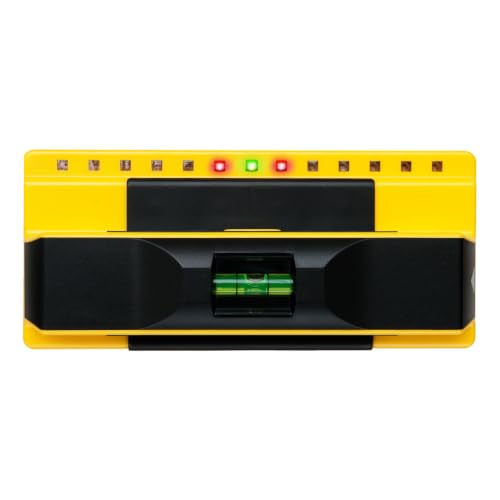
“13 simultaneous sensors detect stud edges perfectly”
See Today’s Price →What we like
- 13 simultaneous sensors detect stud edges perfectly
- Works through thick drywall up to 1.5"
- Finds live AC wires simultaneously
- No calibration needed
- Works on textured walls
Watch out for
- Over 3x the cost of a basic magnetic stud finder
- larger sensor array (4.5 inches wide) too bulky to use in corners and tight wall spaces
- requires simultaneous LED analysis — takes practice to read all 13 indicators accurately
- overkill for users who hang pictures occasionally rather than framing walls
Frequently Asked Questions
Why does my stud finder give false positives?
How do I find studs without a stud finder?
Do stud finders work on plaster walls?
How We Chose These Products
We compare each product’s Amazon listing, the manufacturer’s published specifications and Amazon customer ratings, shown with their review counts as Amazon’s data, and rank the products on how well they answer this page’s question. We do not test products in hand and we do not run our own analysis of review text. A publication or expert is named only where we cite its published findings about that product. No manufacturer paid for placement on this page.
A price appears only when Amazon’s API supplied it at a recent daily refresh, with the date and time beside it, and is withdrawn at 4 AM Central on the day after it turns 24 hours old; otherwise use “Check price on Amazon” for the live price. Read our full methodology →