Best Educational Toys for Toddlers Under $100 (2026)

The Step2 Best Chefs Kids Kitchen Playset ($94.99) is the best educational toy for toddlers under $100 — it builds language, fine motor, and social-emotional skills through pretend play, with documented 2-4 years of active use.
See Today’s Price →What You Need to Know
 Photo by Tara Winstead / Pexels
Educational toys for toddlers (ages 1–5) serve double duty: they keep little ones engaged while building real cognitive, motor, and social skills. The challenge is finding options that are genuinely educational — not just labeled that way — while staying under $100. We evaluated 18 toddler learning toys against developmental alignment, build quality, replayability, and real parent reviews from Amazon and BabyList.
What "educational" actually means at toddler age
Marketing teams slap "educational" on everything from bath toys to party favors. The term has meaning when a toy targets one of five developmental domains: cognitive (sorting, counting, problem-solving), language (naming, storytelling, labeling), fine motor (grasping, pinching, stacking), gross motor (pushing, climbing, reaching), or social-emotional (pretend play, sharing, turn-taking). The best toddler toys hit multiple domains at once. A kitchen playset, for example, builds language (naming foods), fine motor (turning knobs, picking up pieces), and social-emotional skills (imaginative play, role-modeling adult behavior) simultaneously.
Age ranges within "toddler" — they matter more than you think
Toy manufacturers divide toddler stages into roughly three windows: 12–24 months (large grips, cause-and-effect, push toys), 2–3 years (pretend play begins, simple puzzles, building blocks), and 3–5 years (more complex construction, early STEM concepts, interactive electronics). A toy labeled "ages 2+" that works perfectly for a 4-year-old may be frustrating or unsafe for a 2-year-old. We've marked the sweet spot for each pick below. If your toddler is at the younger end, prioritize the VTech Walker and Magformers. If they're 4–5, the LeapFrog Easel and Botley coding robot are better fits.

Screen-free vs. electronic learning toys
The debate over screens for toddlers applies differently to dedicated educational toys. A tablet or YouTube is passive; a LeapFrog learning easel or VTech learning walker requires active manipulation — pressing, turning, dragging — which engages fine motor skills that screens don't. AAP guidelines (2024) distinguish "passive screen time" from "interactive digital learning with adult involvement." Both the LeapFrog and VTech picks fall into the interactive category and are used widely in pediatric occupational therapy settings. That said, open-ended physical toys (sand and water tables, building sets, play kitchens) generate longer unstructured play sessions and more language development when children play with a caregiver. Neither is wrong — they serve different developmental goals.
Longevity: how long will they actually play with it?
At this price tier, longevity is a major factor. The Step2 kitchen playset and sand and water table both have documented 2–4 year play spans across multiple child age groups — siblings use them at different developmental levels simultaneously. Magformers have a documented play life from age 3 to age 10+. By contrast, many single-skill electronic toys (shape sorters with sounds, talking alphabet boards) lose appeal within 6–12 months once the novelty fades. When spending $75–$100, prioritize toys that grow with the child or can be used by siblings at different ages.

What to skip in this category
Avoid toys that are "educational" only in name: generic shape sorters from unknown brands with no clear developmental target, tablet mounts marketed as "learning stations," and battery-operated toys where all the child does is press a button. Real learning at toddler age requires the child to make decisions, handle objects, and experience cause-and-effect — not watch lights flash. Also avoid anything with choking-hazard small parts for children under 3, regardless of age labeling on the box. When in doubt, age-grade up by 6 months for safety.
Watch Before You Buy
Showing 5 of 5 products
“The 65-piece DUPLO Classic Brick Box, set 10913, rated by LEGO for ages 18 months and up. The bricks are standard DUPLO size, so they fit any other DUPLO set added later. Rated 4.9 by 12,518 Amazon…”
See Today’s Price →What we like
- 65 Duplo bricks in primary colors across multiple shapes for open-ended building — no instructions required
- Compatible with all Lego Duplo products — starter set that expands naturally with any future Duplo sets
- Bright primary colors aid color recognition and sorting for children ages 18 months to 5 years
- Brick box doubles as a storage container — all pieces pack inside the box after play
Watch out for
- 65-piece count is intentionally small as a starter set — not sufficient for complex builds alone
- No instruction booklet for guided builds — purely open-ended, which requires adult engagement for younger ages

“Botley 2.0 Activity Set introduces coding concepts through screen-free robotic challenges. Best for ages 4-5 at the upper toddler range. 78-piece set with obstacle course.”
See Today’s Price →What we like
- 78-piece activity set
- Coding challenges
- Screen-free
- Ages 5 plus
Watch out for
- Very high price
- Complex activity set requires space to set up
- Best with parental involvement for ages 5-7
Read Full Analysis
Learning Resources Botley 2.0 is the most intellectually ambitious toy on this page — a screen-free coding robot that teaches cause-and-effect programming logic through physical obstacle courses rather than apps or tablets. Children program Botley's movements using a remote sequencer, then watch the robot execute those commands, making errors visible and correctable in real space. The 78-piece set includes loops, ramps, and barriers that scaffold increasingly complex coding challenges. Learning Resources is a well-established educational toy brand trusted by teachers and parents alike. At $95.99, Botley is the second-most expensive option on this page despite being rated for ages 5+ — above the core toddler demographic. Younger toddlers (2-3) won't have the sequencing cognition Botley requires, and the 78-piece setup demands adult involvement and dedicated floor space. The price-to-age-appropriateness ratio is the weakest on this page. Botley 2.0 is right for parents of children at the upper toddler edge (4-5) who want early exposure to computational thinking before screen-based coding apps. It's a longer investment than the other options — the challenge grows with the child — but requires the most parental engagement to deliver its full value.

“VTech Sit-to-Stand Learning Walker for ages 12-36 months. Encourages walking, introduces letters and music, builds cause-and-effect understanding. Classic first educational toy.”
See Today’s Price →What we like
- Converts from seated activity toy to push walker as baby develops standing balance
- Interactive learning panel plays music and teaches letters, numbers, and animals
- Sturdy at 4.65 lbs with non-slip feet for stable push walking on hardwood and tile
- Designed for the critical 9–18 month walking development window
Watch out for
- Requires batteries (not included); volume control is limited and parents report it runs louder than comfortable indoors
- Walker converts to stationary toy after child walks independently — narrower long-term use window
Read Full Analysis
The VTech Sit-to-Stand Learning Walker at $95.99 is designed for the 9-18 month developmental window when babies transition from floor sitting to independent walking. The interactive front panel introduces letters, numbers, animals, and music during floor play before the walking mode is relevant; the walker provides a push-along stability aid as the child begins pulling to stand. Non-slip feet at 4.65 lbs keep the walker stable for first unsteady steps on hardwood and tile, and the sturdy build prevents the tipping that lighter walkers are prone to. On this educational toys page alongside Botley 2.0 ($77.24), Step2 Sand & Water ($94.99), and LeapFrog Interactive Easel ($39.98), the Walker addresses the youngest age group on the page. Botley 2.0 introduces coding concepts for ages 5 and up; the Easel's alphabet and writing focus targets ages 2 and up; the Sand & Water table is outdoor play for toddlers through early childhood. The Walker occupies a distinct slot: age-appropriate stimulus for the specific 9-18 month motor development phase rather than a complexity competition with older-skewing educational toys. Buy the VTech Sit-to-Stand Walker for babies in the 9-18 month range who are in the pre-walking or early walking stage -- it's the right stimulus for that specific developmental window. Be aware that it runs louder than some parents prefer indoors, with limited volume control. Once the child walks independently, the Walker's engagement drops quickly and toys like the LeapFrog Easel or Botley 2.0 become more developmentally appropriate.
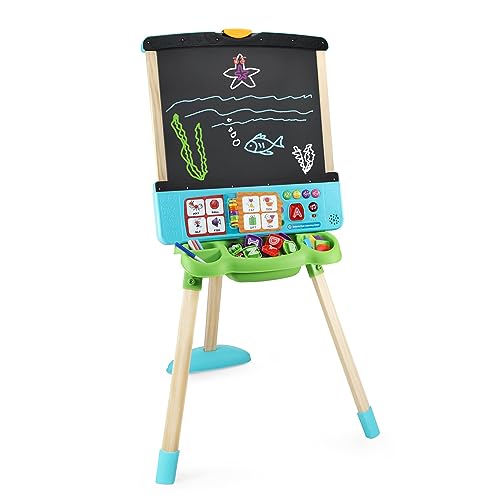
“LeapFrog Interactive Learning Easel covers letters, numbers, art, and music. Works as chalkboard, dry-erase, and paper easel. Best for ages 2-4 as a bedroom or playroom staple.”
See Today’s Price →What we like
- Two-sided easel with magnetic dry-erase board on one side and chalkboard on the other
- Interactive electronics panel teaches letters, numbers, and shapes with audio prompts
- Adjustable height accommodates ages 3–6 as children grow
- At 8.4 lbs the base is stable enough for standing toddler use without tipping
Watch out for
- Batteries required for interactive functions and not included in the box
- Chalk dust from chalkboard side requires regular cleanup; magnetic side is easier to maintain
Read Full Analysis
LeapFrog's Interactive Learning Easel delivers three play surfaces in one compact footprint: a magnetic dry-erase board, a chalkboard, and a paper roll easel. The electronic panel runs through letters, numbers, shapes, and music with audio prompts — LeapFrog has been producing curriculum-aligned electronics for toddlers for decades, and the audio prompts here align with pre-K learning standards. Adjustable height accommodates ages 3-6, stretching the usable lifespan well beyond most single-function toddler toys. At $95.99, it's one of the better dollar-per-feature values on this page. Batteries are required for the interactive functions and not included — a minor but immediate frustration for gift recipients. The chalkboard side generates chalk dust that requires cleanup; the dry-erase side is the lower-maintenance default for most households. The easel base won't accommodate a very small 2-year-old standing at full height without adjustment. LeapFrog Interactive Easel is the best all-day playroom or bedroom staple in this group — the kind of toy that absorbs toddler attention across multiple sessions without parental facilitation. It works well from age 2 through early elementary, making it one of the better longevity values at this price.

“Magformers 30-piece STEM set. Magnetic tiles build spatial reasoning and early geometry. Works from age 3 through elementary school — one of the best longevity-per-dollar toys available.”
See Today’s Price →What we like
- 30-piece magnetic set builds flat and 3D shapes with satisfying audible snap connections
- Compatible with all Magformers products for expanding builds
- Teaches basic geometry and spatial reasoning through hands-on magnetic construction
- Opaque color panels provide better color contrast for younger builders vs. transparent versions
Watch out for
- 30 pieces is a starter set — complex 3D structures require multiple sets or expansion packs
- Strong magnets can pinch small fingers if pieces are snapped together carelessly
Read Full Analysis
Magformers holds a distinct position on this page: at $20.55 it's the lowest-priced option, yet it's also the toy with the longest developmental runway. The 30-piece magnetic set builds from simple flat shapes to 3D polyhedra, teaching spatial reasoning and basic geometry through tactile construction. Every piece snaps compatibly with all Magformers products, which means this starter set can grow with the child through additional packs rather than aging out. The opaque color panels provide better contrast for young builders than transparent versions, making shapes easier to distinguish and name. Thirty pieces is genuinely a starter set — complex 3D structures like icosahedra or multi-room houses require 60+ pieces and additional packs. The strong rare-earth magnets that make construction satisfying can also pinch small fingers when pieces snap together near skin, which warrants supervision for children under 3. Magformers Rainbow 30pc is the right pick for parents who want maximum developmental longevity per dollar. It suits ages 3 through early elementary, introduces spatial and geometric thinking earlier than any other toy on this page, and expands indefinitely through compatible additions — making $24.99 the most efficient entry price in the group.
Frequently Asked Questions
What age are these educational toys for?
Are electronic learning toys (VTech, LeapFrog) actually educational?
How do I know if a toy is genuinely educational?
Are Magformers safe for toddlers?
Is the Step2 sand and water table worth the price?
What's the best educational toy for a 2-year-old?
Are these toys good for multiple kids at different ages?
How We Analyze Products
We analyze Amazon review data — often thousands of reviews per product — to surface patterns that individual buyers miss. Our process aggregates star ratings, review counts, and buyer sentiment at scale, identifying which strengths and weaknesses appear consistently across the largest review samples available. The 15,419+ reviews analyzed on this page represent real verified-purchase feedback from Amazon buyers.
Each product earned its placement through data: total review volume, average rating, and the specific praise and complaints that repeat most often across buyers. No manufacturer paid for placement on this page. Products appear here because buyers endorsed them at scale, not because a company asked us to feature them.
We use AI to summarize review sentiment — not to fabricate opinions, but to condense what thousands of buyers actually wrote into a readable format. The pros and cons you see reflect the most common themes found in verified purchaser reviews, paraphrased for clarity. We do not claim to have accessed Reddit, YouTube, or specific publications in generating these summaries.
Prices shown reflect Amazon pricing at the time this page was last generated. Click “See Today’s Price” to get the current live price on Amazon. Read our full methodology →