Best Headlamp for Camping (2026)
The Black Diamond Spot 400-R is the best camping headlamp — rechargeable, 400 lumens, IPX8 waterproof, and bright enough for trail running or reading. For backpackers who need to shave weight, the Petzl Actik Core at 450 lumens is even lighter.
See Today’s Price →At a Glance
| # | Product | Award | Price | Our Score | |
|---|---|---|---|---|---|
| 1 |  Spot 400-R Headlamp Spot 400-R Headlamp |
Best Overall | $59 | 9.3 | Buy → |
| 2 | Actik Core Headlamp |
Best Lightweight | $64 | 9.1 | Buy → |
| 3 | HM65R-T Trail Running Headlamp |
Best Performance | $79 | 9.0 | Buy → |
| 4 | Princeton Tec Remix Headlamp |
Best Budget | $29 | 8.1 | Buy → |
| 5 | Coast FL75R Rechargeable |
Best Value Rechargeable | $49 | 8.4 | Buy → |
Showing 5 of 5 products
Spot 400-R Headlamp
“The best balance of brightness, battery flexibility, and weather resistance for most campers. IPX8 means full submersion — not just splash-proof.”
See Today’s Price →What we like
Watch out for
Read Full Analysis
The Black Diamond Spot 400-R solves the headlamp's fundamental tension between brightness and battery flexibility better than any competitor in its price range. The USB-C rechargeable battery handles 90 percent of use cases, but the included option to run on AAA batteries provides a genuine emergency fallback that matters on multi-day trips where a dead USB battery could mean navigating camp in darkness. The 400-lumen max output handles technical trail navigation, camp setup in the dark, and overhead scrambling with enough light to maintain foot placement confidence. The IPX8 waterproof rating — submersible to 1 meter for 30 minutes — is more robust than the IPX4 splashproof rating found on many competitors. In practice, this means the Spot 400-R continues functioning through sustained rain without the mental tax of worrying whether a splash will cause failure. The lockout mode prevents accidental activation in the pack, eliminating the dead battery problem that plagues simpler single-button designs. The single-button control cycles through brightness modes in a predictable sequence, with a short-press/long-press logic that takes one trip to memorize. The pivot bracket tilts the beam 90 degrees for ground-to-horizon coverage. At $59.95, the Spot 400-R sits in the mid-tier of camping headlamps — significantly more capable than $20 hardware store options but less specialized than Fenix's trail-running performance units.
Actik Core Headlamp
“Petzl's engineering is top-tier — the Actik Core packs 450 lumens into the lightest rechargeable headlamp in its class.”
See Today’s Price →What we like
Watch out for
Read Full Analysis
Petzl's Actik Core is engineered for backpackers who count every gram. At 55 grams with the Core battery installed, it is among the lightest rechargeable headlamps available without crossing into stripped-down minimalism. The custom Core lithium rechargeable battery charges via USB and provides 450 lumens at max output — more than the Black Diamond Spot 400-R — from a lighter overall package. For ultralight backpackers who have already optimized sleeping bag, tent, and pack weight, a headlamp that shaves 30-40 grams without sacrificing performance is a meaningful upgrade. The AAA backup capability is retained via a separate battery holder included with the unit, though carrying it adds back some of the weight savings. For day hikes and overnight trips where AAA backup is unnecessary, leaving the battery holder at home keeps the system at its lightest. The red light mode handles camp tasks that don't require full brightness — reading, checking gear, preserving night vision during navigation — without depleting the main battery. The IPX4 splash resistance is the main limitation relative to the Black Diamond Spot 400-R: Petzl rates the Actik Core for rain protection but not submersion. On most backpacking trips in non-extreme weather, IPX4 is adequate. At $64.95, the Actik Core costs slightly more than the Spot 400-R for the weight advantage. For gram-counting backpackers, that trade is straightforward.
HM65R-T Trail Running Headlamp
“The best headlamp if you trail run at night or need serious distance illumination for scrambling. 1,500 lumens is transformative on fast-moving terrain.”
See Today’s Price →What we like
Watch out for
Read Full Analysis
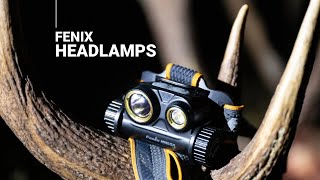
The Fenix HM65R-T is purpose-built for trail running and fast-and-light technical hiking — contexts where 1,500 lumens of max output, dual simultaneous beam coverage, and fast USB-C charging matter more than ultralight weight. The dual LED system operates a spotlight beam and a flood beam simultaneously, illuminating both the immediate ground and obstacles at 20-plus meters ahead without manual switching between modes. This is the operational feature that separates trail running headlamps from general camping headlamps: in motion at speed, requiring manual beam adjustment is dangerous. The 215-degree wide-angle beam wraps light around the field of view, reducing the tunnel-vision effect that narrow-beam headlamps create at running pace. Fast USB-C charging replenishes the battery in under 3 hours, which matters on ultramarathon and multi-day event courses where charging windows are limited. The magnetic charging port cover prevents dirt and moisture intrusion during wet-weather events. At $79.95, the HM65R-T is the most expensive option in this comparison. The performance is genuine — 1,500 lumens and dual beams are transformative for technical night navigation — but represent engineering overhead that general campers don't need. For car campers and casual hikers, the Black Diamond Spot 400-R covers all real-world use cases at $20 less. The HM65R-T earns its price for runners and scramblers who use it for its intended purpose.
Princeton Tec Remix Headlamp
“A reliable, no-frills headlamp that gets the job done. Keep one as a backup in your car camping kit.”
See Today’s Price →What we like
Watch out for
Read Full Analysis
The Princeton Tec Remix is a reliable budget headlamp with decades of brand credibility behind it. At $29.95, it is the least expensive option in this comparison by a meaningful margin, running on three standard AAA batteries available at any gas station or convenience store on the planet. The 150-lumen output is sufficient for camp chores, trail navigation at moderate pace, and reading in a tent — the use cases that cover 80 percent of camping headlamp use. The Remix's operational simplicity is a feature rather than a limitation: one-click operation with no complex mode sequencing or button combinations to memorize. In cold conditions where gloved hands reduce dexterity, simple one-button control is genuinely easier than multi-function interfaces. There is no charging cable to remember, no battery percentage to monitor — carry a spare set of AAAs and the headlamp runs. The practical limitation is the absence of a rechargeable system. Over many camping trips, AAA costs accumulate relative to a rechargeable unit. The 150-lumen ceiling is below what fast trail hiking requires, though entirely adequate for campsite use. As a primary headlamp for casual campers and weekend hikers, the Remix earns its reputation. As a backup headlamp in an emergency kit or car camping bin, it is the obvious choice.
Coast FL75R Rechargeable
“Punches above its price with 530 lumens and a twist zoom. A solid alternative if Black Diamond or Petzl are out of stock.”
See Today’s Price →What we like
Watch out for
Read Full Analysis
The Coast FL75R delivers rechargeable performance at a price that makes it the default alternative when Black Diamond and Petzl are out of stock or over budget. The 530-lumen maximum output exceeds the Black Diamond Spot 400-R by 130 lumens, the twist-focus zoom adjusts from spot to flood beam without button cycling, and USB charging covers modern setups without requiring proprietary cables. The IPX4 water resistance provides splash protection adequate for rain and stream crossings. The battery life indicator prevents the dead-battery surprise that undermines headlamp reliability for late-night navigation. Coast's power management algorithm distributes charge across the battery cycle to maintain usable brightness through most of the runtime rather than running bright until sudden cutoff. The bracket pivots 90 degrees for ground-to-overhead coverage, and the form factor is comparable to Black Diamond and Petzl units. The primary limitation is brand recognition: Coast lacks the retail presence and service network of Petzl and Black Diamond in the outdoor gear market. For buyers purchasing from specialty outdoor retailers who may not stock Coast, this creates a gap in post-purchase support. At $49.99, the FL75R offers strong specification-per-dollar value. For price-conscious buyers willing to look beyond the primary outdoor gear brands, it is a legitimate recommendation.
Headlamp for Camping (2026) Buying Guide
 Photo by Till Daling / Pexels
A headlamp is the most underrated camping essential — you don't realize how much you need it until you're fumbling with tent stakes in the dark. Here's how to choose the right one for your adventures.
Lumens: How Bright Do You Actually Need?
Most camping tasks (reading, cooking, finding gear) only need 50–150 lumens. Trail running or scrambling over rocks at night benefits from 300+ lumens. Headlamps marketed at 1,000+ lumens are primarily for search and rescue or caving — the beam is blinding at close range and drains batteries quickly. For car camping, 200–400 lumens covers everything. For backpacking, look for a headlamp with a 30–100 lumen low mode for hours of battery life on camp tasks.
Battery Life and Rechargeability

Rechargeable headlamps (USB-C charging) eliminate battery waste and are cost-effective over time. However, they can leave you stranded if you forget to charge before a trip. The best rechargeable headlamps also accept AAA batteries as backup — a critical redundancy for multi-day trips. Alkaline batteries lose power fast in cold temperatures; lithium AAAs are worth carrying in winter.
Beam Pattern: Spot vs. Flood
Spot beams reach farther (good for trail navigation). Flood beams spread light widely (better for camp tasks, reading, cooking). Most quality headlamps offer both through a zoom or dual LED system. Regulate your brightness down when talking to others — shining 300 lumens at someone's face at close range destroys their night vision.
Red Light Mode

Red LEDs preserve night vision and don't disturb tent-mates or nearby campers. If you share a tent, a headlamp with a red mode is a courtesy feature worth having. Red light is also used in astronomy and for reading maps without waking others.
The Bottom Line
For 95% of campers, any headlamp from Black Diamond, Petzl, or Fenix in the 200–500 lumen range will serve perfectly for years. Spend on waterproofing (IPX4 minimum, IPX8 for wet environments) and rechargeable batteries. Skip the cheapest no-name options — the pivot bracket always breaks within a season.
Related Guides
Frequently Asked Questions
What headlamp brightness do I need for camping?
What is the difference between flood and spot beam headlamps?
What is red light mode on a headlamp and when should I use it?
Are rechargeable headlamps better than battery-powered ones?
How do I prevent my headlamp battery from draining in cold weather?
How We Analyze Products
We analyze Amazon review data — often thousands of reviews per product — to surface patterns that individual buyers miss. Our process aggregates star ratings, review counts, and buyer sentiment at scale, identifying which strengths and weaknesses appear consistently across the largest review samples available.
Each product earned its placement through data: total review volume, average rating, and the specific praise and complaints that repeat most often across buyers. No manufacturer paid for placement on this page. Products appear here because buyers endorsed them at scale, not because a company asked us to feature them.
We use AI to summarize review sentiment — not to fabricate opinions, but to condense what thousands of buyers actually wrote into a readable format. The pros and cons you see reflect the most common themes found in verified purchaser reviews, paraphrased for clarity. We do not claim to have accessed Reddit, YouTube, or specific publications in generating these summaries.
Prices shown reflect Amazon pricing at the time this page was last generated. Click “See Today’s Price” to get the current live price on Amazon. Read our full methodology →